




Transforming Weight into Wisdom Through Reflection and Learning
What if the weight you’re carrying isn’t holding you back—but pointing you forward?
So many of us move through our days carrying more than we realize: unfinished goals, unmet expectations, family pressures, and the constant mental noise of what still needs our attention.
In this episode of Chain of Learning, I share a Zen teaching that has stayed with me long after hearing it from a priest in Japan following a Zazen meditation—and one that has deeply resonated with leaders who’ve joined me on the Japan Leadership Experience:
“Remove the muda to reveal the buddha.”
In Japanese, muda means waste. In Lean thinking, it refers to what doesn’t add value. But this teaching invites us to look beyond systems and processes—and turn our attention inward.
It asks us to notice what feels heavy, to reflect on what it’s teaching us, and to transform those experiences into wisdom rather than carrying them forward unchanged.
In this episode, you’ll learn:
✅ What Daruma dolls reveal about resilience, focus, and habits rooted in practice, not perfection
✅ What “Remove the muda to reveal the Buddha” means beyond lean – and how reflection helps turn inner weight into wisdom
✅ Four additional Zen teachings that apply to effective leadership, helping change leaders move beyond tools to presence, purpose, and a growth mindset
✅ A simple reflection practice to reframe or release muda so it supports – not burdens – your growth
✅ The distinction between goals and intentions, and why letting your being guide your doing leads to more meaningful progress
Listen Now to Chain of Learning!
Whether you’re closing out a year or navigating a full, demanding season of work and life, this episode is an invitation to slow down, study your experiences, and release what no longer serves you—so you can move forward with greater clarity, intention, and a continuous learning mindset.
Watch the Episode
Watch the full episode on YouTube.

Four Zen Teachings That Go Beyond Words—and What They Mean for Change Leaders
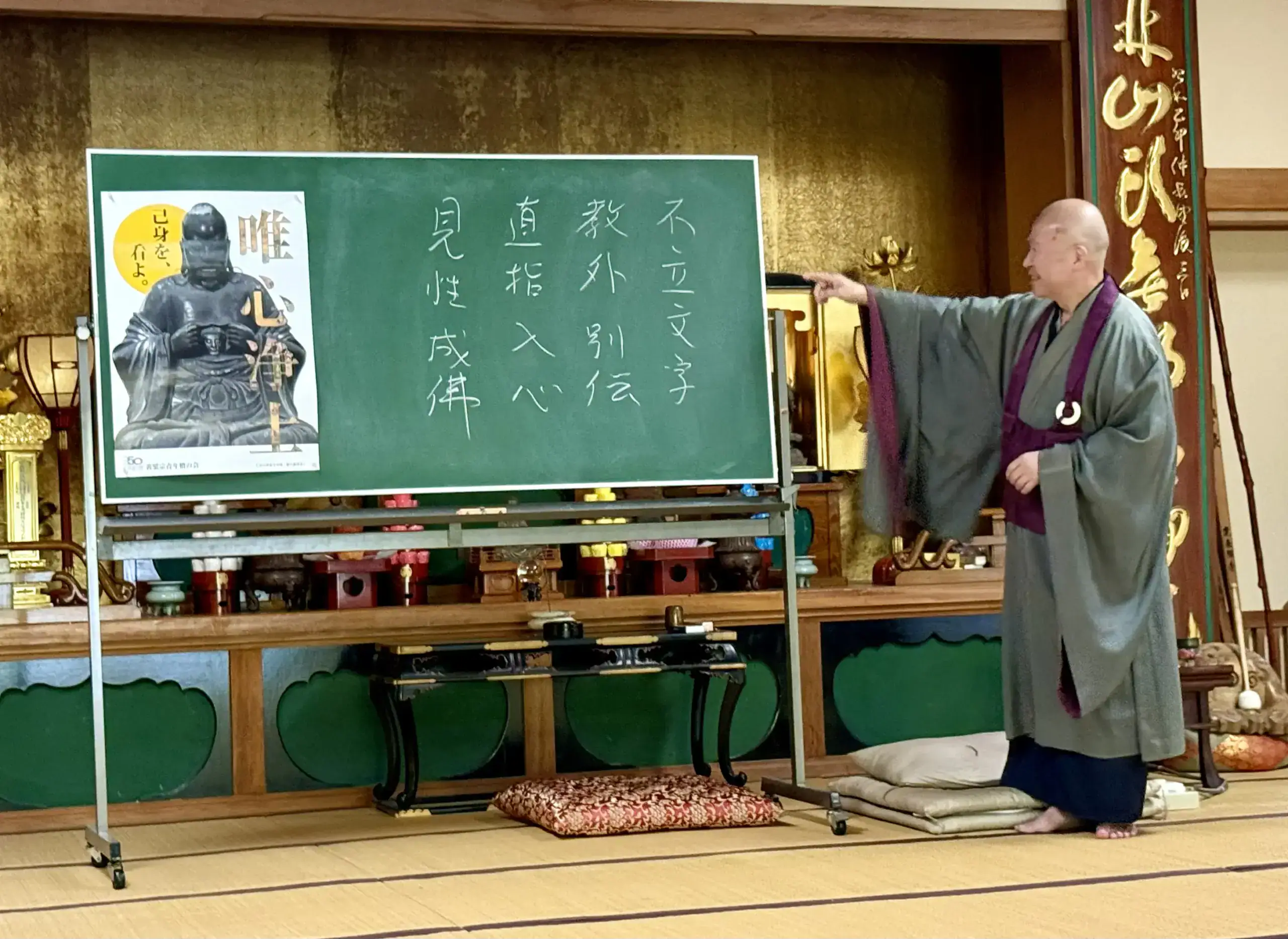
After our zazen meditation at the Daruma Temple, the Zen priest walked to a chalkboard and wrote four lines of kanji. What he shared was simple, profound, and deeply relevant—not just for personal growth, but for how we lead change and learning.
Here’s what he wrote, along with the meaning I’ve been reflecting on.
不立文字 (Furyū monji)
The way to enlightenment cannot be shown through words.
Growth doesn’t happen from reading alone. Words can point the way, but they can’t take you there—practice does.
教外別伝 (Kyōge betsuden)
Enlightenment is transmitted from heart to heart.
Transformation is relational. Real learning happens human to human, through shared experience and connection.
直指人心 (Jikishi ninshin)
Directly perceive your true heart.
This is an invitation to become aware of what’s beneath the noise—the wisdom, clarity, and purpose already within you.
見性成佛 (Kenshō jōbutsu)
Perceive your true essence and transcend yourself.
When you see clearly who you are, you can act with intention and lead from purpose, not habit.
As a leadership and continuous improvement practitioner, here’s what I see in these teachings for us:
- Don’t cling to tools or labels.
It’s not about the framework—it’s about how you use it to learn, reflect, and improve.
- Learning is lived, not just taught.
Wisdom comes from practice: going to the gemba, experimenting, reflecting, and learning by doing. - Transformation happens through connection.
This is the essence of the Chain of Learning®—we grow through each other, not in isolation.
- The real work is returning to who we truly are.
Being over doing. This is what I mean by Intention = Heart + Direction®—aligning our actions with our purpose and who we want to be as leaders.
Reflect and Take Action
As this year comes to a close, instead of rushing to set new goals or judge what didn’t happen, I invite you to pause. This is an intentional practice—one that turns weight into wisdom and helps you move forward lighter, clearer, and more aligned.
Reflection is the bridge between experience and learning. It’s how we transform what feels heavy into insight that serves us now and into the future.
1. Choose one thing you’ve been carrying.
A pattern like perfectionism or overdoing.
A goal you didn’t reach.
A relationship that shifted.
Ask yourself: What can I learn from this?
2. Decide what you’re ready to release—or adjust.
If you’ve been stuck in constant doing, ask: What’s one way I can practice more being?
If plans didn’t unfold as expected, ask: What got in the way—and what could I adjust to create more spaciousness next year?
If a relationship changed, ask: What meaning do I want to keep, and what weight am I ready to let go of?
3. Create space for reflection.
Journal.
Write a few notes.
Then make a conscious choice: carry the learning, release the weight.
What is one piece of weight you’re ready to transform into wisdom—and how do you want to be as you step into the year ahead?
Important Links:
- Check out my website for resources and ways to work with me
- Follow me on LinkedIn
- Learn more about my Japan Leadership Experience
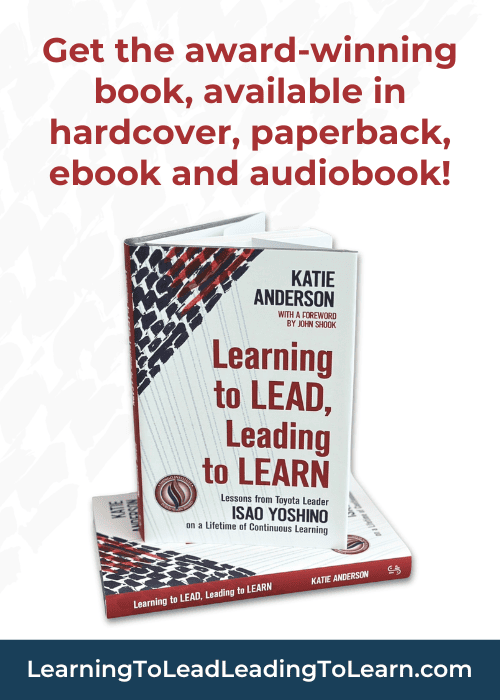
- Get a copy of “Learning to Lead Leading to Learn”
- The daruma temple: Leadership Lessons from Japan’s Daruma Temple
- Learn more about the 7 wastes in lean
- Episode 56 | Slow Down to Speed Up: The Power of the Pause to Accelerate Continuous Learning
- Episode 61 | Reflections from the Japan Leadership Experience: Live from Tokyo with Nick Kemp
- Episode 42 | Do the Right Thing: Japanese Management Masterclass Part 1 with Tim Wolput
- Episode 43 | Cultivating Human-Centered Leadership: Japanese Management Masterclass Part 2 with Tim Wolput
Listen and Subscribe Now to Chain of Learning
Listen now on your favorite podcast players such as Apple Podcasts, Spotify, and Audible. You can also listen to the audio of this episode on YouTube.
Timestamps:
01:55 – Daruma dolls and what they represent
03:28 – How Zazen meditation can bring you back to inner peace and inner being
04:26 – What it means to “Remove the muda to reveal the Buddha”
06:43 – The burden Isao Yoshino carried of what he considered was his big failure as a business leader and the shift in perspective to lift the burden, as highlighted in “Learning to Lead, Leading to Learn”
08:07 – Four Zen teachings and how to apply them as a transformational change leader
12:00 – How the burning of daruma dolls each year show reflection in practice
13:05 – Your intentional practice to help you remove the muda
13:36 – 3 examples of how to use this reflection process to adjust or release so to turn waste into wisdom
13:49 – Example 1: You’ve been stuck in constant doing
14:16 – Example 2: Your plans didn’t unfold as expected
15:07 – Example 3: A relationship has shifted
16:38 – The distinction between goals vs intentions—being and doing
17:31 – How to “Remove the muda to reveal the buddha” to release the weight you carry and move forward
Full Episode Transcript
What if whatever is weighing on you is the very thing that could unlock your next level of growth. So many of us carry experiences, expectations, and stories that distract us from what is happening in our lives and leadership right now. Today I wanna help you uncover what isn’t serving you or feels heavy, and transform it into wisdom that supports your future.
Not burdens it. Welcome the Chain of Learning with the links of leadership and learning unite. This is your connection for actionable strategies and practices to empower you to build a people-centered learning culture, get results, and expand your impact so that you and your team can leave a lasting legacy.
I’m your host and fellow learning enthusiast, Katie Anderson. As we reach the end of the year with holidays and wrapping up the final business results, there’s often that familiar moment you look back at everything you’d hoped to do, the things you accomplished, the goals you didn’t quite achieve, the pressures of the holidays, or family [00:01:00] expectations, or a challenge or a change in a relationship that’s been weighing on you, or the endless list of to-dos that you haven’t gotten to yet, and you feel that mixed swirl of gratitude, fatigue, and maybe a bit of self-judgment.
You know that feeling right? Me too. As I reflect on the year, there’s been one grounding idea that has been helping me process my experiences and emotions in both my personal and professional life, and that has been a key learning point for the leaders on my recent Japan leadership experience cohorts.
I’d heard this teaching Japan several times, but it’s really resonated with me this past month, and I wanna share it with you. There’s a place in Japan that’s become an anchor for me. The show rings on Daruma Temple a few hours outside of Tokyo. I first discovered it on a personal trip back to Japan in 2017, just a year after moving back to the United States After living in Tokyo for 18 months.
By then, I was already obsessed with Daruma dolls. These round paper mache figures that represent the [00:02:00] Bodhi-dharma, the founder of Zen, they’re weighted at the bottom, and when they get knocked down, they write themselves back up. They’re just a head. They have no legs. As the story goes Bodhi-dharma meditated so long that he transcended the physical dal symbolize focus, resilience, and the deep commitment to practice and learning.
I have dozens of daruma at my office, and if you’re watching this episode, you can see some of them behind me. I give smaller darumas to participants in my workshops and keynotes and larger ones to every leader who joins me on the Japan leadership experience. Darumas Embody one of my favorite Japanese Proverbs.
Fall down seven times. Get up eight. When you set a goal, you fill in one eye and when you complete it, you fill in the second. Every year, individuals and companies bring their completed darumas back to the daruma temple. Some of these darumas are two or three feet high. I have a few who are probably about two feet or one and a half feet tall.
They’re special darumas and they’re stacked so high [00:03:00] around the temple that you have darumas of all these different colors and shapes and sizes. As a wonderful backdrop as you visit the daruma temple. Ever since that first visit, I’ve returned to the Daruma Temple every time I’m in Japan, and now it’s become a core part of my Japan leadership experience with over 150 leaders joining me there since 2018, over eight cohorts.
This year was the third time I’d brought a cohort for a Zazen meditation session with the head Zen Priest. Participants consistently tell me that it’s one of the most meaningful moments of the entire week, perhaps even more than the amazing companies we visit and the inspiring leaders we talk with because it brings them back to inner practice and inner being.
During Zazen, we sit in silence on Tami mats and simply breathe. Zazen can be uncomfortable. Your legs get sore. Your mind jumps from thought to thought. But in that stillness, [00:04:00] something shifts, something opens. We often talk about mindfulness, but this is the purposeful emptying of the mind clearing space rather than filling it.
It’s the embracing the ma, the space between thoughts, the space between, I talked about this concept of MA back in episode 56, so go and listen to it if you haven’t yet. After our meditation on the last two visits to the daruma temple, the priest shared a phrase that is the cornerstone of this episode, and that I’ve been reflecting on a lot.
Remove the muda to reveal the Buddha. So what does this mean? Remove the Buddha to reveal the Buddha. Muda is a Japanese word for waste. What doesn’t add value? In lean? We think about muda in systems and processes. It’s a foundational concept in the Toyota production system, and it’s what leaders at the companies we visit in Japan [00:05:00] talk about eliminating from the work.
But here the priest was inviting us to look inward, clear the mind of waste. So your inner wisdom, your true self, your Buddha can be revealed. I recently wrote about this phrase in our zazen meditation on LinkedIn and said, if an experience from your past isn’t serving your present, helping you learn or become better, then it’s time to let it go.
And while that’s true, one comment added a nuance that I deeply agree with. Peter Weiss said, some experiences are not waste. They’re weight. And weight becomes wisdom when you learn to carry it, not throw it out. Letting go is powerful. Yes, but sometimes the lesson sits inside the mess, not outside it.
Exactly. I believe that deeply removing the muda isn’t about treating your inner world like a five S project. For those of you who don’t know, five s is a workplace organization practice that originated [00:06:00] in Japan. Removing the Muda is not about discarding your history. It’s not about bypassing the difficult parts.
It’s about transforming them. Take the experience, do the reflection. And learn from it. Identify how it can serve you today, then let go of the weight, and that’s how we reveal more of who we really are, our essence, our intention, our purpose. I’m reminded of a moment in my conversations with Isao Yoshino, the 40 year Toyota leader, who’s a subject in my book, “Learning to Lead, Leading to Learn”, and who also joins us on the Japan leadership experience for the full week, including this Zazen meditation experience.
For years, decades, even Mr. Yoshino carried the burden of what he considered his big failure as a business leader, and it was a big failure in terms of Toyota’s business costing the company over $13 million. He would go [00:07:00] quiet when we talked about it. His demeanor heavy. He literally seemed to get gray.
But in one conversation, after months of reflection and questions asked, with curiosity and kindness, as I tried to sift together his history and piece together, that decade of this ultimate business failure, something shifted. I remember it vividly sitting at my desk and having a conversation with him late at night for me after my kids had gone to bed in the morning for him.
His face literally brightened, and he sat up, leaned forward on the video camera and smiled, and he said this with gratitude, I’m starting to see this experience in a different way. Thank you for helping me reflect and shift my perspective. Together, we had transformed the muda of this experience that was a burden for him into new insight, new perspective, and in doing so, release the weight that he no longer needed to [00:08:00] carry with him.
Remove the muda to reveal the Buddha.
After our meditation at the Daruma temple in November, the priest did something new. He walked to a chalkboard, picked up a piece of chalk, and wrote four lines of kanji. One of our cohort participants in a speaker on my most recent Japan program, my friend and Japanese expert, Nicholas Kemp, had asked him to share additional teachings.
Side note, Nick was also a guest in this podcast in earlier episodes, episode 56, where we talked about Ikigai in roleful. Two of the concepts he talked about with this cohort, and he appears in the bonus episode that we recorded in Japan just last month, reflecting on the whole week of the Japan leadership experience together back in episode 61.
So go check those out. And if you want to see photos of this moment of the Zen priest writing the words in kanji, you can go to the episode webpage linked in the show notes. [00:09:00] So here is what the priest wrote, it’s translation and what it means for me and for you first. fur-yu mon-ji, the way to enlightenment cannot be shown through words.
This means that growth doesn’t happen from reading alone, from words alone. Words can point the way, but they can’t take you there to the learning practice. Kyo-ge be-tsu-den. Enlightenment is transmitted from heart to heart, meaning transformation is relational. It happens human to human in connection together.
Ji-kishi nin-shin. Directly perceive your true heart. Become aware of the Buddha, your heart within yourself. Your essence beneath the noise in all the doing. Ken-sho jo-butsu. Perceive your true essence and transcend yourself. See your purpose and [00:10:00] act from intention. And as a leadership and continuous improvement practitioner, here’s what I see in these teachings for us as transformational change leaders in our organizations, one, don’t clinging to tools and labels.
It’s not about the framework or the tool or what it looks like. It’s how you use the tool and the words for learning and for improvement. Second learning is lived, not just taught. Wisdom comes through practice, learning by doing, going to gemba, reflecting, experimenting, and continuing that cycle. Three, growth happens through connection, and this is what I mean by a Chain of Learning.
Transformation is relational, and we learn through each other as both learner and leader together, connected. And fourth, the real work is returning to who we really are about seeing who we really are and focusing on [00:11:00] being overdoing. This is what I mean by intention equals heart plus direction, aligning your actions with who you want to be, your purpose.
If you wanna explore any more of these concepts of Zen in the origins of more Japanese history and culture, listen to my conversation with Tim Wolput in episodes 42 and 43. Tim is both the translator and my in-country partner on the Japan leadership experience, and brings a wealth of knowledge of Japanese history, culture, and martial arts to our program.
Practicing Zazen has deepened my appreciation of the daruma doll and how it supports learning, reflection, and resilience. Daruma reminds us that setbacks aren’t failures. They’re part of the journey. Getting knocked down is part of the path towards success. They’re only muda only waste if we don’t learn from them.
It’s about getting knocked up and learning our way forward. [00:12:00] At the beginning of each year, the hundreds of daruma returned to the temple are then burned in a massive bonfire. They’re not discarded. They’re honored and released by removing the muda. To reveal the Buddha, you’re acknowledging the experience.
You thank the learning, and you make more space for that next chapter. You take the experience, let go of what’s no longer serving you and take that learning forward to today towards something that is value add. This is reflection in practice, and this is what it really means to fall down, get up, and move forward.
It’s also something that is Isao Yoshino has reflected on, and I share in the book that failure is only failure if you don’t learn something from it. Experiences are not waste. They’re only waste when they’re weighing us down and we don’t transform them into something meaningful and useful [00:13:00] today. So. As we come to the end of this episode and the end of the year, here is your intentional practice.
Think of one thing you’ve been carrying this year. One thing, a pattern like perfectionism of overdoing a goal you didn’t reach, a relationship that has changed, a story that you’ve been replaying over and over and over in your head. A pressure or expectation that you’ve put on yourself. Choose one and ask, what can I learn from this?
Two, what am I ready to release? Here are a few examples of how you can use this reflection process and what I’ve been reflecting on and releasing or adjusting to so that the mood in my life can serve me better now and into the future. If you’ve been stuck in constant doing, ask yourself, what is one way I can practice more Being instead of constantly doing.
I see you. If this [00:14:00] resonates with the endless holiday to-dos, family schedules, and year end tasks, as a mom and entrepreneur, I feel this too and keep reminding myself, how can I focus on who I wanna be and let go of the things that don’t matter right now of what I do. Second, if your plans this year didn’t unfold as expected or a goal you had for yourself wasn’t achieved, ask yourself reflect what got in the way and how can I create more spaciousness next year?
Or what can I adjust and actions that I was taking so that I can make more progress for me? I had big intentions to draft my next book this year. Well, it didn’t happen in large part of my busy travel schedule personally and professionally, and taking some more time off in the summer to be with my family.
I was focusing on more being rather than doing, but it definitely got in the way of making progress on a goal that I had. To help as a countermeasure. I have cleared the calendar the first week, few weeks of January, so to [00:15:00] create some spaciousness and some intentional protected time for writing and deeper thinking, wish me luck as I make progress on this.
Goal three. If a relationship shifted, ask yourself. What meaning and value do I want to keep from our relationship? And what weight am I ready to let go of? Personally, I’ve had a relationship change this year that’s brought me some sadness moving into the new year. I am releasing what I cannot control and carrying forward the positive learning and gratitude from our history together.
Reflection and acceptance is the bridge between weight and wisdom. It’s the transformation for muda to value how we transform experiences into learning and into action that serves us now and into the future. So take a moment, journal, write things down, reflect. Or record a voice memo as you’re [00:16:00] walking and thinking about these things or talk it through with someone you trust.
Then consciously choose to carry the learning. Release the weight. This is how we reveal the inner Buddha and how we lighten our load, the weight of our Buddha. Without abandoning our story and our experiences. It’s about transformation and moving forward, learning our way forward to a better us.
As you do this work, you’re gonna naturally start thinking about the new year, new goals, other things you wanna accomplish and do. And this is where I return to one of my favorite distinctions, goals versus intentions. Goals are about what you want to achieve. They’re external, in shaped with. The mind.
Intentions are about who you want to be. They’re internal and shaped with the heart. Both matter, but intentions give meaning and direction to your [00:17:00] goals. And while you can’t always change external circumstances that influence your effectiveness or ability to achieve a goal, you can always choose how you show up with intention, with purpose, and actions that are aligned with the person and impact you want to have.
If you wanna explore this further, go back to episode six and revisit this distinction on being versus doing As you plan your goals and your intentions for the new year. As you reflect on this episode, here’s what I want you to carry with you. The weight you carry from experiences or expectations can either hold you back, be muda, be waste, or.
Become the wisdom that moves you forward. It’s the actions you take to transform waste into value. Remove the Buddha to reveal. The Buddha invites you to study your experiences, learn from them, release what no longer serves you, and step [00:18:00] into a new year, a new phase aligned with who you want to be and who you are.
So choose one thing. Do the reflection, transform that weight into wisdom, and let yourself enter the New year a little lighter, a little clearer, and a little more intention as a leader and as a human being. If this episode resonated with you, be sure to follow or subscribe to Chain of Learning on your favorite podcast player or.
And share it with someone who might value this reflection process too, so that we can all strengthen our Chain of Learning together. Thanks for being a link in my Chain of Learning today. I’ll see you next time. Have a wonderful end and beginning to the year ahead.
Subscribe to Chain of Learning
Be sure to subscribe or follow Chain of Learning on your favorite podcast player so you don’t miss an episode. And share this podcast with your friends and colleagues so we can all strengthen our Chain of Learning® – together.