




Moving from Expertise to Enabling a Learning Organization
You can be deeply committed to lifelong learning—and still find your influence narrowing as a change leader.
Many of us in continuous improvement, Lean leadership, Agile, or operational excellence take pride in growing our knowledge. We read. We earn certifications. We refine our tools. We go deep into our methodology. That depth builds capability and credibility.
But as your responsibility expands—from leading projects to guiding organizational transformation—what’s required of you shifts.
At some point, going deeper into your method or functional expertise is no longer enough. Your role moves from applying tools to helping leaders see the whole system, clarify the real business problem, and decide which approach truly fits. That’s where change leadership becomes less about execution and more about influence.
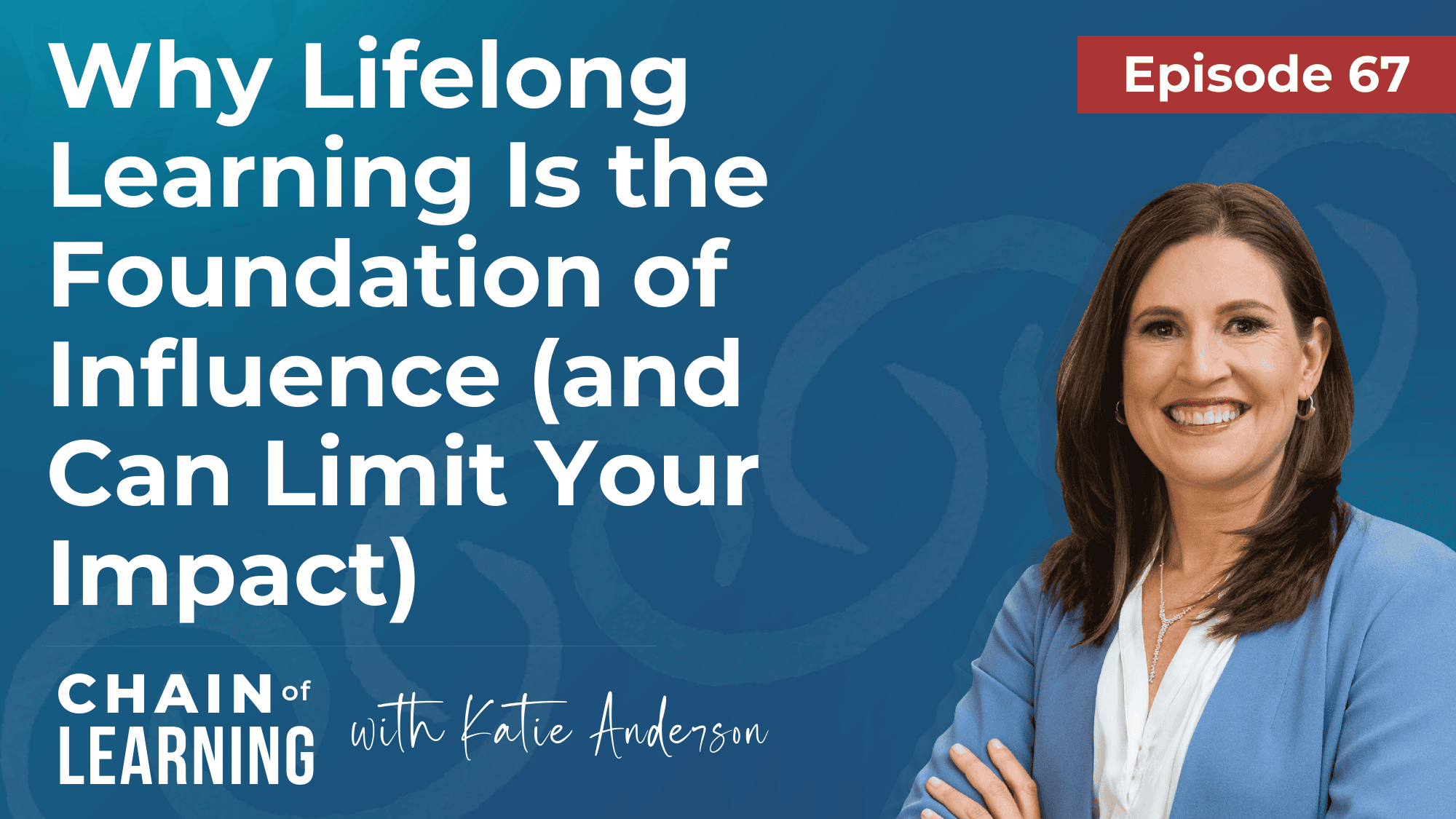
In this episode of Chain of Learning, I explore how to move from learning as accumulation to learning as adaptable influence.
As your scope grows, you’re no longer just responsible for delivering results. You’re responsible for how others think, decide, and take ownership. That requires more than technical skill. It calls for systems thinking, intentional leadership, and the ability to question the form instead of defaulting to it.
Your learning might be limiting your impact. We often define lifelong learning as going deeper into our expertise. What’s missing is the shift toward adaptability and perspective. A learning mindset is the foundation for building a learning organization—yet if it remains tied to one framework, it can constrain your influence and slow transformation.
In this episode, you’ll learn:
✅ Describe the impact you create tools or jargon
✅ Move from Shuhari—rigidly following a method to adapting based on context
✅ Practice beginner’s mind—Shoshin, even when you’re the expert
✅ Identify when you’ve fallen into the Doer Trap—and choose to develop others instead
✅ Notice when you’re following the form in situations that call for flexibility
Listen Now to Chain of Learning!
Tune in if you want to build a learning organization and evolve your learning mindset.
Watch the Episode
Watch the full conversation on YouTube.

Reflect and Take Action
Lifelong learning is often treated as a set of activities—reading, studying, improving skills. But it’s more than a doing practice. It’s a being practice. If you’re a leader or change leader in your organization, you are part of the system. You are a condition that requires ongoing improvement and development.
If you want to create a learning organization, your own learning can’t just be visible in what you know. It has to be visible in how others experience you.
Here are three practices to apply to improve your impact:
- Describe your work without the method. Can you clearly explain what you do and the impact you create without using jargon?
- Ask what you need to unlearn. Where might an old habit, assumption, or attachment be limiting you?
- Practice Shoshin—the beginner’s mindset.
Enter a conversation with curiosity instead of expertise. Pause and ask open ended questions. Hold the space, even if you think you know the answer.
If lifelong learning is about who you are, not just what you do—how is that showing up in your leadership right now?
Important Links:
- Full episode show notes with links to other podcast episodes and resources
- Check out my website for resources and ways to work with me
- Follow me on LinkedIn
- Download my free KATALYST™ Change Leader Self-Assessment
- Learn more about my Japan Leadership Experience
- Episode 65 | From Learning to Impact: Turn Insight into Leadership Action
- Episode 9 | The 8 Essential Skills to Become a Transformational Change Katalyst™
- Episode 15 | 5 Steps to Revitalize Lifelong Learning
- Episode 27 | 3 Practices to Become a Skillful Facilitator
- Episode 42 | Do the Right Thing: Japanese Management Masterclass Part 1 with Tim Wolput
- Episode 52 | What You Love About Lean and Operational Excellence — And Your #1 Frustration: How to Get Executive Buy-in
Listen and Subscribe Now to Chain of Learning
Listen now on your favorite podcast players such as Apple Podcasts, Spotify, and Audible. You can also listen to the audio of this episode on YouTube.
Timestamps:
00:40 – The Katalyst model revision and why lifelong learning was removed as a standalone competency
03:24 – Why learning isn’t what distinguishes your influence. It’s what makes influence possible
05:07 – What it means to be a lifelong learning enthusiast
06:52 – Three questions every change leader should be able to answer without jargon
09:22 – What 75 leaders revealed in a survey and the lesson underneath it
10:31 – The concept of Shu Ha Ri that shapes how you develop and learn:
11:13 – [SHU] following the form
11:25 – [HA] where you begin to adapt
11:35 – [RI] Transcending the form entirely
12:20 – Five Toyota Kata Coaching questions developed by Mike Roth that requires learning and unlearning to develop, grow, and improve
15:05 – The concept of Shoshin and clearing what’s in the way
16:04 – Katie’s personal confession about her own telling habit and what modeling the way actually looks like in practice
17:35 – The “doer trap” and why getting leadership buy-in starts with us
20:39 – What lifelong learning really means and why it’s a being practice
21:01 – Three practices to try this week to create more impact
Full Episode Transcript
[00:00:00] What if your biggest strength as a learner is also holding back your influence as a change leader? This episode unpacks that paradox. Welcome to the Chain of Learning where the links of leadership and learning unite. This is your connection for actionable strategies and practices to empower you to build a people-centered learning culture.
Get results at expand your impact so that you and your team can leave a lasting legacy. I’m your host and fellow learning enthusiast, Katie Anderson.
Learning is core to who I am, and if you’re listening to this podcast, it’s probably core to who you are too. So what I’m about to say might sound surprising.
Over the last several months, I’ve been deeply revising my Katalyst change leader model as part of my work on a new book, really harvesting what I’ve learned and bringing it to fruition like they talk about back in episode 65. And in that process, I’ve come to a realization that shifted how I understand the model that I originally developed several years ago.
The acronym [00:01:00] KATALYST was designed to describe the eight essential social and influence skills that change leaders like you need to master. To lead meaningful transformation skills. You have to pair with your technical expertise. If you wanna move from being a change practitioner, to be becoming a transformational change leader who creates an empowered learning organization.
And here’s the shift in my thinking. I’ve come to see that this model is really about interrelated influence capabilities. Things like aligning senior teams around a shared direction, coaching leaders through complexity, navigating organizational dynamics, facilitating learning, and building real ownership for change.
It’s all about influence and that lifelong learning, the original L in Katalyst isn’t actually an influence competency on its own. If you’re not familiar with the Katalyst model yet, or if you wanna see how it’s evolved, you can download the free Katalyst self-assessment at KBJanderson.com/katalyst, spelled with a K, and go back to episode nine of this podcast for more context.
It’ll give you a snapshot of all of the capabilities that I’m talking about here. Learning is the foundation of all of them. Back in episode 15, I talked about the five attributes at the heart of being a lifelong learning enthusiast, actively seeking new experiences and knowledge seeking feedback, intentional practice and reflection and adapting based on new learning.
And importantly, modeling the way, and all of that still holds true, but this is what I see more clearly now, that lifelong learning isn’t a function of influence. It’s the foundation that makes influence possible. And that distinction matters more than I initially realized. Because when clients and podcast listeners like you take the Katalyst self-assessment as I’ve originally created it, almost everyone scores themselves high, really high on lifelong [00:03:00] learning, and that’s a great thing.
It makes sense. People work with me and listen to this podcast like you because you care about growing, improving, and learning. You are a learning enthusiast just like me. But when nearly everyone rates themself at the top of a scale, that tells us something important. Not that the assessment is wrong, but that the model needs to evolve.
Lifelong learning wasn’t distinguishing. Who could influence transformation and who was struggling to do so or needed to grow in that capability? And I’ve realized it’s because it’s not a competency that you develop alongside the other influence skills. It’s the foundation you need before you can develop them.
It’s what enables you to learn these capabilities and grow in your impact. And once I saw that over the last month or so when I’ve been doing a deep dive in the model, two things have become clear. First, lifelong learning needs to be [00:04:00] reframed, not as a skill to build, but as the orientation that makes developing all the other influence capabilities possible.
And so I needed to take it out of the Katalyst eight competency model. And then second, moving it to a foundation and out of the model opened up a space for an influence capability that I realized it actually been missing. And a gap that I’ve been seeing come up over and over again with my clients’ internal continuous improvement practitioners and senior transformation change leaders, and I’ll share more about that new L competency in a future episode.
But today in this episode, I wanna stay focused on this reframe that I’ve had about lifelong learning. What does it really mean that lifelong learning is foundational? How does it serve you, and where might it actually be limiting you? Because I’m seeing patterns and how learning shows up for smart, committed practitioners just like you that can [00:05:00] hold you back from the influence and impact that you’re capable of.
So I wanna unpack that here today. Let’s start with what we usually mean when we say we’re a lifelong learning enthusiast. For me, it tends to be thinking about what it means to be curious, wanting to understand more, to explore, to grow. As I highlighted in episode 65, that often shows up as gathering more knowledge, reading books, going to conferences, taking courses, staying current in our field, earning certifications or belts, learning the latest tools or frameworks, and all of that is good.
Of course it is, but as I explored in that episode, gathering knowledge alone isn’t enough if it’s never making its way into our practice. So here’s a deeper nuance that I wanna explore today. A way that learning itself can sometimes hold us back. If all your learning goes deeper and deeper into your own methodology, whether that’s lean, agile, six Sigma, DevOps, or [00:06:00] design thinking, or even something else, that depth can actually start to look like blinders.
You end up being constrained in your impact, not because you’re not learning ’cause you are, but because you’re learning more of the same thing and not seeing the system and everything else from a broader lens. Your learning actually starts to limit you. And I’ve been seeing this more recently with clients and on LinkedIn posts, and I catch myself here too.
The risk of going deep is that you can become so committed to your methodology or so trained in a specific approach, like always running a five day Kaizen workshop or relying on a familiar set of tools that you’ve become, perhaps without realizing it, a hammer looking for a nail. You know the tools inside out, but can you explain what you do and why you do it?
Without the jargon, without reference to the tools and methodology, can you connect with an executive who doesn’t [00:07:00] speak that language of continuous improvement or operational excellence? Can you define the problem that needs to be solved, not just the approach you want to use and know can help, and can you adapt when you realize that the right countermeasure.
Isn’t the method you’ve mastered. So here’s the irony. When you’ve been going deep, you think you’re learning and you are, but you may also be narrowing instead of broadening your perspective. To lead organizational transformation, you have to go broad and deep as well beyond the presenting problem or process, and help leaders step back and identify what problem.
Actually needs to be solved before you get started. Only then can you determine the right approach, not the other way around. That ability to zoom out and see the whole system is essential, and it starts with being willing to step beyond your own discipline. [00:08:00] And I continually have to check myself on this too, to say yes to the thing or the solution that a potential client comes forward with.
For example, when a leader reaches out and says, can you run a Break the Telling Habit workshop? Or We wanna address alignment in our next leadership retreat, it’s so easy to just say yes and then jump straight into the designing and delivering that content. And what I really had to get good at is learning to pause and ask, what problem are you really trying to solve?
What’s happening in your organization that led to this request? When you help leaders zoom out beyond process to leadership behaviors, reward systems, organizational structures, and people development practices, the real problem often becomes much clearer. Sometimes the original request is exactly what’s needed, and sometimes what’s needed looks very different.
I shared an example of this [00:09:00] back in episode 27 when I talked about the concept of being a skillful facilitator, one of the core competencies in the Katalyst model. I was asked to facilitate a leadership retreat for a large healthcare system, and the executive planning team initially assumed that for their leaders, the main gaps were around problem solving and innovation.
But before designing the session, I had built in a process to survey the leaders in their organizations, and we surveyed about. 75 leaders to find out about what’s going on currently for them. And what came back surprised us. The biggest barrier wasn’t tools or innovation like the executive team thought.
It’s how the organization’s leaders were struggling to work across silos. And that insight completely shifted what we focused on in the retreat, how I designed the learning experience, and what those leaders actually needed the support with and the skills to walk away with from that [00:10:00] session. So here’s the first insight.
Lifelong learning isn’t just about consuming more knowledge or going deeper into your expertise, if that’s all it is, it can reinforce blind spots instead of expanding your vision. Being a lifelong learner also means deliberately pulling yourself into new perspectives, so your depth becomes a resource to draw from, not a box you operate inside of.
I also wanna introduce a concept that I learned when I was living in Japan over a decade ago, and one that shaped deeply how I think about how we develop and learn. It’s called Shu ha Ri comes from martial arts and is embedded across Japanese culture. It’s in the tea ceremony, calligraphy. And yes, in the practice of kata that many of us know from the lean world, I explored the origins of Shu ha Ri in its connection to martial arts [00:11:00] in more depth.
Back in episode 42 with Tim Wolput my Japan leadership experience co-leader and former Aikido world champion. Here’s the essence. Shu ha Ri describes three stages of learning and mastery. SHU is about following the form. You learn the steps exactly as prescribed and practice them until they become second.
Nature habit, routine ha is where you begin to adapt. You’ve internalized the pattern enough to respond to what’s actually happening in front of you. What’s emerging in that situation? And then RI is about transcending the form entirely. It’s when you’re no longer thinking about the steps and the process, and you’re present, responsive and grounded in principles rather than procedures, rather than the form, the tool, the process.
And here’s why this matters. Many of us get stuck in shu. We learn the tool, the kata, the framework, [00:12:00] and we want to keep practicing it exactly as taught. And that’s necessary early on. It’s so helpful to have a routine to learn from, but if we stay rigid. It starts to limit us and limit our impact. Take for example, the five Toyota Kata Coaching questions developed by Mike Roth.
They are designed as a SHU practice, a structure to help leaders learn the pattern of scientific thinking and coaching for improvement, and they are a great practice to learn these routines from. Yet, the goal isn’t to clinging to that exact structure forever. It’s to internalize the pattern of thinking and behaving so deeply that you no longer need the script and can adapt.
And that requires something harder than learning. It requires learning. Learning and unlearning is essential for how we develop, grow, and improve. [00:13:00] And this really comes to life when I take global change leaders and executives to Japan, on my Japan leadership experience, many arrive expecting to see the exact tools that they’ve read about in the books, or have been taught through their training courses.
I’ve even asked before if they’re gonna see Toyota Kata storyboards in use. The answer is no. What surprises them is the flexibility. And the differentiation they see of the application of the principles that we call Lean and Kaizen in these organizations. People are responding to the situation in front of them, guided by principles, not formats.
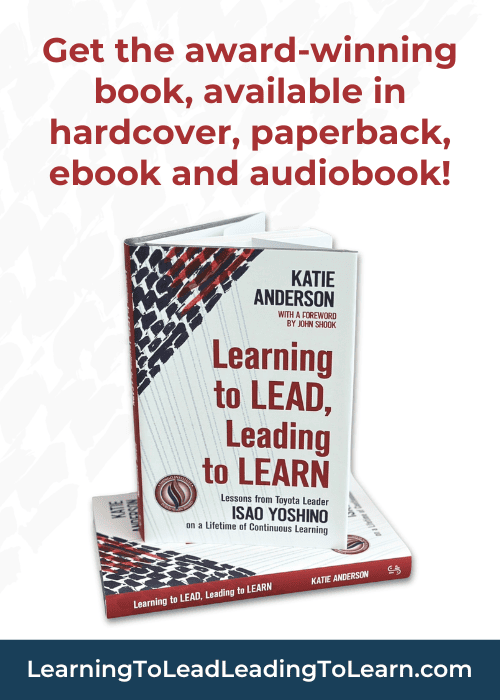
Even at Toyota, what was documented decades ago has evolved. When we go to Toyota suppliers, of course you’re still gonna see a three reports and Kanban cards, but the tools serve the learning not the other way around. As Isao Yoshino 40 year Toyota leader shared with me and are [00:14:00] the opening lines of my book, “Learning to Lead, Leading to Learn”.
The only secret to Toyota is its attitude towards learning. I wanna emphasize that again. The only secret is the attitude towards learning. So let me ask you, where might you be following the form rigidly? When your role actually calls for adaptation and flexibility. Can you read the room? Can you flex between asking and telling?
Can you move away from the tool and be present in the moment to respond to what your leaders need? Mastery doesn’t look like doing the thing perfectly every time. It’s about knowing the foundation and being able to adapt. It looks more like a jazz musician, someone who knows the scales so deeply that they can improvise in the moment.
If you wanna move from doing improvement projects to enabling transformation, that’s the [00:15:00] journey. That’s the learning.
There’s another Japanese concept that’s closely connected with Shoshin. The beginner’s mind. A quick shout out to past podcast guest Stephanie Bursek, who recently shared with me that shoshin is her word of the year. Just like harvest is mine. Shoshin isn’t about adding more knowledge. It’s about clearing what’s in the way.
It’s related to this concept of ma, the space between that. I’ve talked about the power of the pause. It’s about letting go of assumptions, certainty, and attachment to being the expert so you can actually see what’s in front of you with the awe and wonder of a newbie. And this is something I intentionally try to practice every day.
It is one of the five attributes of lifelong learning that I shared back in episode 15. It’s modeling the way, and for me that means being honest about where I still [00:16:00] struggle and about being open about what it looks like to be a learning leader. So here’s a confession. My name is Katie. I have a telling habit.
You might be surprised, and I’ve worked for years to break it and I’ve gotten better. In fact, my process of trying to Break my Telling Habit is so central to my own learning that is now core at what I teach and coach with my clients. And still I catch myself literally having to sit on my hands to counteract the urge to jump in with all my great ideas or helpful suggestions.
Instead of holding space for someone else to think through their problem. Breaking that habit is a daily practice. It’s not a destination into itself, it’s a practice, and we never actually fully break habits. We just build stronger ones. When I lose touch with my intention to hold the space for others to learn and grow, that’s usually when old patterns show up.[00:17:00]
What Shoshin invites us to do is to hold our expertise lightly and to stay grounded in intention to walk into a conversation, genuinely curious, not assuming that we know the answer or even that we know what the problem really is. And this matters because we often, as change leaders are asking leaders to do exactly that.
We’re asking them to let go of control to say, I don’t know, and then to learn their way forward. But the question for you is, are we really doing that ourselves? One of the biggest frustrations that you shared in my Change Leader survey last year, the results of which I broke down in episode 52, is getting leadership buy-in.
Buy into the change. Buy into the vision of this people-centered learning culture to take on board the behavior changes that they need to really lead it. And here’s the paradox. Sometimes we become [00:18:00] the very thing we’re trying to change in others. We fall into the doer trap, the expert with all the answers.
We’re solving problems for others instead of building capability. So part of the problem that we’re experiencing starts with us.
You can know all the methods. You can be technically excellent, but without a learning mindset, without shoshin the beginner’s mind. And Shu Hari, the movement from form to mastery influence collapses into telling, owning. Controlling, and that’s exactly what we’re trying to shift in our organizations. We say that we want to move away from command to control and towards empowered people centered problem solving at all levels.
But without this foundation, the learning and growth mindset, we often default right back into the very behaviors we’re trying to change. And the flip side is true too. Lifelong learning on its own [00:19:00] doesn’t create influence. It prepares you for it. You still need the influence capabilities to turn learning into impact.
The ability to communicate in language that leaders understand, to see the whole system, to navigate complexity and politics, to facilitate groups towards shared outcomes, and have the presence and credibility to be taken seriously in rooms where decisions are made. These are the interrelated influence capabilities that I’ve explored in past episodes, and we’ll continue to dive into more deeply here on the podcast into my upcoming book.
But none of these capabilities function effectively without the foundation underneath. This is where my Leading to Learn framework comes in that I talked about in my book. At its core, Learning to Lead is simple leaders set direction, provide support, and develop themselves. This last part matters more than we often acknowledge, because if you’re trying to create a learning organization, one [00:20:00] where people take ownership, solve problems, and grow capability, you have to model the way.
You can’t ask others to stay in learning if you’re not willing to do that work on yourself. As one of my coaches and mentors, Margie Haney shared with me, and it’s a phrase I come back to often in presentations and learning experiences. If you’re part of an organization, especially as a leader or change leader, you too are a business condition that requires improvement.
So here’s my biggest takeaway from all of this. Lifelong learning isn’t about what you do, it’s about who you are and how others experience you. It’s not a doing practice, it’s a being practice. If you’re part of an organization, especially if you’re a leader or a change leader, who your being matters because you two are a condition in the system that requires ongoing improvement and development.[00:21:00]
As you reflect on this episode, here are three things I invite you to try this week. First, describe what you do without using your methodology. No tools, no jargon. Can you explain what you do in the impact you create? Simply second, ask yourself what you need to unlearn, not what you need to learn. Next three, practice Shaheen.
The beginner’s mindset. Go into a conversation leading with curiosity instead of expertise. Ask an open question and pause. Hold the space even if you think you already know the answer, and notice what emerges. And if you’re realizing that you and your team could benefit from support, not just in learning, but in building the influence capabilities that turn learning into impact, I’d love to work with you.
You can learn more about how I support executives, change leaders and their teams through immersive [00:22:00] learning experiences, including custom retreats and my Japan leadership experience and as a trusted advisor and more at KBJanderson.com. If you enjoyed this episode, be sure to follow or subscribe now and share the podcast with your friends and colleagues so that we can all strengthen our Chain of Learning together.
Thanks for being a link in my Chain of Learning today. I’ll see you next time. Have a great day.
Subscribe to Chain of Learning
Be sure to subscribe or follow Chain of Learning on your favorite podcast player so you don’t miss an episode. And share this podcast with your friends and colleagues so we can all strengthen our Chain of Learning® – together.