




 Book Giveaway – Artificial Organizations
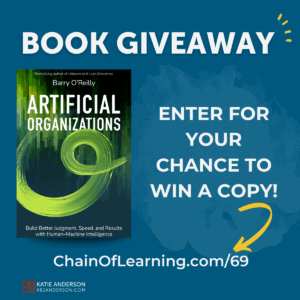
Barry O’Reilly has generously donated his book Artificial Organizations for 3 lucky listeners of the Chain of Learning Podcast!
In this book, Barry explores how leaders can combine human judgment with machine intelligence to improve how decisions are made and how teams work together. He shares practical examples and experiments to help leaders rethink how they work, unlearn outdated habits, and use AI to support clearer thinking and stronger judgment.
Enter to win a copy! Register by March 27th, 2026 and be sure to share your lucky URL to increase your chances of winning.
The Leadership Shift Behind Effective AI Use
You’re being told to use AI. But have you stopped to think about which tool you actually need to do your best work?
Leaders and change practitioners everywhere are feeling the same pressure right now — more meetings, more information, more mandates to adopt AI — with less time to think and less clarity about where to start. And most of the advice out there begins in the wrong place: with the tool.
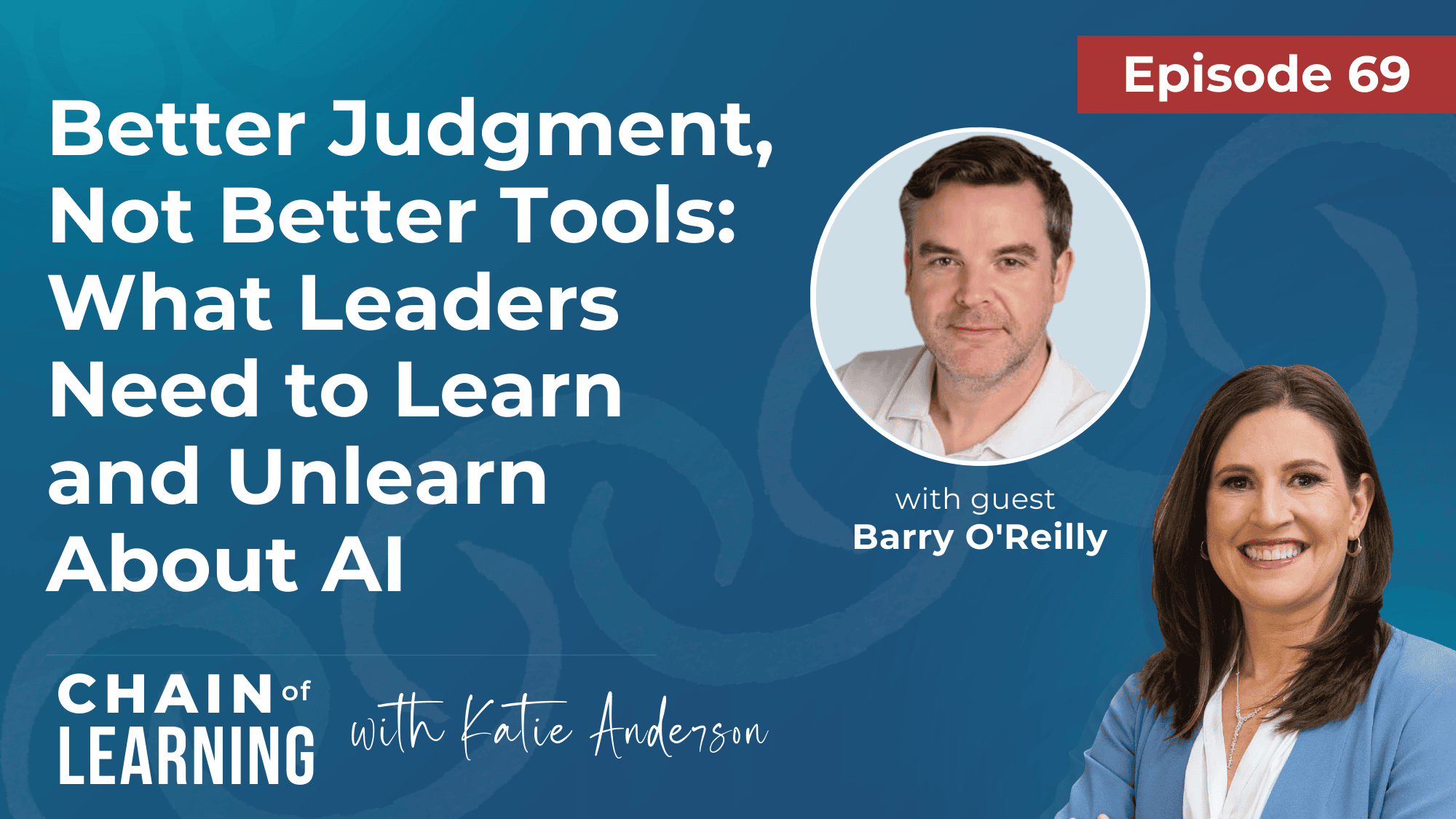
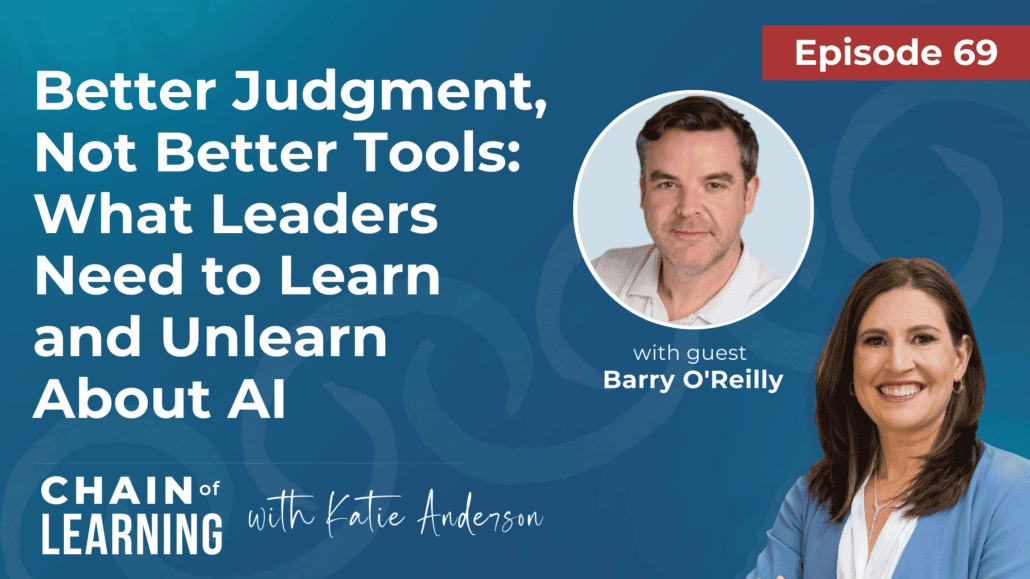
In this episode of Chain of Learning, I talk with Barry O’Reilly, bestselling author of Unlearn and Lean Enterprise, and author of the new book Artificial Organizations, about why the real opportunity with AI isn’t automation. It’s better judgment.
Barry shares examples from his work with Fortune 500 executives who are successfully pairing human instinct with machine insight — not by adopting every new tool, but by understanding how they work, where judgment matters most, and what needs to be unlearned along the way. It’s about letting go of the belief that your expertise is your competitive advantage, and starting to see AI not as a replacement, but as a thinking partner that can sharpen your clarity, your presence, and your preparation.
In this episode, you’ll learn:
✅ Why starting with the tool is the wrong place to start — and what to do instead
✅ How to identify your natural traits and highest-leverage tasks as the foundation for working with AI
✅ The unlearning required to shift from relying on instinct alone to combining human judgment with machine insight
✅ How successful leaders are using AI to pressure-test ideas and show up more prepared and present
✅ Why the skills that make you more effective with AI are the same skills that make you more influential with people
Listen Now to Chain of Learning!
Tune in to explore where your judgment matters most in your role and what you might need to unlearn to create space for a better way of working.
Watch the Episode
Watch the full conversation between me and Barry O’Reilly on YouTube.


About Barry O’Reilly
Barry O’Reilly is the bestselling author of Unlearn and co-author of Lean Enterprise. He hosts the Unlearn Podcast and is co-founder of Nobody Studios, an AI-driven venture studio. His newest book, Artificial Organizations, is a practical guide for leaders ready to combine human and machine intelligence to make better decisions faster.
Reflect and Take Action
Before you download another AI tool, pause and look at how you actually work.
One of the most helpful ideas Barry shared in this conversation is that the starting point isn’t the technology. It’s you. Your natural traits. The way you do your best thinking. And the places in your work where judgment matters most.
So this week, take a moment to reflect.
First, ask yourself: how do you do your best thinking?
Do your ideas come out through conversation, writing, drawing, or reflection?
Then consider one or two of the highest-leverage tasks in your week—the moments where your judgment really matters. It might be preparing for an important meeting, thinking through a decision, or synthesizing insights from conversations.
Instead of downloading five new tools or trying to redesign your workflow overnight, notice how you work and where you could use support. Then experiment with one tool that helps you capture, synthesize, or clarify your thinking.
That small step is enough to begin learning—and unlearning.
Where in your work does better judgment matter most—and how could the right support help you think more clearly in those moments?
Important Links:
- Full episode show notes with links to other podcast episodes and resources
- Check out my website for resources and ways to work with me
- Connect with Barry O’Reilly
- Follow me on LinkedIn
- Check out Barry O’Reilly’s book, Artificial Organizations
- Subscribe to my newsletter
- Learn more about my coaching, trusted advisor partnerships, and leadership learning experiences: [email protected]
- Unlearn Podcast | Intentional Leadership with Katie Anderson
- Episode 59 | Get Better at Getting Better: Leveraging AI to Elevate Human Learning with Nathen Harvey
Listen and Subscribe Now to Chain of Learning
Listen now on your favorite podcast players such as Apple Podcasts, Spotify, and Audible. You can also listen to the audio of this episode on YouTube.
Timestamps:
02:28 – Where to start on adopting AI
05:04 – Importance of understanding natural traits and strengths before looking into AI tools
07:12 – Defining the problem first before looking for the tool to close the gap
08:17 – Why some may see AI as a deflection tool
09:02 – How to use AI for synthesizing data rather than rudimentary tasks
12:28 – Why judgment is the leadership advantage and leveraging AI to make better judgment
12:38 – Using decision velocity to improve decision making
13:35 – Decision advantage in synthesizing data to make a decision
14:35 – The difference between AI and human strengths in decision making
16:26 – Unlearning how you work to make progress
19:32 – Why human thinking plus machine equals a better outcome
20:28 – Examples of how to use AI to be the best business and thinking partner
24:46 – Importance of asking the right questions when brainstorming with AI
26:06 – The limitations of AI and knowing how to use it to your advantage
30:18 – How technology can help us be make a bigger impact
33:12 – The loss of psychological safety when implementing AI and unlearning this fear
35:35 – Better results when teams collaborate with AI vs. doing it independently
36:06 – Shifting from control based learning mindset to influence based learning mindset for continuous improvement
37:54 – Implementing AI to be the most effective in your organization
40:34 – How to start building an AI stack knowing your natural traits, one or two tasks, and then experimenting with an AI tool
Full Episode Transcript
Barry: [00:00:00] Leaders who show up like that to meetings, then imagine you’re going into a high stakes meeting and you have been through four or five rounds of pressure testing your thinking with a machine, asking questions that are counterintuitive, that are disconfirming. So when you rock up to that meeting compared to someone who’s just going on gut.
It’s not even a fair, uh, situation, right? You’re prepared, you’re, you’ve thought through your thinking, you have confidence in it. You know what? Maybe the gaps are.
Katie: Welcome. The chain of learning for the links of leadership and learning unite. This is your connection for actionable strategies and practices.
To empower you to build a people-centered learning culture, get results, and expand your impact so that you and your team can leave a lasting legacy. I’m your host and fellow learning enthusiast, Katie Anderson. Something I keep coming back to is that learning is the foundation of everything. Our growth [00:01:00] as leaders, our ability to improve, our capacity to navigate change.
And our fundamental humanness. And right now in this moment of rapid change with AI and integration with machine learning, our ability to learn and unlearn has never mattered more. But here’s what I keep hearing from executives and change leaders alike, and I bet you’re experiencing it too. Days packed with meetings, endless information coming in, less time to think.
More pressure to decide. And now on top of all of that, there’s this mandate by many organizations you need to use AI often without any clarity on how or why. The promise of AI was to make things easier for us, but for a lot of people it’s just adding more noise. So what’s really going on and how can we use these tools to actually elevate our thinking and our humanness, not replace it?
This question keeps surfacing in my keynotes and leadership retreats and conversations with leaders trying to make sense of what AI actually means for [00:02:00] how they. And we work to help explore this. I invited Barry O’ Reilly to join me on the show. Barry is the bestselling author of Lean Enterprise and Unlearn, and he hosts the podcast by the same name, which I was a guest on a while back.
His new book, “Artificial Organizations,” is a practical guide for leaders to relearn the way they work and use AI to support better judgment rather than adding more noise. We started off our conversation with this question, with so many leaders feeling overwhelmed and pressured to adopt ai, what’s really going on?
And where should we actually start? Let’s dive in.
Barry: You know, we’re in this time where we have more data, more dashboards, uh, more instant messages, you know, flooding, um, our, uh, screens. And yet decisions are slower, you know, and they actually feel harder, heavier, um, and they have higher stakes consequences now than ever before.
So, uh, and leaders are overwhelmed. It’s, it’s [00:03:00] that simple. They’re, they’re just overwhelmed. And, uh, so the promise then, uh, and this is probably what the market is doing, it’s almost like this fear of missing out FOMO messaging that comes out of these very well funded, uh, marketing teams. Uh, in of these huge, uh, companies telling you that you’re behind, uh, that you’re late, that you’re, you’re gonna be irrelevant if you don’t buy the tool and start using it.
So it’s, um, a really difficult situation for leaders to be in because they’re naturally, regardless of whether they have a technology support, overwhelmed, if they look at, uh, their feeds. They’re overwhelmed and, and made to feel that they’re behind, that they’re slow and they’re going to lose their job to a robot.
Uh, and this is sort of like the, you know, situation we’re trying to create for leaders, uh, where they have to make decisions. Um, and for me that was sort of the moment where I was like. Actually we’re thinking about this totally wrong. Um, we’re, you know, [00:04:00] you’re not behind, uh, you’re great at what you do.
And recognizing really how these tools can support your natural abilities is the trick. Um, and for me, it happened when I was just sitting at my desk in that very overwhelmed state. It was midnight. I was working on another business case. Uh, I was tired, but I was excited because there was loads of opportunities in front of me.
My dinner was cold ’cause I hadn’t had yet with my family. ’cause I was like, sorry, I gotta finish this email. Like all these situations that people were in and for me then that was the moment where I said, no, I’m not going to continue working like this. I’m gonna change the way I behave. I’m gonna have to find ways to sort of augment my natural abilities to get the most outta what these technologies can offer.
And that was sort of the moment for me where I was like, right, I’m gonna work in a different way. And I think that’s the, the place that people need to start [00:05:00] from. Certainly not start from what AI tool do I need? You need to start thinking about your natural traits, your strengths, your uh, and then the tasks that have the highest leverage on the work that you do.
And when you understand your natural traits, how you work, do you talk, do you type, do you draw? The tasks that matter most for you to be effective in your week, then it makes sense to start looking at tools that will help you achieve the things that you want. So for me, as someone who spends a lot of time on meetings, who does a lot of their thinking by sort of Socratic method of open dialogue and back and forth, I knew that those were my natural traits, that I do my best work.
That meetings, especially digital ones, were one of the highest leverage tasks for me. So starting off with a tool that started to capture every piece of information that was in the conversations I was having and [00:06:00] turn that from just information to a data asset that I could reuse leverage later was an obvious place for me to start.
And that was sort of the beginning for me to start augmenting my natural skills, uh, for tasks that mattered to me, and then the tools that supported it. For me then that was like the first big breakthrough.
Katie: I, I’ve had the same experience too, as like a external processor and a podcaster and you know how I think about it, having AI to help capture all those thoughts and then synthesize them, it’s not creating it new for me, but it’s helping frame that in a different way.
And I really wanna call out something you said here. It’s like in no matter what, if we’re working in a continuous improvement or something else, we are looking at, there’s all these great tools out there, but. You clarified and, and reinforced that we, it’s not about the tool, it’s about defining the problem and the need first, and then get the tool or the process to help with that opposed to being like a hammer, looking for a nail.
Right. It’s the tool. What’s the tool that’s gonna help you [00:07:00] close the gap that you need to as well? And it sets the right, the right framework. And I’m hearing so many leaders like, oh, we have to just use ai, but it’s like the same thing. We have to implement a something. We have to do this without understanding what.
What are they trying to improve or what help do they need, and then find the right support and tool for that as well.
Barry: Yeah, and the problem is when, when you, if you think of a tool, it’s sort of like a calcified method of working, right? It’s designed in a certain way. Who knows if that design matches the way you work.
And, and this is the challenge again for most execs, is they are picking up these tools and then they’re trying to force the way they naturally work upon them, and it doesn’t necessarily guarantee a fit. So then they struggle or it’s the wrong tool for the job, but they don’t know the job they’re trying to do.
So someone told them they had to download chat, GBT or Anthropic or clo. So they’re sort of trying to force themselves into. [00:08:00] A way of working that might even be the right way of working for them. And then what often happens is they’re like, oh no, the tools aren’t advanced enough yet. They like, there’s easy ways for people to then deflect the situation and go, oh, the tool, the tool isn’t good enough.
Or, um, it’s really, AI really isn’t that advanced as people say. So it’s, again, it’s a deflection mechanism because they’re starting with tools, which is the worst place to start, but the marketing, uh, machine. Has this FOMO going, or they’re sitting at, you know, dinners or dinner parties and people talking about how they’re using these tools.
But again, even if they start to use the tools, they, they’re using them for very rudimentary tasks like. Summarizing a document or typo, checking an email. And look, these are all helpful, but they are nothing compared to the power of, if you’re aligning your natural traits about how you work, the tasks [00:09:00] that have the highest leverage for you each week.
That could be your one-on-one meetings with your team. It could be the weekly business review, and then finding the tools that necessarily get the most out of them. So a, a classic one for me. Again, uh, I’m coaching a lot of these execs in Fortune five hundreds now, and even just having them record all their one-on-ones with their, you know, senior reports each week means at the end of the week, they probably have eight to 10 transcripts of every high stakes conversation that they’ve had for the week, and then allowing them to put that into a space to synthesize it.
So they capture everything. They’re synthesizing it. Um, and then they’re able to sort of decide and actually. You know, what, what were some of the patterns of the conversations that I had this week? What were all the actions that we committed to? Whose are they? So when they do their end of week sort of wrap up, they’re suddenly able to synthesize this information in in seconds and then [00:10:00] literally.
Take action and pass that out to their team. So this ability to keep tempo, to keep clarity, to be prepared for every conversation that they’re about to have or, or how they close a week with confidence. It just starts to increase their performance, not productivity, but performance. And then the, the real gift of all of this for me is as you get more into this habit of capturing, uh, transcribing disinformation, even just using a meeting copilot, being able then to sort of decide what you want to do to take action, suddenly you, you’re in a space where.
People show up more prepared. People have greater clarity about what’s important, and you get productivity. Yes, you get better performance from the team, but the real magic is leaders become more present. They’re actually calm. They’re not running from one meeting to another with their head overloaded.
Wondering, [00:11:00] what, what was that thing? Um, I agree to in the last meeting or it’s all captured, right? It’s, there’s, there’s, there’s an ability to sort of relax and go. The data is there. I can recall it at any moment, and then I can synthesize my week on Friday. Double check against everything that I was planning to make sure my team have clarity and take really great action, uh, for next week.
And that is amazing experience for leaders to be in. Because their job is judgment. It’s not to use AI tools. It’s making high stake decisions under pressure. And really this book is about creating that judgment, infrastructure and system to help leaders, uh, get to their highest performance.
Katie: That was actually the thread that I wanted to pull that because in, uh, your book, your new book, “Artificial Organizations,” you make that argument and, and putting forward that the real opportunity with AI isn’t that automation, although there’s automation that happens with it, but that our judgment and I [00:12:00] talked about a similar concept with Nathan Harvey on the podcast back in episode 59.
Nathan works at Google and the Dora report and how AI is influencing how teams are collaborating as well. And, and it’s like how do we elevate our humanness. Like the things that we do best and let the AI support that. So it’s not like replacing humans, but actually elevating what we can do best. And that is that, that judgment alignment, that all of those things.
So, you know, how do you think about like why judgment now is the true leadership advantage and, and you know, leveraging AI to help increase that ability to make better judgment?
Barry: So there’s two things, uh, that I think about. One is this ability called decision velocity. So our ability to actually make decisions.
Most, most companies struggle to make decisions. They have decision latency. You show up to a meeting, everyone’s trying to remember, what did we talk about last week? Uh, you try to rebuild context. Maybe you do a little bit of creative problem solving on it, [00:13:00] but for the most part, most meetings end with a, oh, yeah, we’ll come back to this and make a decision next week.
Where, where high performance organizations work is they show up prepared. They show up informed. So the meeting is a creative problem solving act to make a decision. And then once the decision is made, we might have booked it for an hour, but we made it in 27 minutes. Great. Let’s go back to work and do our other things.
Now, decision made. So that’s a velocity question. Now, often for people to make decisions, they need to feel informed. So decision advantage for me is this ability to synthesize and pull together all the insights, the information that you want to make a critical call, uh, a high stakes call confidently, that you have the information you need to make that decision in that moment.
Right? So the two main metrics I. Challenge people in the book to start measuring is their decision velocity and their decision advantage. And the [00:14:00] power of that then is teams start to then get into this habit again of making decisions. So what are humans amazing at? Well, that’s right. We’re great at making decisions that that’s the uniquely human part of the component.
What are machines great at? Guess what? Pulling lots of data together, having synthesis, automating and understanding patterns that you can’t see from huge data sets. So again, even the subtitle of the book is Combining the Best of Human and Machine Intelligence, and that’s really what we’re talking about here, is let the machines do what they are amazing at.
Capturing information, synthesizing it, pulling it together from disparate sources and presenting it. Let humans do what we’re really good at your unique instincts and with these machine insights, and that’s where you get this again, huge performance uplift.
Katie: A hundred percent behind that. And I really have enjoyed reading your book because it’s very, it’s very practical [00:15:00] too, and how leaders at all levels can really take these tools and really identify, you know, what are the capabilities they need to enhance the capabilities they need support with.
And like going through this. So it’s not a dry book, it’s really quite. Practical in terms of how to, how to do this effectively. There’s a real link to Barry, to your previous book, um, unlearn about all the things that leaders need to unlearn as well. And, and AI is really giving an opportunity for us all to have to let go of sort of old habits unlearn.
Our old ways of doing things so that we have capacity to learn how to use the new thing. So I’d like to explore with you sort of how you see this connection of unlearning and then learning how to use AI most effectively.
Barry: Yeah. Like it, it’s funny, uh, you know, you never join the dots, uh, going forward, but it seems to be easy to join them going backwards, right?
Katie: Yeah, always.
Barry: Uh, and that was sort of a really, again, a bit of an aha for me. You know, when I started [00:16:00] working, uh, with a lot of these tools to help me be more productive and, and higher performance is that there was a sort of recognition, uh, as I described that moment at midnight at my desk where I was like, I need to find a better way of working.
I can’t rely on what has brought me to this moment because I can see the results of the moment. Uh, I’m in from the behaviors that I currently have. And, um, that was again, another unlearning moment for me. Where you are able to recognize that the things that have brought me success to date will not be the things that bring me success in the future.
So I have to change how I work. Um, and that again, is even what that whole book I learned was inspired by, even before that, when we wrote Lean Enterprise, it was all about helping large scale organizations innovate at scale. And the problem was never the talent. People were super smart. I could show them new models.
They new ways of working, they’d be like, yeah, this all makes sense. But then [00:17:00] they would go back to how they always behaved. So my, my problem at that time was like, well, learning is not the problem. These people are super smart. It’s on learning their existing behavior that brought them success. And that is the hardest part.
So for many people listening to this show. They’ve probably elevated in their role because they had good recall, because they have tenure, because they have great understanding of domains, right? That used to be a competitive advantage, your sort of natural instincts, uh, for the role you were in. But now you’re in a world where you have human instinct and then there’s also machine insight.
This ability of what these machines to source information, synthesize it, make it available, and, and this is why you have in many domains. People who have very naive domain experience are short tenure in companies, but they know how to get information very quickly at really high rigor. So then they can [00:18:00] start, they have this decision advantage, which means they can start making decisions even if they’re not experts with confidence, because they can look at the data and start learning actually faster than people who have been in a domain for many years, but are relying on.
Instinct on gut, on tenure, you know, so there’s this really interesting, I think, clash going on at the moment in the world where you have these people who are just really good at finding out the answer. They have great systems to discover the insight to inform the decision, and they’re actually powering ahead because they could, they know the system to find information.
Plus they’re learning a domain as they make the decisions versus the folks who understand domains. And are relying on their instinct to, which is again, it’s, it’s invisible how they make those decisions. Uh, and you know, but they don’t know how to get the information to use the machines to help them, uh, make decisions with confidence.
So for me, it’s just a [00:19:00] fascinating, uh, time and the leaders. Who are absolutely powering ahead are human and machine. It’s not human on your own. Uh, you’re, there’s, you’ll hit your local maximum. You probably already have machines on their own. Absolutely dangerous because you can’t control control of the outcome.
Uh, Deloitte got pinged, uh, half a million dollars because they were just generating reports or the, the, the Australian government and just handing them over no one sense checking them half a million dollar fine. That was only just last year. So it’s human plus machine equals better outcome, and that’s sort of the unlearning that people have to go through.
Katie: Totally agree. It’s like, it’s like with any new technology or something emerging, and there’s this identity shift too that we have to let go of, you know, being the expert with all the answers or that I was the one who has all this functional knowledge, and maybe in some ways our functional knowledge is getting less important ’cause we can gather that so quickly From AI with [00:20:00] the executives and other leaders that you’re working with, what are you seeing?
As some of the, i I this, the traits or examples of people who are ha feeling maybe a little more resistant or reluctant to take to have this identity shift and embrace more experimentation with ai, or what are the qualities that maybe are helping other leaders embrace the unlearning and making this shift so they can learn how to leverage ai.
Barry: Yeah, so I’ll give you some fun examples of the things we’ve been doing, right? So, um, one of the most powerful aspects of these tools is they can become essentially the best business partner you’ve ever had, the one you’ve always dreamed of. So when you’re an executive, um, it’s kind of lonely at the top, right?
Like if you are trying to come up with new ideas or present strategies, uh, you know, it’s often hard to find someone to sort of talk it out with. If you’re a CEO and you go to a team member and go, Hey, I’d love to talk about should we open, uh, a new office in [00:21:00] North America or South America? Um, immediately the person you’re speaking to starts extrapolating ideas like, hang on a sec, are we closing the North America office?
Are we, are we moving to South America? Like, it’s very difficult, um, to get this sort of, uh. Open dialogue just to pressure test hunches and ideas that you have. So one of the tools that I build with a lot of these execs is basically like, uh, it can be a CEO bot or like an an executive bot that they can basically start pressure testing some of these hunches that they have.
And start to see AI as a thinking partner that they can sort of have, uh, open dialogues with to say, look, I’ve got a sense of the dashboards over here sort of are telling me this signal. I’ve gotta formulate Ara, go to market strategy for a new market. Um, I’ve seen some information over here that is kind of interesting to me to help inform that.
So suddenly then they can start to pull this [00:22:00] all into a a, you know, and a conversation literally with a machine to sort of say, well, what? And then ask these disco conform questions like, what, what am I missing here? What are some of the hidden assumptions? Um, how could I think about this differently?
Gimme three options. Um, if I was to invest a million dollars in each one, what would be the pros and cons of each? So suddenly these leaders are now in these very sort of creative, um, knowledge work conversations with these machines that are improving their thinking, right? Some of that will result in them being able to say, right, actually this, this idea has merit.
I’m gonna go and take it to the next, uh, level of stakes, if you will. Some of them will be like, you know what? That was a completely hair-brained idea. Barry. Just put it, put it in the bin, and let’s move on to the next idea. Right? And so, so these are sort of, again, when you talk about performance leaders who show up [00:23:00] like that to meetings, then imagine you’re going into a high stakes meeting.
And you have been through four or five rounds of pressure testing your thinking with a machine, asking or questions that are counterintuitive, that are, um, uh, you know, disconfirming that are, so when you rock up to that meeting compared to someone who’s just going on gut, it’s not, it’s not even a fair, uh, situation, right?
You’re prepared, you’re, you’ve thought through your thinking, you have confidence in it. You know what, maybe the gaps are. And that experience both for the person who you’re meeting with and the people around you just makes everyone go, wow, I, I wanna either work with that person, or I wanna be that person.
What are you doing differently to get you to that place of presence? And that, you know, like that is the magic for me when you start to ladder this up to like how I’m helping, uh, leaders do this.
Katie: We talked a little bit about this as well. You, you know, you were [00:24:00] writing, “Artificial Organizations,” and I’m working on my next book too.
The working title is Influence First, so that’s a first time I’ve shared that here. But The Thinking Partnership and we, you talk about it in your book and we were sharing too, how we both have used. To, uh, AI tools to help us synthesize past podcasts that we’ve done, talks that we’ve had, interviews are out external thinking, and that’s so valuable.
It’s still your own ideas, but it helps see through lines or connections that maybe you didn’t make. And I’m an external processor, so for me to be able to like, bounce ideas off of, you know, I’ve, I work with a few different ais and get some different ideas. The same skill though, comes back as what you were just talking about is how do we get better at asking good questions and the right questions.
And I think that no matter, even if we’re working with humans or we’re working with the machines, the better we are at being able to ask those right prompts to deepen thinking with the humans we’re working with or the machines we’re working with. We’re gonna get better output in either way. I’m experiencing this, this for myself.
It’s helping the executives are working with [00:25:00] be more clear and more prepared and have greater presence when they’re coming into, or the, to meetings and organizations. And then this would be true for change leaders too, who are trying to bring, bring an idea forward. So pressure, test those ideas and, and get more clear and, and practice.
Don’t let the AI do your thinking for you. Right. But like, how does it help elevate your thinking?
Barry: That’s it. And, and that’s why I always say it can be, as you say, the best thinking partner that you’ve ever had. Because if you ask it, and remember, the machines are trained to be nice.
Katie: Yeah, yeah.
Barry: They’re trained to give you the answer you want to hear.
So you, you know it. But if you say to it, like, I literally write in, uh, most of the conversations I have, be brutally candid with me. You’re not gonna hurt my feelings. I want to know that, you know, your honest view on this. And again, it’s a very different type of response you get because again, the machines are trained to like you because are they want you to spend more [00:26:00] time on their platform and use it, right?
So like a human has made that design choice, by the way. So it’s, so you have to actually be just aware, and this is again, some of the things as you really start to dig deep here is you have to make a lot of implicit things explicit. You have to say to it, challenge my thinking. Be brutally honest, be candid, push, ask me disconfirming questions.
And again, the more you then start to work with this, uh, business partner, if you think of it like that, they start to know that that’s what you want. They start to respond more like that. And again, you start to build, uh, more rapport. So, and go deeper again. So, and again, the, the, the fascinating thing about this, um, you know, and we’ve done so many great examples in the book, uh, you know, working with companies from American Airlines.
Like the team, they’re amazing. Misty, who’s their VP of, um, commercial technology, like she’s an external thinker, right? She puts her ideas out there and she’s one of the first people, um, who I [00:27:00] started working with on this. And just her ability to understand and test strategies at speed now is just frightening.
And it’s all about her. She uses this, um. Method. A lot of the music in American Airlines, they call it Rumble. It’s inspired by, uh, Brené Brown’s, uh, book, uh, sort of dare to lead. Like how do you get into these healthy, productive, uncomfortable conversations around high stakes ideas? And she’s, she has built this sort of bot for herself now where she can do that.
You know, or simple things like in between meetings for meetings. She’s constantly in meetings. And those five minutes that she’s walking from one to the next, she just pops open a transcriber and. Like basically downloads what’s in her head, how the meeting went, what actions she might need to do, something that she’s not really a hundred percent on and wants to look back to later.
So then her synthesis at the end of her day is literally like, [00:28:00] pull all these short, uh, voice notes together, synthesize it into a clear list of what were the key themes, what were the actions I need to take, what do I need to do, follows up on. That synthesis typically would take someone two to three hours at the end of their day.
Misty’s doing it in 10 to 15 minutes, and then she’s on to the next thing in her life that might be going home to have dinner with her family that might be going to the yoga class. She’s canceled for the last six months. Right? It’s, but she’s getting her life back and she’s more performant. And I think these are some of the magics that, um, you know, especially as people dig into the, hopefully the book, they’ll learn all these strategies that we’ve been helping people with to really show up in a way that they’re the best version of themselves and, and that is very rewarding.
Katie: Yes. It’s like, use the tools and the technology to elevate. In our humanity as well. And you know, I’m hearing too like and I, and I’m seeing this with the clients I’m working with in my own experience, when we can use these [00:29:00] skills or these tools to, with the machine learning to help us have better judgment and help have more clarity of thought and to pressure test our ideas and to have greater presence, we actually are more influential.
With the humans that we’re working with because we have greater clarity or we’ve, it’s helped us think about who in our organization do we need to be bringing in? Where are our blind spots? Where are we need to be looking a broader system, and maybe we’ve put some blinders on on things. And so a lot of the things that I’m talking about.
My book about how do we elevate our and grow our influence, our human influence capabilities also can be augmented and supported by how we’re using AI to help us get better at getting better.
Barry: Right. And but like you say, you’re obviously seeing this right? And it’s inspired, uh, the new book. Um, so I like, I’d love to, you know, ask you that in, in many ways it’s like, you know the people you wanna work with or you know the people that inspire you, right?
They show up. They are prepared, they are calm, they are someone who wakes decisions. They’re [00:30:00] the people that inspire you, right? Like that’s how you build influence. And um, again, our conversation today has really been about showing you how these machines can augment your natural abilities. So you show up as the best version of yourself.
So. You know, what, what are some of the things you’re thinking about with these, um, technologies about how to make people more influential?
Katie: Well, absolutely, and this conversation’s really sparking a lot for me right now. You know, it’s, you know, I was thinking back to my conversation with Nathan too, because we talked a lot about how do you, um, collaborate on teams, and that’s an important part of being influential as well.
How do you build the networks? How do you, how do you collaborate? How do you bring groups in, uh, along on decision making? You know, I, I really responded to some of the comments you made here about how do you have greater clarity of thought and think about how do you, have you pressure tested your ideas.
It’s almost like the, the pre-work of not just going to a meeting with your viewpoint, but you’ve, maybe you can ask, well, what, how would a CEO with, you know, [00:31:00] describe the, the person and their constraints? It’s almost like. Thinking about their needs beforehand or maybe what would they be thinking about from this angle?
What concerns would they have about this initiative or this idea? And it’s like giving you greater insight so that when you’re interacting with the human, you can come from a greater place of compassion and understanding and knowledge. Not necessarily knowledge for your own, like I’m a smarter person, but that I can work with this human and really understand their conditions.
As well. I mean, I see other things too. It’s like facilitating a meeting or a session is really about how do I help guide a group of people from A to B? I’m not the person like doing the content, and my responsibility is guiding them. So thinking about, this is where I need to get them. Here it is today.
How can I structure this learning experience or this working experience and to help you be a like. Pressure test the, the structure that you might be putting together. So I see so many different ways, and then the coaching too. How can I ask some better coaching questions? Uh, what are some things that I need to be asking?
I, I see it in so many ways in helping us get our, [00:32:00] through our thinking, help understand the people we’re working with, help hold up blind spots, you know, make visible some blind spots. Things that maybe we haven’t been thinking of to help elevate then how we’re working with the, the organization and the people within our organization.
Barry: Yeah. And, uh, elevate some of my favorite words. Uh, another one of the case studies, there’s this with Pete, uh, Ky, who’s the CEO of Progeny. They’re probably in the us They’re the LA largest provider of fertility and health benefits. Uh, Pete was also the former CFO of WebMD. And then, you know, one of the great, sort of, he’s one of the first case studies we talk about in the book, uh, progeny, but.
This idea that, um, you know, one of the great things Pete did very early in the progeny journey was saying that we’re here to use these tools to elevate, not eliminate people. And, you know, that is a powerful statement of safety, if you will. When you know, most people are reading again the headlines, like Amazon letting go of 30,000 people last year.
Or, you [00:33:00] know, meta paying half a, a billion dollars to hire, you know, uh, 40 people. It. You know, like the talent is reorganizing around this exponential curve between those who are experimenting with these tools and getting better versus those that are sticking with their current behavior. But at the same time, you know, when you have leaders who are very explicit, again to say, we want these tools to elevate your work, not eliminate you, that encourages people to experiment.
And I know you know this from your own work. If people don’t have, uh, psychological safety, if they have learning anxiety, if they feel this mandate, and again, to the, some of the things you said at the start of the show, this mandate that if you do not learn, you are eliminated. That just puts people instantly on the back foot and under pressure, and it’s the wrong message.
Right. And transfer. And, and there’s so much, um, research now that supports [00:34:00] all of this from organizational change and transformation. If you treat these tools as tools to be adopted, you will fail. If you treat this as a transformation for your workforce, you will succeed. So you have to start thinking about how you help people unlearn their existing behavior, relearn how to augment themselves with these new behaviors, and that’s will give you breakthroughs if you mandate that you have to use this tool.
You will be fired. It’s all the wrong behaviors that we’ve talked about where starting with tools is the worst place to start. You need to start with the person and their traits.
Katie: Yeah.
Barry: Right. Like I’ve sat in, uh, rooms with boards where they’re like, they literally sign off a million dollars, $30, you know, a license fees a month for 5,000 people, and they just say, yeah, we need ai.
Let’s sign it off. Let’s say, you know, 10, $12 million burn rate just right there. Then nobody knows how to use this stuff. And [00:35:00] then there’s pressure to return on that investment, but it’s not grounded in any sensical thought. Uh, so again, like these are some of the challenges that, again, the, where people are feeling such pressure from being overwhelmed, the fomo, the need to respond, that they’re going about it in the wrong way, you know, and I’m sure through your work and certainly in artificial organizations, we’re showing people a better path.
Because 95% ai, gen AI initiatives fail. Uh, MIT have already reported that teams to collaborate with AI to come up with ideas are three times more effective than those who do it on their own. That report has come out from, uh, HBR. So there’s just so many, um, of these researches that are also captured in the book.
That show when you pair Human Plus machine intelligence is better outcome, not one or the other.
Katie: This idea of control based leadership in any way, the mandates, the thou shal I the leader [00:36:00] telling we that, I mean that’s the same thing we see in the continuous improvement operational excellence world to, it’s like we have to make this shift from more of a control based leadership mindset to more of an influence based leadership mindset, which is understanding the real problems we need to solve, setting clear direction and enabling the organization its.
Humans and now it’s machines to help achieve their and then to collaborate together. And there was one thing I wanted to point out, which I thought was really interesting that you said too, Barry, like, you know how we work, collaborate with the machines and being very clear and explicit on how you want the relationship to be like.
I want you to tell me, honestly, I want you to speak the truth. I don’t want you to sugarcoat things. I wanna be able to have this honest dialogue. We need to do that with our humans that we work with too, because the more we’re I right
Barry: on. That’s it.
Katie: The more we’re explicit on how we want to engage and and be in relationship, the better the outcome and the actual relationship is gonna be.
So those very skills that you can develop in working with your machine is actually so important. I talked to [00:37:00] about how leaders and change leaders need to quote unquote, like label it, describe what you’re doing and the reason behind it, and it actually enables us. To get from here to there, so much better.
So that same skill is transferable, uh, for humans and for machines as well.
Barry: I couldn’t agree more. You know, and again, I hope what people take away from our chat today is like, again, the machine allows you to prototype so many things, prototype conversations, prototype, preparing for a high stakes meeting, prototype a strategy, and then ultimately, as you’ve nicely put it, bring it back to people.
Like that’s ultimately where the decision is getting made. Right. And um, it’s a great space for everyone to practice and improve and again, ultimately bring it back to people.
Katie: So what’s your top recommendation for listeners, whether or not they’re executives or change practitioners or team members to start?
Learning and experimenting with AI so they can be the most effective human in their [00:38:00] organizations.
Barry: Yeah, so I, I would really ask themselves to deeply consider how they work. How do you do your best work? Um, and obviously for you and I, maybe we we’re, we’re akin here where talking is a really important part of how we get our ideas out, right?
That’s, that’s a natural trait that we have for how we generate information to innovate. We wanna talk it out. That’s a really important part of a task that we have to do right, is talking to generate in information for innovation. So a tool like a a, a meeting copilot or a capture tool, it’s almost picks itself, right?
It’s just like that’s an obvious path. I should be capturing all of this amazing information on creating. So I can transcribe it later, synthesize it and take action, right? That’s a key sort of learning loop or one of the methods in the book. So I just would ask people that question, like, think about your natural traits first.
What’s something, um, do I, am I a talker? Am I a [00:39:00] drawer? Am I a typer? Like how do I get all of my best ideas out? And then just look at two or three tasks that they think are the most important leverage points in their week. It might be one-on-one meetings with their team. It might be, uh, the end of week business review.
And then once you start to think about your traits and these sort of high leverage tasks, the tools then start to become. Pretty obvious, um, because you’re setting up a design constraint about, uh, what’s gonna help me best, right? Maybe you’re a researcher, maybe your job is sort of a, you know, you’re a, a project manager and your import, your job used to be all this sort of administration of making sure all the tickets are put into a task management system.
Like you could start to automate that because. That’s administration work and really your job shifts from administration being 80% of the time and your creative problem solving being 20% of the [00:40:00] time to maybe like 70 30. To maybe 60 40 to imagine a day where it’s 80 20 in the direction of creative problem solving for product, um, project managers and 20% admin.
Imagine that world, right? Yeah. You’re smiling ’cause you know it’s exciting, right? And, and that’s the work people want to do. Right. So again, it’s, it’s, uh, very much from unlearn. You’ve gotta think big, but start small, right? Don’t go down and download 14 different tools and try and build an AI stack on day one.
Just, just think about one or two natural traits, one or two tasks, and then a tool and just experiment with it. And then that’s how you start to build up a stack over time. And for me, I, again, I started with, um, meeting co-pilots naturally because of the way I work. Now I’m up to like 14 tools, sometimes of 16, sometimes of four.
So like it’s a constant process, but again, it’s helping me, I believe, get better outcomes over [00:41:00] time.
Katie: Yeah, and as we started off, it’s not about the tool, it’s about the support. You need. And then finding the right tool that’s going to help you get there. And it’s like to wrap everything up, you know, going back to this world word of elevate and how do we keep elevating our humanness, elevating our human abilities, our human connections and our human effectiveness is really, you know, what this is all about.
So I appreciate the, the book you’ve written and really practical guide of, of how, how. Leaders at all levels can really start taking on and learning these new skills, leveraging them, and then of course building on what you had wrote about and unlearn, unlearn the ways that you need to do so that you have the capacity and openness to be able to learn these new skills.
So thank you Barry.
Barry: Thank you again for having me on the show and it, it’s always great to have a chat about these things. I’m already excited about your new book on influence. I think, uh, I’m looking forward to reading that too, as well.
Katie: Thank you. I’ll be, uh, reaching out for sure, um, as I [00:42:00] continue down the path.
So thank you again. And also I’ll be dropping in a link of, in the show notes of the podcast episode on Barry’s podcast I was on many years ago when my book, “Learning to Lead, Leading to Learn,” came out. So always love the conversation Barry, uh, wishing you the biggest success and impact in helping leaders elevate their humanness through collaboration with ai.
Barry: Thanks very much.
Katie: What really stood out to me in this conversation with Barry is this idea that AI isn’t about the tool. It’s about you, your natural traits, your highest leverage tasks, and then finding the right support for how you actually work. And what I appreciated in how Barry framed it is that the real opportunity with AI isn’t automation, it’s better judgment.
It’s about elevating our humanness. Not replacing it. And that connects so deeply to what I keep coming back in my own work and on this show that the skills that make us more effective with machines are the same skills that make us [00:43:00] more effective with people being clear on what we need, asking better questions, pressure testing our thinking, being explicit in how we wanna work together.
Whether you’re prompting an AI or preparing for a conversation with your leadership team, these are influence skills. As you reflect on this episode, here’s what I invite you to do this week. Think about Barry’s recommendation. What are your natural traits and how do you do your best thinking? And what are one or two highest leverage tasks in your week?
Where does judgment matter the most in your role right now? Start there. Don’t download five new tools or think about how to integrate them. Just notice how you work and where you could use support. That’s the beginning. And then start experimenting with one tool to help you learn and get more efficient.
If this conversation sparked your thinking about the connection between AI and human influence, go back and listen to my conversation with Nathan Harvey in [00:44:00] episode 51, where we explored how AI is reshaping how teams collaborate and learn. I’ll put the link in the show notes as well. As I shared with Barry in this conversation, and I’ve mentioned in a few past episodes, I’m working on my next book.
The working title is Influence First, which explores many of the influence and change skills that we talked about here today, and that you as a change leader need to develop to enable real transformational change in your organization. If you wanna be the first to know more as the book evolves, be sure to subscribe to my [email protected]/newsletter.
And of course, I’ll be sharing more here on Chain of Learning too. And if you and your team would benefit from support in strengthening your influence and leadership skills, whatever you need to learn and unlearn to increase your impact and the success of the transformation you’re leading, I’d love to help.
You can learn more about how I partner with teams and organizations. K bj anderson.com. The link is in the show notes. And of course, if you enjoyed today’s episode, be sure to follow [00:45:00] or subscribe now on your favorite podcast player and share the podcast with your friends and colleagues so we can all strengthen our Chain of Learning together.
Thanks for being a link in my Chain of Learning today. I’ll see you next time. Have a great day.
Subscribe to Chain of Learning
Be sure to subscribe or follow Chain of Learning on your favorite podcast player so you don’t miss an episode. And share this podcast with your friends and colleagues so we can all strengthen our Chain of Learning® – together.