




How Everyday Actions and Human Connection Make Change Last
The way you’re leading transformation may be getting in the way of the culture you’re trying to create.
As change leaders and practitioners, we care deeply about results. But in that focus, it’s easy to stay on the outer work—processes, metrics, systems—and underestimate the inner work—mindset, behaviors, and relationships—that actually influences how people engage.
In our drive to move things forward, we can unintentionally step in too quickly—solving, doing, and taking ownership back instead of creating the conditions for others to learn, align, and grow.
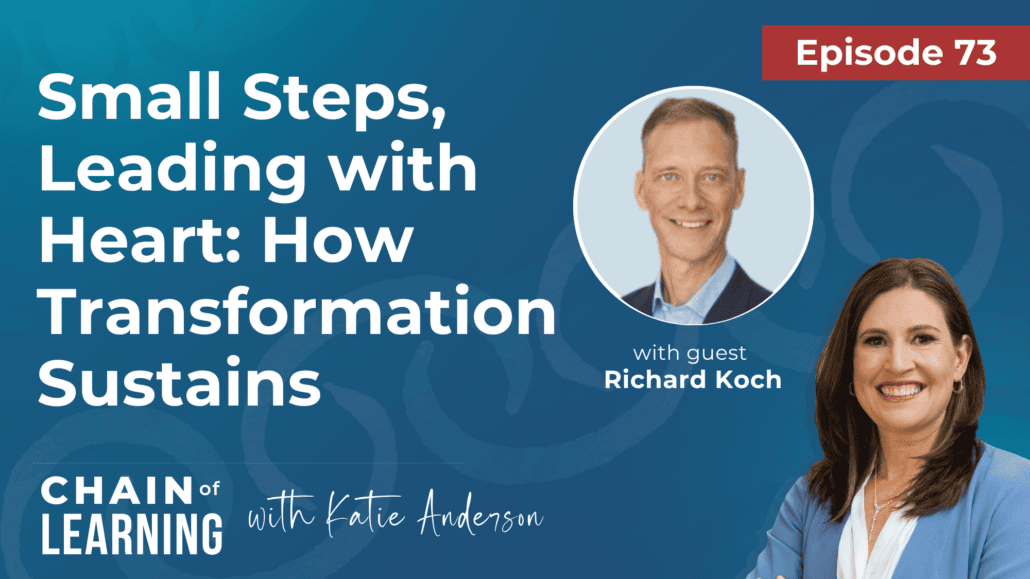
To explore this, I’m joined by Richard Koch, who has spent more than 25 years leading change inside large, complex global organizations—from frontline improvement to system-level transformation. We share a common belief: sustainable transformation doesn’t come from pushing harder. It comes from creating the conditions for people to be successful and take ownership of the work.
In this conversation, Richard shares what he’s learned from working within that tension—including why the way many organizations deploy improvement teams can unintentionally limit the problem-solving ownership they’re trying to develop.
In this episode, you’ll learn:
✅ Why daily work and small steps are where long-term change is actually built
✅ How separating leadership development and continuous improvement creates confusion—and weakens ownership
✅ Where improvement teams unintentionally take over the work and limit capability growth
✅ What it looks like to support leaders in owning change without stepping in to solve it
✅ Why the leader must be at the center of transformation—and what changes when that responsibility is held
Listen Now to Chain of Learning!
Tune in to see how small steps and how you show up shape lasting transformation.
Watch the Episode
Watch the full conversation between me and Richard Koch on YouTube.
 About Richard Koch

Richard H. Koch is Managing Director of Serofia and works with leaders who want to create meaningful progress for people, performance, and the future they are helping to shape. Drawing on more than 25 years of international experience across strategy, leadership, operational excellence, innovation, and transformation, he brings together coaching, training, and consulting in a way that is both human and practical. His approach is grounded in systems thinking, deep listening, and helping leaders turn strategic ambition into real progress through small steps and real work.
Reflect and Take Action
What Richard shared at the end of this conversation really gets to the heart of the work.
It’s not a new framework, a better tool, or bigger improvement initiatives. It’s how we create the conditions for change to become transformation—through small steps and how we show up with people.
So as you reflect on this episode, start with your own practice.
- Where are you moving too fast, pushing too hard, or skipping the inner work because the outer work feels more urgent?
- What would it look like to slow down just slightly this week and lead with a little more heart?
Then think about a leader you’re working with right now. Maybe someone who’s felt resistant or disengaged.
What’s one small step you could take toward them this week—not to convince them or push your change forward, but to connect, to understand what they’re up against, and to show them that you see their potential?
That’s where transformation starts. Not in the big moves, but in the small ones and in how we choose to show up in those moments.
Important Links:
- Full episode show notes
- Connect with Richard Koch
- Follow me on LinkedIn
- Subscribe to my newsletter
- Check out my website for resources and working together
- Episode 52 | What You Love About Lean and Operational Excellence — And Your #1 Frustration: How to Get Executive Buy-in
- Episode 54 | The ROI of Elevating Strategic Positioning & Messaging for Lean Consultants
Listen and Subscribe Now to Chain of Learning
Listen now on your favorite podcast players such as Apple Podcasts, Spotify, and Audible. You can also listen to the audio of this episode on YouTube.
Timestamps:
03:44 – Importance of seeing potential in every person
06:10 – How seemingly insignificant actions ripple through teams
08:37 – Why separating leadership and improvement work breaks progress
09:14 – The Inner System vs. Outer System framework and how it drives change
12:19 – The negative effect with silos that keeps you away from focusing on the work and the leader
15:14 – Why forcing change undermines ownership
17:32 – The mindset shift for change leaders and internal consultants
19:07 – Why daily work is the path to long-term transformation
21:22 – When improvement work splits into process and leadership, change stops sticking
23:19 – Why direct observation and connection matter
25:23 – Challenge of relying on experts to help solve problems
28:27 – How to build sustainability instead of dependency
29:05 – Navigating trust, timing, and influence with senior leaders
32:25 – Leading with empathy and understanding the pressure leaders are under
33:52 – Value of having the right outside partner to achieve goals
35:50 – Seeing a leader move from sponsor to truly owning and enabling change
39:36 – Importance of staying curious and creating space for ideas and growth
41:00 – Taking small steps to make big changes
43:00 – The essence of small steps, belief in people, and leading with heart to create the conditions for change
Full Episode Transcript
Richard: [00:00:00] I think we always need both. And the inner system to me is really about the mindset, the intangible elements, the emotions, the behaviors, the the way of thinking. And then the outer system is what we see. And it’s of course much easier to focus on what we see. What is tangible. It’s nice because you see it, you see the results.
It’s maybe also often more short term, and then we tend to underestimate. The importance of the inner system.
Katie: Welcome to the Chain of Learning for the links of leadership and learning unite. This is your connection for actionable strategies and practices to empower you to build a people-centered learning culture, get results, and expand your impact so that you and your team can leave a lasting legacy.
I’m your host and fellow learning enthusiast, Katie Anderson. If you’ve been listening to the show, you know that one of the biggest frustrations we face as change leaders is getting other leaders to truly [00:01:00] own the change their change. Not just sponsor it, not just not along in a meeting, not just buy in, but actually lead and own it.
And here’s what I keep seeing and what is emerging as the focus of my next book. Leading with our expertise, the tools technical problem solving isn’t sufficient to create the conditions for sustainable transformation. We can’t control our way to a people-centered learning organization. We have to focus on how to create the conditions for people to own the change and develop our human influence skills to enable that to happen.
In our enthusiasm for outcomes, we can end up focusing so much on the outer work, the processes, the metrics, the systems, and perhaps unintentionally underestimate the inner work, the mindset, the relationships, the small and almost invisible moments of human connection that actually moves people because transformation doesn’t happen in the big leaps.
It [00:02:00] happens in the small steps, taking consistently with patients and with a genuine belief that every single person has potential waiting to be unlocked. That’s why I invited Richard Koch to join me in conversation today to share his insights from decades of leading transformation inside large, complex global organizations across Europe, China, Taiwan, and Brazil.
Richard works at both the system and individual level shaping strategy, building leadership capability, and partnering with global companies to create cultures where learning leads to performance and people feel genuinely engaged and empowered. Richard and I first connected almost six years ago right after my book.
“Learning to Lead, Leading to Learn,” came out, and I’ve had the pleasure of partnering with him as a thinking partner and working side by side onsite and remotely with leaders and change practitioners in his organization. And what came out of that work together and in our own experiences of what it takes [00:03:00] to move from transactional improvement to leading organizational transformation is what this conversation is all about.
We started off with this question. Richard spent decades leading change inside large, complex global organizations. And what has that experience really taught him about what sustainable transformation actually requires that he couldn’t have learned any other way. Let’s dive in.
Richard: It’s hard to pull out one thing.
I think it’s many things to have learned or I have learned. I’ve been reflecting quite, quite a lot lately about what is actually the things I, that matters to me and what really stands out. And there are a a few things. One thing that I actually always come back to is how it’s almost a value, but, but it’s about how we see others, how we, how do we see?
Human connection. How do we connect to [00:04:00] people? How do we respect people? And it’s not so much the respect actually. It’s more about how we as leaders see the potential in every person. I think what I’ve learned and see over and over again, and this is no blame, this is absolutely normal and natural, we are.
In stress we have, I, I see leaders are under sometimes extreme conditions. You know, a lot of pressure. Pressure to perform, pressure to deliver, pressure to follow pressure to do certain things because it’s coming from somewhere. So, but how do you. Always come back to this anchoring of that in each person there is a potential and how do you unlock that potential?
You know, if we really take a bit of time to understand the other person and as a leader and really [00:05:00] invest. Sometime in going deeper into that connection, usually we can find so much that can be unlocked even with the, the one that was difficult or the one that did the failure, uh, did the mistake or the one who did something.
But there is so much potential and and power in every person, and I think if we as leaders can unlock that power and that potential. We have already done a big step towards transformation. I think that is somehow core, at the core of this, I think. Uh, so that’s one, one really critical thing. I see.
Katie: Uh, I mean that’s the, the fundamental goes to, you know, you.
Toyota pillar of respect for people, but it actually means holding precious what it means to be human. And that’s that, that that potential and that connection and that heart is, is so, so critical. What have you seen sometimes, like things that have really worked well to when leaders have been really [00:06:00] enabling and seeing that potential, and what are some, some things that you’ve seen that have maybe inhibited that or gotten in the way?
So, you know, the, the, the positive and the negative side of it.
Richard: It’s about almost being brave as a leader to, to, to invest the time in the small things in the small steps that somehow for might look almost. Intangible or not that relevant, but it might be extremely relevant for the person that they engage with.
So, so making that kind of small difference, I’ve seen some leaders where they actually took the time and they actually discovered what the kind of cascade of it can have when you support one individual and how that then is spreading throughout the teams. Uh, I think this. Looks maybe almost ridiculous because it’s just a small thing.
Doesn’t matter for on the big thing, on the big scheme, but when you actually take the [00:07:00] time and paying attention to those small things that matters to someone, uh, and feeling, getting the feeling, he listened to me, he talked to me, he cared about what bothers me, and something changed. The, the power of that and the, the, um, effects that brings also with the team members, with the other leaders, that is also something I’ve seen, uh, can be making a big difference actually.
Katie: I mean, it all goes, it all goes back to the heart. I mean, when you and I first, uh, met, gosh, almost five years ago, almost six years ago, after “Learning to Lead, Leading to Learn,” came out, I remember you were. I think on one of my very first webinars when the, after the book released and you reached out and you said, ah, this is the heart.
The heart is what we need for all, all of this. And we, we, we, we’ve always connected on that human, human dimension. Of course, all, you know, we’re great. We love to solve problems and help organizations do that, but, but really creating that, [00:08:00] that human. Capability and that human connection is, um, what’s really united, the two of us.
What else have you seen? It sounded like you were gonna talk about something else too, about leading transformation. That’s been a really key insight.
Richard: I think what has been challenging in many situations is, uh, this was of course an example or where it was, where I’ve seen leaders maybe making a shift and, and, and seeing something from a new angle, but.
Very often I see also that we try to put things in boxes, you know, so, so as a big organization or even a smaller medium organization. The world is complex. So what we do, which is understandable, we start to to categorize things and what that makes and how, what that really sometimes damages is that you put maybe leadership development in one box might be owned by a specific team.
Maybe human resources. And then you put the process improvement or the continuous improvement in another [00:09:00] box, and then the leader himself or herself is kind of there trying to jungle, who should I reach out to for what type of support do I need? And, and I, and the leader has actually to deal with everything at the same time.
So I started to kind of work on, uh. Framework you could say, which I call the inner system and the outer system. And uh, I think to neglect one of them. Will at some point result in non-sustainability, we will not be able to create the the change that we want. I think we always need both. And the inner system to me is really about the mindset, the intangible elements, the emotions, the behaviors, the the way of thinking, and then the.
Outer system is what we see and it’s of course much easier to focus on what we see. What is tangible? Uh, it’s nice because you see it, you see the results. It’s maybe also often [00:10:00] more short term. And then we tend to underestimate the importance of the inner system. And to me, I see these as actually really two systems working.
Nested, almost nested. You know, they, they intertwine and, and they influence each other and, and I think we need to start to understand how these. Needs to be connected, uh, in a different way.
Katie: Two things on in that too, that you said is, and in my experience too, is when we try and put things in the silos and functional areas, like HR is over here doing leadership development and then the process improvement people are just in process.
That’s when things actually don’t sustain. It’s actually, it needs to be integrated and. There’s so much that’s, you know, that what we are trying to do from leading system change and processes, develop people’s capability to be able to do that. And that has leadership development, you know, a core aspect of leadership development.
It also creates this [00:11:00] siloed like, is that my, is that mine or my, your yours? And like, almost like infighting within organizations, which is totally counter to what we’re actually all trying to achieve. So it, it, it sets, it sets up a. I don’t know about, not a dichotomy, but a, an us and them kind of situation when actually we’re all trying to achieve the same ultimate vision of how do we enable the organization to be successful and its people to be successful.
Richard: Absolutely.
Katie: I love, I really like this approach of like the inner and outer system and it, it relates to what I’ve been talking about here about the, you know, the technical pro skills that we need to lead change and process improvement and, you know, and then the human dimension skills around influence and leading with, leading with connection and heart and, and that those mind, that inherent mindset drives the behaviors, which then leads.
To the results. And when we get just focused on the results side, that outer system that you’re talking about, we can get some short term, as you said, short-term things, but not, not the sustainable long term. [00:12:00] So how, how are you seeing this playing out? What in your experience has led you to really seeing this and in creating this, this model to help leaders see this intertwined inner and outer systems?
Richard: Some of it is also what you just mentioned in terms of that when trying to bring these things together. It’s not natural for how companies organize themselves because we are used to, to organize things around teams. We are used to allocate roles to certain responsibilities, and we are used to divide the work, which then starts to form into silos.
And I’ve seen this. With many leaders that I worked with on all kind of levels. Everything from a shift leader to a site manager to to a functional, global functional leader where they struggle because they are [00:13:00] then a leader in the middle of all this and they need to understand how. Use all these competencies and use these skills and use, be able to navigate through this complexity of, of both emotions and processes and structures and way of thinking and and so on.
And how do you bring that all together and when they need the support. It’s all divided and, and it’s kind of almost competition and fighting for who is, who is going to be allowed to support this leader. Because being able to support the leader, I’m also showing and demonstrating I actually have my role is my job is important.
Right. So, so I think that is really the big challenge for many companies today. How do you focus on the work and on the leader? I think to me. Probably that’s the other thing I have as a, almost like a thesis or like a CE miss, is [00:14:00] I think there needs to be a shift of view on the role of the leader in change in continuous improvement in driving transformations very often.
What I’ve seen is the leader is an add-on. It’s a being seen as a sponsor or being entitled as the, as the one who’s going to support and, and we are expecting things. I see the leader in the middle, and that’s the heart of this. The leader needs to drive it and the rest needs to follow the leader. He needs to be in charge and no one else.
And that is where I see a switch.
Katie: Insightful. I was about to say insightful insight, but that’s not, that sort of doesn’t really work. That’s a, it’s a powerful insight, right? It’s like if we’re seeing like the, the leader who should be owning whatever that scope of work is, the person who’s truly the, the functional leader in that area, as more of just like the passive sponsor or someone who’s like giving ownership to the.
Project or the transformation to [00:15:00] whoever the, you know, whether it’s the operational excellence team or the HR team, we’re actually at, it’s like an abdication of the leadership, but I think that that can, that’s like one way that comes from the leader, but there’s also then if we’re in support roles. And we’re taking over that responsibility and we’re driving the change or leading it and we’re just sort of like, oh, the, the, the leader’s just this sort of sponsors person, but not really leading it.
That’s not, that’s not gonna create sustainable transformation ’cause we are gonna leave eventually. And it’s not creating the organizational capability. There’s like a mindset shift I hear in there too, of if you are in a support change leader type of role with, you know, where you’re coming in as sort of an internal consultant and whatever your role is, HR.
Process improvement, you know, operational excellence. You’re there to serve the leader, to be able to grow in the capabilities, to figure out how to bring their team together, to teach them new skills and some techniques. ’cause they’re, they probably don’t know how to do all of these technical sides of [00:16:00] things.
And that’s a real shift in mindset, right? Yeah,
Richard: it is. It is. And I think also what I’ve seen a lot. This, of course, the, the idea that we need to control the leader or we need to, you know, the, the, the mindset of compliance. We need to try to create maybe checklists or process controls and make sure everyone is following the process that we now set up, which is ideal for the leader, for the operator, for the shift leader, and so on, and they need to follow.
No, it’s not. It’s, they decide what they need to follow. They are the leaders and they need to, to what we need to create instead. This ownership. And, and, and help them to find the space to drive this change and that they see that they are owning this, they are leading it and not, and they are not asking someone else to do it.
But having the support is a different thing. You know, having the support, having the, all the. People who might help with seeing certain things and so on. That’s another, [00:17:00] another story, but yeah. But I think, I think it’s, it’s a, there needs to be a shift in, in gravity and how we, how we set things in motion.
Uh. Different compared to what we’ve historically been doing quite a lot. I think
Katie: I’ve been exploring that, that word control a lot as well. Like we kind of try and like use, like how do we enforce, how do we control, how do we drive change? It’s, it’s very fr like actually comes from this sort of.
Traditional command and control mentality, even though we have this great vision for change. And, you know, I’ve come to this conclusion, we cannot command and control our way to an empowered learning organization. And that comes from, we can’t like force a leader to be on board. And like I, I did this change leader survey and talked about it last year and talked about it in a past episode that one of the biggest frustrations from change leaders is, you know, getting, getting leadership buy-in.
But then that’s on us. How do we get, how do we not force them to like comply? How do we create the conditions for them to [00:18:00] say, yes, this is going to help me. And then I’m walking alongside you to say, here, here now, now let’s create up the conditions for your people to come on board. And it’s a just a shift in mindset where I’m doing, I’m doing the transformation rather than we’re enabling the transformation.
Richard: Yes, absolutely.
Katie: You’ve worked around the globe in so many different languages. I mean, I’m impressed by the number of languages you speak, Richard, uh, uh, in the impressive, uh, you know, industries and, you know, at different levels of system as well. And how do you see this mindset of command, the, the commanding change versus creating the conditions for change showing up across the board?
Richard: I think there is another piece to this, which I think is also, um. Often a, a misunderstanding or maybe a missing link is the big picture versus the, the small. You know, I think what we, why this happens is because we often argue the leader doesn’t have time. They need to worry [00:19:00] about maybe the operational stuff or they need to worry about their certain strategic, uh, things.
And we don’t make that connection of that daily work is strategic. Uh, daily work, small steps is also part of the long term and, and how to make those small steps being long term change. I think that is another thing we often say, okay, no, that’s just a small one, or that’s just a short term. Uh, and we need to focus on the short term.
We don’t have time to, to do the long term and the change, and I think that is another illusion or if it’s a. Misunderstanding. But I think helping organizations and leader to see that you can actually focus on what is important today and build in the long term. Today. So you do in the small steps that you take, which are necessary for today is built in.
So to say [00:20:00] we, in Toyota, we talk about built in quality, but I think it’s a built in strategy, built in long term aspect into the small steps. So I think that is another thing, uh, which I think is really important.
Katie: Yet that requires a lot of patience, right? It has a vision for the long term, but the patience that small steps, maybe today one small step doesn’t feel like a lot, but collectively it’s truly what’s gonna get us there.
Richard: Yeah.
Katie: When you say the word small steps, it’s true. It’s bringing me back to some of the work we did together a few years ago and and building out how to help. Leaders and especially the high, the system level leaders see some of these behaviors and mindsets play out in the organization. I, I’d love to maybe share with some people some this, some of this tangible, practical work that we did together that you were leading for some context.
There was some intense process improvement work going, but concurrently you were really focused on building the leadership capabilities. So yeah, that’s a great example of bringing this [00:21:00] together.
Richard: Yeah, so I think that was. A fantastic opportunity there where we actually try to take a holistic approach, I’d say, to driving excellence, driving, um, improvement, driving a transformation which would lead to more competitiveness and, and, uh, stronger, more healthy organization.
I think the challenge was. Both a learning and a, and a challenge. We then divided kind of two into two teams. One was more focused on the processes, as you said, uh, more on the operational analysis and di and analyzing how to create the right metrics, uh, and drive. Performance improvements in more short term while the other side where I got the responsibility to, to kind of take that longer view and, and help leaders to see how to support this change and really build.[00:22:00]
Competencies and skills in, in, in leading their teams to unlock a lot of potential and, and actually see that you can go much further than you maybe first think is possible. Uh, so that was a fantastic journey. At the same time as it was also a fantastic challenge and a lot of things triggered around that.
So, you know, lot of interest, lot of curiosity, a lot of, um, engagement, but also a lot of worries I’d say because where we were moving, we were moving kind of in between different chairs. We were. Driving and supporting the leaders. We had to move into a bit of leadership development area. We were moving into a process area.
We were moving in between different teams and stakeholders, and that is a very complicated space to be in, uh, [00:23:00] because, um, that could. Then trigger also worries and concerns about are we now starting to do something that someone else should be responsible of doing? I think one of the key great learnings from this work was that it’s really important to be on the ground as well.
So you know, to see how you engage leaders and support them in the small, to start to practice, uh, to be able to. Get feedback on their practice to be using coaching as a support where you can have time for reflection and create a support mechanism between the leaders. So you actually start to build the relationships and build stronger mutual support within the team as well, so they actually can then stay stronger.
I think that was many, many learnings there.
Katie: Well, I, and I appreciated the opportunity to go out twice to Scotland and work directly with you and that, and that, uh, functional leadership team. There’s, there truly is [00:24:00] nothing like going to see the actual work in workplace. I mean, we can do so much remotely and we can do so much other things, but being there on site and also just.
Interacting and seeing people and the, and actual, the, the work and the context is, is so powerful. And we, and even though we can’t do that all the time necessarily, or, and leaders and executives can’t be out there all the time, going to see and directly interacting is so powerful.
Richard: And I think even if you can’t do it all the time, of course you can’t do it a executive or as a, even you’re a site manager.
But there are differences of course. If you, if you take some time and you actually. Understand how important it is. Uh, it can be extremely valuable. And you could see when we had someone going out on the shop floor, being in a executive it, uh, and actually taking the time to listen to, to an operator or a shift leader and having that conversation, it’s very power.
Katie: There were a few tensions that you and I have talked about. You know, and [00:25:00] this is not just unique to you or my situation with I was internal and the first was a tension of, especially the more process improvement side of teams are often assigned by the organization or the leaders to go fix that problem or to be the more technical experts.
And yet, you know, like say you and I are coaching them to also be there to help develop the people and not just stick. Do the project work. And then there’s this tension and expectation and roles of like, I’m supposed to be this technical expert, and now I should also be looking at the human dimension as well.
In your experience, and I have some perspective on this, of course. What do you see as this challenge for when organizations send in the operational excellence experts and, and they’re there to like do the work and then move on? Both for the organization and then for those individuals and we’re asking them to grow in a different way?
Richard: Hmm. I think it’s challenging. It’s, uh, also sometimes not fair. Actually, uh, it’s quite, quite, the expectations are high, as you say. You know, the expectations are [00:26:00] huge. Uh, you send in a team of operational excellence experts knowing how to go into, deeply into the processes, collect the data, and, and analyze and come up with maybe to all, maybe not even alone, maybe even in a, in a joint effort with, with local, uh, experts coming up with solutions.
And there might be. Quite often there is an improvement and there is possibilities to, to create a step change. But then the question always comes back, how long does it last? How long time does it actually take until it falls back? And how much. Of ownership. Is there still in this, how do you build the capability that then stays within that local organization?
I think it has a role to play, but I think we are missing that point of ownership and, and the, the, the role of the leader here in driving this change, uh, and driving [00:27:00] this change doesn’t mean I. I give an order to someone to fix it. No, I engage. I, I’m there down on the ground. I try to pay attention to the details of the work that is being done, and I’m caring about it, and I’m, I’m playing an active role in leading this.
And then the. Maybe the process analyst expert from um, operation Excellence Team is there to support the leader, but it’s the leader who’s driving this, taking the lead on it. And I think there it probably needs another type of support. To the leader, someone who can maybe coach the leader, support the leader in a different way, more on a, on a different level.
I think that is very much underestimated, uh, and, and forgotten. I think this change here.
Katie: Right. The leader needs probably some support in those capabilities for the change process and how to grow in their skills to develop and coach. And I think there’s something really important. Well, I know there’s something important here [00:28:00] too, and, uh, about, you know, and for anyone who’s operational excellence, you know, CI consultant in your organization.
Even if you’ve been assigned to do a project, there is opportunity for you to engage your stakeholders and the leaders to help bring them along with the vision that you may be doing more doing in the beginning. But it’s with, uh, your mindsets with the going to, how am I teaching capability for sustainability?
And I mean, that was what happened to me when I was first started this work. I love solving problems and I go in and do it, but then. You know, six months later it wasn’t sticking and so it was this aha of like, yes, there’s still technical skills and problem solving and framing and all of that that I can bring to the work and I need to show up with a different stance of this collaborative like consulting model.
You know, we brought in Peter Block’s flawless consulting of how, how do you not. Just be a pair of hands who’s doing the work, but really creating the systems. And so the more you can grow in those influence and change capabilities [00:29:00] too, you actually will be better positioned and more effective in the the actual doing work.
And then. This other tension is one that at a more senior level that I know we both experienced and we’ve talked about too, that especially when you’re coaching and advising senior leaders and executives, there’s a real tension, especially when you’re internal from speaking truth or holding up your observations and like building up enough trust to get that access yet.
Speaking truth when it matters and, and having permission to hold up the mirror. And there’s sometimes ramifications, uh, of doing that. It can feel really scary. What have, what have you learned through experience, um, in, in that, and that’s a really hard stance, like to speak the truth to power and that is part of your role, but it’s feel, can feel really risky.
Richard: Yeah, absolutely. Of course it can be, it can be very risky as well. And I think it’s also about having a sense for what is the right timing to, to [00:30:00] holding up the mirror. Uh, is it in a one-to-one discussion or probably not so much in a. Team setting less of that and, and you know, really engaging with the leader as well to understand the leader situation.
Uh, I think it’s started talking about respect for the individual and seeing the potential in every human and holding precious, what it means to be human. I think there is another one there is around compassion. And empathy with the leader. I think many leaders I’ve seen are struggling, uh, on a lot of things in terms of pressure, in terms of stress, in terms of always having to be to this meeting and that meeting and another meeting.
It’s hard to say no, it’s hard to, to carve out the time that is really needed for the things that really matters, um, as a leader. And I think having. Building up a relationship with the leader, [00:31:00] uh, to. Support and, um, try to understand the challenges the leader is in front of, and then create that trust and then be able to hold up the mirror once in a while.
I think is, is of course really a really important, but maybe it’s not the first thing you do. First thing is probably to build that trust and, and, and, and, and the mutual understanding and that the chemistry works and, and all these other human factors that play an important role in be able to do that.
And that’s really an important part of it. Uh,
Katie: I was, uh, just recently at the, the Shingo Connect Conference and had a conversation with Skip Stewart, a fellow shingle faculty fellow, and we were talking about this theme. Complaints about leadership buy-in and this frustration that leaders aren’t getting it, and it’s sort of a similar thing.
It’s this mindset of like us versus them in some ways. And it’s like sometimes we need to step back and have that real empathy and compassion for all the things in front of these executives and operational [00:32:00] leaders on their plate. It may not be that they don’t. Believe in this. It just as they’re so overwhelmed or have all these competing priorities and it’s like, how can we help them?
You know? Maybe, what’s that one small step, as you said, like for how can you too, have the long-term vision and get, like, we can get frustrated ’cause we see the vision of where we wanna go and have the, but how can we too have that small step, long-term approach and patience. And empathy. Empathy that changes hard.
And there’s a lot of realities in front of people.
Richard: Yes, I think so. I think so. Yeah. And I think that is also what I’ve seen a lot, which sometimes happens in, in different organizations, not just the one that I work where I were now recently. Also, other organizations we try to divide into different roles and different, you know, it’s us and them can be in many different ways.
Can both be both, uh, the leader and the change. Agent, but it can also be within change, change, different groups of change, uh, teams and so on, and that that is of course. [00:33:00] Can be really disastrous when we, when we do that, I think. Um, uh, so I think finding ways, and of course I don’t think the answer is easy, but finding ways to really partner with leaders on, on the same level, I think is, is critical and as partnering as humans more than, than different roles and that we are.
Looking for supporting each other and, and being of support for the leader in going, uh, into the future of, of new things. Yeah, so.
Katie: We all need support and partnership. And, you know, on that, on that theme, you know, you brought me in for many years as a, as a partner for you both as a thinking partner and then coming into the organization to partner in some different ways to help you do some certain things.
What was for you? In your senior internal change leader role, what was the value of having the right outside partner and how did that like help you achieve things or do things that might not have been [00:34:00] possible otherwise?
Richard: First of all, I think the chemistry worked really well. So I think, uh, coming back to that, I think it’s really important that it’s someone that you trust and that you can connect with and, uh, also have, like we just talked about.
You holding sometimes up the mirror to me and, and the challenge, you know, challenge what I, where I was going or not going. Also having someone who coming in with fresh eyes, looking at things, uh, not being part of the. Of the puzzle, so to say in the organization is very helpful. I think having someone, and as you mentioned a bit earlier about your book and so on, uh, I had the feeling already when I started to read your book, uh, and I think it was quite early when it just came out.
Uh, and then we started to connect. I think that was a big trigger for me that I started to see here is something that I really feel was the missing piece. I had been looking for some ways of, of. Shifting that focus in the organization [00:35:00] towards more leadership. We had been focusing a lot on practitioners and training practitioners, but somehow the leaders were outside of the loop.
Uh, or in the best case, they were there as a good sponsor, but, but that was kind of at the end, almost the end of it, you know? So, and I wanted to shift that, and I needed something as an extra. Liver, so to say, to, to make a bit of a different type of icebreaker, so to say. And that’s, that’s where you came in and made a very good, you know, a fantastic, uh, contribution.
So, yeah. That was good.
Katie: Oh, well, I, I, I love being able to help support, you know, the change inside, help everyone Yeah. Become their better selves, both the internal change leaders, and then help enable the, the, the teams too. Uh, you were getting to the end. I’m, I’m curious like. If you can think of one person in particular, you don’t have to share their name, but like one moment when you genuinely saw a leader make [00:36:00] this shift as well, not just the shift from like the ownership or like really getting it from, from sponsor to truly engaged, from like trying to control the conditions to really creating the conditions.
What did that look like and and what did it unlock either for them, the team, the organization
Richard: there is one. Which is quite long time ago I was out in on the shop floor. I think part of the leader’s role is actually to once in a while get their hands starting. It’s not just to sit in the office, it’s actually getting out there.
We talked about that, and this is coming back to this kind of potential where I really see the potential in, in people there. A leader, a quite senior leader, been working with the company for. 30 years plus. Uh, so very senior, very a lot of experience respected in the organization as a very. Knowledgeable person, an expert, but maybe sometimes a bit difficult with change because he had his [00:37:00] experience and he knew very well how, what works and what doesn’t work.
And as, uh. Quite young person in the organization at that time. I was of course faced with the same challeng as many others. If you don’t have 30 years of experience, why would he listen? You know, so why, why? What are you doing here? Coming across? So I actually spent as part of my routine, I went out to him every day for I think at least a month or two, just to connect outside.
On the shop floor when he, I knew roughly early in the mornings when he were out there doing his walks. He was a lot out in the factory and I went out without any type of agenda, just being curious about what his work is, about, what ask him about technically, questions about how the processes works and you know, after some time he really.[00:38:00]
Got really warmed and, and, and started to trust me a lot and, and started to, to have con we could start to have real deep conversations about the organization, about developing the team, about the change. And he started to make. Some fantastic moves and he was actually seen as various troubles. I mean, not very knowledgeable, very expert, but difficult when it comes to change.
And a lot of people said he, you never convince this guy. You never convince him. He’s a stubborn old guy, but he. But he actually then convinced, was convinced and, and started to make moves that no one would have expected. That is probably one of those experiences I still carry with me and is, which I’m building on my belief, and there is a huge potential in everyone, and it’s about spending time together and, and trying to understand each other and listen to each other and, and connect and, and on the same level.
I think that is [00:39:00] the main,
Katie: I I love that too, because it, it’s like. You weren’t just focused on the work or the project, you were, you’re trying to make genuine human connection. And so moving truly from that transactional focused on the, the project or change you needed to do to really how do we build the trust and relationship on the human level to a place where he was.
Seeing the change for himself.
Richard: So that, that was a really good, good, good experience.
Katie: How has that early, many decades ago experience, uh, influenced how you show up as a, as a leader and, and now an increasingly transformational change leader in large organizations?
Richard: One thing is I don’t want to get into the habit of not listening.
Uh, even if there is someone really young, really different background, a different experience. Always try to be curious and open to learn and, and as much as possible, even under stress, even when maybe not having too much time, [00:40:00] trying to make sure that that. Taking the time to listen and to invite people to provide ideas.
I think, uh, every, every idea is, could be a seed for something, uh, that can grow, even if it’s not exactly that final solution or that kind of, but it’s, it’s this giving seeds to each other, almost sharing seeds with each other and then starting to grow things together. I think that is, um. Something I try to take with me, you know, that there is always an opportunity in every conversation that we have.
Uh, and, um, giving space, I think is really what I’m taking with me for that. Yeah.
Katie: So my last question to you, I always ask for some advice. So for someone who is really passionate about this work in the human side and cultivating human potential and deep believes deeply in it. Maybe whose organization isn’t there yet is more focused on the tools and the process and the results.
What advice do you have for them as they’re [00:41:00] navigating this?
Richard: My mantra has been, come more and more strong is these small steps. You know, don’t try to, if you feel there is a struggle. Organization is not there. Look for the small things. Look for even, it feels maybe not that big change that you are wanting to have immediately, but try to find a small success every day, almost, you know, a small mini success.
And, and try to open up, uh, a path somewhere and take a step and try. And then I think it’s about patience, about learning. Continues to stay curious. There will be many moments where you feel, oh, it didn’t work out and I was pushed back. That guy didn’t listen to me. Well, it’s not about pushing, it’s not about forcing.
It’s about creating the conditions, so, and [00:42:00] understanding. The needs. Be curious and to try to understand the needs of the person that you’re trying to help, and be as helpful as you can.
Katie: Small steps, be patient and lead with the heart, with compassion, caring. Yeah.
Richard: And lead with that. Lead with the heart.
Absolutely. Yes. Well,
Katie: Richard, it’s been such a like. I a pleasure knowing you for almost six years and partnering with you. Uh, truly a leader who does lead with the heart and that’s why we’re so united and it’s been fantastic. So I look forward to many more conversations and collaboration to come. And thank you for coming on Chain of Learning to share your insights and the small steps it takes to lead transformational change.
Richard: Thank you so much Katie, and I’m very grateful for this opportunity to, to have this conversation with you and I’m also looking forward to our continued next six years of
Katie: Yes,
Richard: experi of experiments and learning. Yes.
Katie: Thanks Richard.
Richard: Thank you.
Katie: What Richard shared at the end of this conversation is the essence of what all of our work is truly [00:43:00] about.
It’s how we truly create the conditions for change to become transformation, small steps, and leading with the heart. That’s it. That’s the whole thing. This is what opens up the path to real transformation, both individually and organizationally. Not a new framework, not a fancier tool, not bigger improvement initiatives.
Simply what is one small thing that I can do today in this moment with this person that shows that I genuinely see their potential? And how can each step get us towards just being a little bit better and collectively that leads towards excellence. That’s what Richard and I have both seen in our decades of experience from leading frontline improvement to system level global transformation.
The leaders who create the most lasting change aren’t necessarily the ones with the boldest vision or the most sophisticated methodologies. They’re the ones who are willing to show up consistently in the small moments with patience and a [00:44:00] genuine belief in the people around them, and with a greater vision of what is possible.
And that’s the invitation for all of us. So as you reflect on this episode, I want you to sit with these two questions first. What is one small step you can take in your own practice this week? Where are you moving too fast, pushing too hard, or skipping the inner work because the outer work feels more urgent.
What would it look like to slow down just slightly and lead with a little more heart? And second, think about a leader you’re working with right now. Maybe one you felt a little frustrated with, one who seems maybe resistant or a bit disengaged. What’s one small step you could take towards them this week?
Not to convince them not to push the vision of your change, but to simply connect, to understand what they’re up against, to show them that you see their potential and understand their world. That’s where transformation starts, not in the big [00:45:00] moves, in the small ones, and connecting with the heart. In the opening of this episode, I referenced the change leader survey that I conducted last year about what we love and what frustrates us in leading this type of change.
I encourage you to go back and listen to episode 52 where I dive into the survey results and what’s really underneath our leadership buy-in frustration. And then listen to episode 54 where Betsy Jordan and I talk specifically about how you can increase your influence capabilities to get genuine commitment from leaders, not compliance, but real ownership.
The links to both episodes are in the show notes and if today’s conversation resonates with you and your sitting with that tension of knowing what’s possible and not quite being able to get your organization there, this is the heart of the work that I love to do. The partnership I’ve had with Richard over nearly six years from thinking partner as a trusted advisor to being the outside perspective that supports your vision of change and to developing the human side of [00:46:00] leadership for both operational leaders and internal change teams.
That’s what I love to do, whether you’re internal change leader or executive who needs a thinking partner, or you’re looking for outside support or a boost of energy to help grow your leader’s capability to actually lead and own the change. Let’s talk. You can learn more at KBJanderson.com and the link is in the show notes.
And if you’ve enjoyed this episode, please share it with a colleague or fellow change leader who needs to hear it. That’s how we grow our Chain of Learning together. Thanks for being a link in my Chain of Learning today. I’ll see you next time. Have a great day.
Subscribe to Chain of Learning
Be sure to subscribe or follow Chain of Learning on your favorite podcast player so you don’t miss an episode. And share this podcast with your friends and colleagues so we can all strengthen our Chain of Learning® – together.