




How Strong Team Habits Lead to Stronger Results
Have you ever invested months in a strategy your team struggled to put into action? Or watched talented, committed people give their all and still find it difficult to work together effectively?
High performance isn’t simply the result of a stronger strategy, more expertise, or longer hours. It’s shaped by the everyday habits that help people collaborate, make decisions, and foster continuous learning.
Karina Mangu-Ward, author of Teams That Meet the Moment, has spent more than a decade helping complex organizations redesign the messy day-to-day of how people actually get things done together.
Her belief: good everyday teaming habits are both good for people and good for results. We don’t have to choose between people and results—or between effective leadership and high performance.
Making this real doesn’t require a reinvention. You just need the right structure and the intention to show up differently.
In this episode, Karina shares simple, tangible practices you can use in your very next meeting or strategic project.
We can do hard things and have nice things.
In this episode, you’ll learn:
✅ The three lies leaders tell themselves about teamwork, and why believing them holds your team back
✅ How the framework of the “Even Over” ends the swirl when your team is stuck choosing between two competing options
✅ Why creating a “Safe to Try” process gets a team unstuck when you’re chasing consensus and certainty
✅ What a steady team cadence unlocks when everything around you feels like an emergency
✅ The instinct nearly every high performer has to unlearn before they can build a team that thrives
Listen Now to Chain of Learning!
Tune in to learn how small shifts in your team’s daily habits can help you navigate uncertainty with greater clarity and confidence.
Watch the conversation
Watch the full conversation between me and Karina Mangu-Ward on YouTube.
About Karina Mangu-Ward

Karina Mangu-Ward is a partner at August Public, an organizational change consultancy that helps large, complex organizations build more human-centered ways of working, whose clients include PepsiCo, Planned Parenthood, and Sundance.
She’s the author of Teams That Meet the Moment: 9 Practices for Unlocking Performance and Growth in Uncertain Times. Karina’s passion is helping groups navigate complexity, gain insight, and unlock highly complex challenges.
Reflect and Take Action
Intention is only meaningful when we put it into practice.
When we’re under pressure, it’s easy to become reactive. We jump in with answers, treat everything like an emergency, or keep pushing because we care about getting a good outcome.
But as Karina reminds us, simple structures can help us choose a different path. Practices like defining an “even over,” creating something that’s “safe to try,” or establishing a steady cadence make it easier to stay intentional, clarify trade-offs, and keep moving forward instead of getting stuck.
As you think about your own team, consider:
- Where might defining an “even over” help you make a clearer decision when you’re trying to hold onto two competing priorities?
- Where could you work more in public instead of waiting until something feels perfect enough to share?
- What is one opportunity this week to bring a learning mindset to something that’s still in progress?
Leadership isn’t about getting it right every time. It’s about making intentional choices, practicing new behaviors, and creating the conditions for other people to learn and grow alongside us.
Important Links:
- Connect with Karina
- Purchase a copy of Karina’s book: Teams That Meet the Moment
- Learn more about Karina’s company
- Take the Team assessment
- Follow me on LinkedIn
- Subscribe to my newsletter
- Check out my website for resources and working together
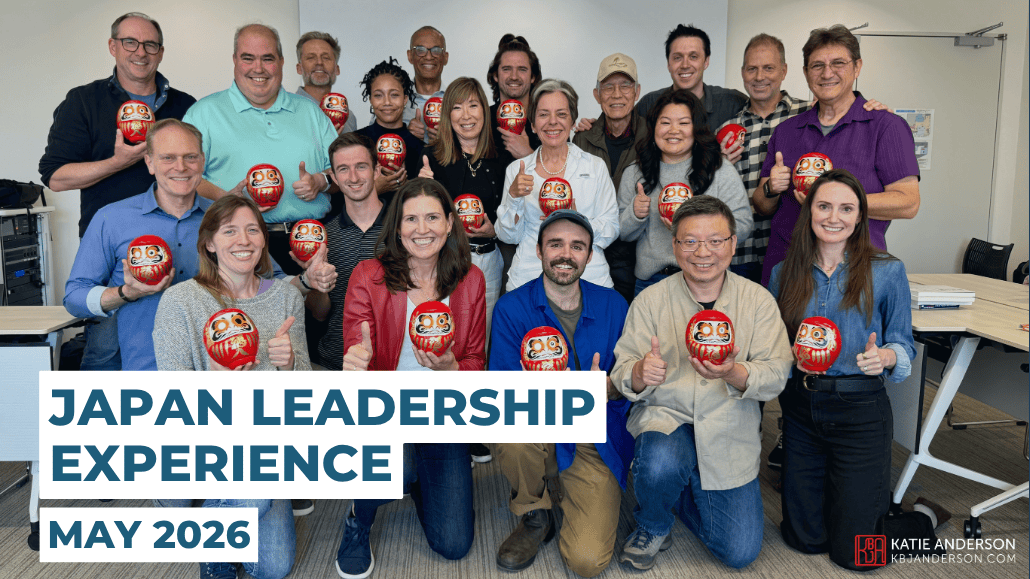
- Join us on the Japan Leadership Experience
- Episode 26 | Harness the Power of Storytelling in Leadership to Inspire Action with Carol Cox
- Episode 71 | Own the Thinking Process, Not the Thinking: How Leaders Build Problem-Solving Capability
Listen Now to Chain of Learning
Listen now on your favorite podcast players such as Apple Podcasts, Spotify, and Audible. You can also listen to the audio of this episode on YouTube.
Timestamps:
03:01 – Why great strategy still fails
04:13 – The hustle culture myth that’s burning teams out
05:20 – Everyday habits drive extraordinary teams
07:11 – Meeting the moment in uncertain times
09:13 – The “Safe to Try” mindset that breaks gridlock
11:18 – Setting guardrails without limiting innovation
12:06 – Why small bets outperform big risks
13:29 – Unlearning the need to have the answer
15:17 – Why sticky practices beat complicated frameworks
17:16 – Simple retrospectives that strengthen learning
20:19 – The surprising cost of treating everything like an emergency
22:09 – Using “Even Over” to make better trade-offs
25:28 – Intention over reaction in decision-making
30:32 – When perfection becomes procrastination
31:53 – Why working in public accelerates learning
34:22 – The power of stories over instruction
37:08 – Intention + practice = better leadership
39:14 – What trade-off do you need to make?
Full Episode Transcript
Karina: [00:00:00] I’m anti any dogma, anything that sniffs of dogma i- in any way, because I think that my sniff test is, is it sticky, memorable, and useful? And that is frankly the only thing that matters.
Katie: Welcome to Chain of Learning, where the links of leadership and learning unite. This is your connection for actionable strategies and practices to empower you to build a people-centered learning culture, get results, and expand your impact so that you and your team can leave a lasting legacy.
I’m your host and fellow learning enthusiast, Katie Anderson. Most leaders believe that to win, they need a better strategy, more superstar talent, or to just work harder. My guest today says that all three are lies. You’ve probably felt this. You’re working hard, and so is your team, but things are stuck.
The meetings pile up, the decisions stall. Good people, including yourself, are burning out, [00:01:00] and the strategy you’re working towards is just not moving. It’s exhausting, and it’s so common that we’ve started to treat it as normal, just the cost of doing hard things, of living in a world with so much change and pressure to transform.
It doesn’t have to be. I’ve seen this in my own experience working inside teams and coaching leaders, and I’ve seen it in myself. We get caught up in the urgency of the now, being the one with the answer, jumping in to fix and do because we care about getting to success, believing that if we just push a little harder, it will all come together.
My guest for this episode, Karina Mangla Ward, has spent more than a decade helping teams find another way, and she has the practices and the results to show it’s possible, which she’s documented in her new book, “Teams That Meet the Moment: Nine Practices for Unlocking Performance and Growth in Uncertain Times.”
She’s a partner at August, a consulting firm that helps some of the largest, most complex organizations in the world [00:02:00] change how they actually work day to day. She’s been inside teams at organizations as diverse as PepsiCo, Colgate-Palmolive, Planned Parenthood, and Sundance. Her motto, “Get caught trying.” I love it.
We started off our conversation exploring the provocative opening of, “Teams That Meet the Moment,” that most leaders believe these three things that she considers lies. I asked her about why she considers them lies and what she sees in organizations that’s getting in the way of team success. Let’s dive in.
Karina: The book starts with what we lovingly call these three lies we love, and it’s framed that way because they’re so alluring. They’re, they’re a fantasy. And the first one is that all we need is a great strategy to win, and what… The way I see this playing out in organizations is that people will spend, you know, 18 months on a strategic planning process or hire Bain to, and spend a million dollars for the highest fidelity strategy.
[00:03:00] And it’s not that that’s wrong. It’s fine. It’s great. Strategy is really important. Making choices is essential. It’s just not enough, because if you have a strategy that can’t be executed, it’s, it’s just dusty on the shelf, and I’ve seen that happen too many, too many times. Um, so that’s a big one. The second one is many organizations are, I think, rightfully obsessed with talent, right?
We want superstars, and at the most extreme, that plays out with Microsoft paying $250 million, you know, to, for a top AI talent. But it plays out in much smaller ways in most organizations, which is, like, getting obsessed over getting people who have the right expertise and the right pedigree. We cannot take it for granted that people who are exceptionally talented in their domains are any good at teamwork, and often that’s a reverse correlation between those things in my experience.
So, so like a reframing of talent actually as being talented at teamwork and complexity, and I think that’s something to think about. And the last one is, have you heard about 9-9-6?
Katie: Oh, yes. No, I have. Yes.
Karina: We’re supposed to be working six days a week from [00:04:00] 9:00 to 9:00 if we wanna be successful and hustle culture and grind culture and 10X- Yes
productivity and all this. So there’s this mantra around just, like, working harder, right, putting in the effort. And, um, I think we love that lie because it is the thing that we can control the most. It is linear. If I just put in more time, I will be successful. And it’s such a lie because working harder in broken ways of working doesn’t lead to good results.
It just leads to burnout. And, a- and those are the three things that when leaders gather around a table, I find that that’s what they talk about around what drives performance instead of talking about how teams execute, decide, and learn, which is what I believe is actually the key.
Katie: I, I live h- in the Silicon Valley, and so that hustle culture is so pervasive across a lot of the organizations that exist here where I live, and it’s, it, it, it’s really exhausting, right?
And it’s, it’s not good for humanity. You know, one of the, the things that really stuck out to me in an early page of your book [00:05:00] was that it’s not about… You know, sometimes we think about how do we build teams for, like, a big moment crisis or something, but the moment it sounds like you’re talking about is the everyday moment.
Like, how are teams really functioning every day for high performance and, and not being burnt out?
Karina: If you think about how we spend the balance of our time, it’s at work every day But with other people trying to get things done. There’s almost nothing that gets done in organizations these days that doesn’t involve coordination and interdependency with other people.
That is how we spend our time. When we talk about, you know, meeting culture, that, where I’m in meetings from 9:00 to 5:00, that’s because we’re teaming with other people. We’re not working alone. So I think a lot about how that is where we spend our time, and that is how we actually deliver value. That’s how we get things done.
It’s not to say, I love a good team retreat. You know, I love a good big moment. That stuff really matters, and I think crisis can be a moment that reveals either what’s working or not [00:06:00] about our team, and that can be really helpful. But at the end of the day, it’s about everyday habits, habits for how we get things done, how we stay accountable, how we decide, how we learn, that I think make, uh, and this is the hill that I will die on, that good everyday teaming habits are both good for people and good for outcomes.
And you don’t have to choose between those two things. We often think that. I, I’ve, like, gotta have a good vibe for my people and maybe compromise on great results. No, no, no, no, no. When teams are working well, we can have, we can have nice things. We can do hard things and have nice things.
Katie: Right. And I think that’ll resonate with a lot of listeners because we, we talk about, like, how do we develop people as well while doing the work that needs to happen, while getting results?
And, and if we really can, like, unleash the greatness of people as individuals and then collaboratively as teams is really how we’re going to then get to that long-term result or even the short-term results as well.
Karina: Even the short, short-term results are great. 90-day results are great as well because that’s what accumulates into [00:07:00] the long-term results that you want.
So, totally agree.
Katie: In the title, you say, you know, meet the moment, and what, what are you seeing as the moment now that we really need to be meeting a- as teams, as individuals?
Karina: It’s a great question. I mean, I think my macro answer to that is, um, economic instability, geopolitical complexity, leadership changes inside many organizations, the rise of AI, a technology that everyone keeps saying is gonna change everything, but also keeps changing all the time.
I think that moment is really, really challenging for folks. I think we’re still dealing with the fallout of a pandemic, which kind of, um, in a nonlinear, incomprehensible way, step-changed everything about work, and we’re still kind of step-changing back out of that, returning back to the office. Not to mention, just, like, the constant internally generated transformation agendas inside organizations right now.
Like, I don’t know a single organization that doesn’t have… May- maybe 10 years ago it was, like, one or two transformation priorities, [00:08:00] and now many organizations have 10 concurrent transformation agendas that they’re all going through. And so I think the moment also involves, like, a incredible amount of just change fatigue and transformation fatigue.
But I don’t think that the way out of that is to say, “Let’s do less change.” ‘Cause that is the moment that we’re living in. I think it’s about learning to have everyday habits to help us, like, tolerate and metabolize that change in a way that doesn’t feel so incredibly stressful.
Katie: Your book has so many great tactics, tools, practices to, to handle that, and I wanna dive into that a little bit.
But first I wanna think about, you have so many great stories, too, of, like, organizations that approached you and your consulting firm, August, about, like, they’re in that moment. They’re like, “We have so much change. Things aren’t working. What’s going on?” Like, what are you seeing when companies usually re- reach out to you?
What, what are some of their challenges? Or maybe, uh, share a specific story to illustrate what this looks like.
Karina: So a couple of the stories that come to mind. There’s a story in the book about, uh, [00:09:00] Sundance Institute. And what’s interesting is we had been, uh, working with them before the pandemic, but the story in the book is about the, the pandemic.
And there was a moment when the institution needed to figure out what to do about the live festival. This is an institution that’s entirely dedicated itself to producing an in-person live festival, and they… The pandemic came, and they had to figure out how to, how to pivot. And we had already been working with them and had in- introduced this language of safe to try, which from August, the kind of lingo is about moving from a decision that we feel is right or wrong- To one that we think it’s not perfect.
We’re dealing with imperfect information, but it’s not gonna do harm, so let’s try and let’s learn. And the story in the book talks about how important it was to have that language and the culture in a moment when an organization was making a decision where they had deeply imperfect information. What was the [00:10:00] pandemic gonna look like in 10 months when it was festival time?
Could we do some of the things, uh, in the festival digitally that we had been doing in person? And it’s a really powerful tool, and it was in the story in the book, out, out of getting out of consensus gridlock, where, like, waiting for total agreement or waiting for total certainty or assurance that the path was right.
And at the end of the day, they pivoted to digital, and it was a tremendous success, and their ability to do that in a safe-to-try mindset helped them do that faster, sooner, and better than if they didn’t have that kind of language in the, in the ether.
Katie: Having some parameters to know where is it safe to try and run the experiments and test.
I mean, I see this so often in organizations, too. We get paralyzed because, like, we put everything on the outcome rather than, well, what are the ways we can learn our way forward and really understand where it truly is it safe to experiment and to try, and through that, we’re gonna actually get information that will lead us on a better pathway.
Karina: Absolutely, and also being able to say to each other, [00:11:00] um, having permission, and this comes back to psychological safety, to say, “This isn’t safe to try.” Like, and to be able to say, “Here’s the data that I have, and here’s why that’s the case,” and then, “So then let’s not do it.” I think there’s, there can be a misunderstanding that using the language of safe to try means everything safe is safe to try.
It’s not. But when we have a culture where you’re kind of expected to e- like, say yes or, like, get everybody to yes, it actually gets harder to say no. So I love the idea that safe to try makes it more safe to put your hand up and say, “I strongly oppose this” and make it, making it discussable around here’s why.
Katie: Yeah, I’m thinking back to an image in your book where, you know, there are guardrails, right? And so leaders can put guardrails on where, where it’s not safe to try or what’s outside the scope, and then within that, giving people permission to, to try to experiment, to bring ideas, and that actually gives so much more space than rather we’re putting so many constraints that everything has to be within this box.
I mean, you need to have that safety box.
Karina: Yeah, I mean, I think the other time that people come to us [00:12:00] is when, um, they’re trying to pursue some kind of big ambition. I mean, often it’s around, like, a growth ambition or an innovation. Ambition. And there’s a story in the book from Colgate, and, you know, Colgate’s a, a huge company.
And they are incredible because of the way that they manage complexity across a huge, and manage efficiency. And they wanted to move into a new market, a new kind of beauty adjacency market, which is an unusual one for, like, a personal care company. And the story in the book is about them wanting, uh, kind of benefiting from August practices and coaching support to go from taking kind of a longer time to launch a new product to be able to do it with a cross-functional team, like, rapidly and efficiently.
Um, I think k- kind of taking, like, a small bet mentality. Like, what’s the smallest bite of this that we can chomp off and make the fastest progress on, and go after that in service of [00:13:00] learning. Um, and getting into that mindset of, like, many small bets within certain guardrails rather than one too-risky big bet or big bite is just one of the most important, um, I think, mindset shifts for organizations in this age that we’re talking about where everything is so nonlinear and unpredictable.
Katie: What are some of those challenges you see in helping leaders move from that, like, former mindset of, we just have to put everything towards this big goal, and then starting to break it down and seeing that it truly is safe to try run those small experiments? Like, how, how do you help them make that shift?
Karina: There’s two points of resistance that I observe to that. And sometimes it is about leaders that have been working in a certain way, like, enjoy, enjoy it. They enjoy having control. They enjoy having the right answer. And, and I get that. I really do. So part of the journey is just, like, unlearning that, the idea that that is what great leadership looks like, moving away from the [00:14:00] idea that great leadership is measured in having the right answer to thinking about great leadership as trusting yourself and having the confidence to navigate, like, whatever comes up, even in spaces where there’s, there is no right answer.
So I think there’s, like, an unlearning component about that. And then I think many leaders that I experience just don’t know another way yet. And there’s a way that leadership and teaming is taught in business school, and the way that folks were mentored into learning their practice, everything from how they plan, to how they decide, to how they lead.
And so often it’s just a gap of, like, shared practice and shared language, and that’s why the book… I mean, I’m a practical gal. I, I, like, you know, I love a, a practice and a script and a tip. Um, so the book is, the book has that in it ’cause I think it’s useful. But also A lot of what I see is just the say/do gap.
Leaders know they need to work in a different way, but often no one has answered for them, “But how? What do I actually do differently, say differently?” And the book is [00:15:00] intended to be an answer to that question for the folks that are yearning for that already.
Katie: I think it’s such a great, uh, framing. I recommend everyone who’s listening to pick this up, ’cause there’s s- it’s just great practical insights, but it real.
Like, you’re like, “Oh, I can do this. I can apply this. I can start practicing this.”
Karina: It’s not a mystery.
Katie: No, it’s not a mystery.
Karina: It’s just a new practice, and you and I have talked about this a little bit that, like, you have a, you know, practice in, in lean and kind of, like, formal agile, and I am, like, I’m anti any dogma, anything that sniffs of dogma i- in any way, because I think that my sniff test is, is it sticky?
Memorable and useful. And that is frankly the only thing that matters. So over the 10 years of August, we’ve tried a million practices. Our practice stack is 150 deep, you know, for, for teams alone. The nine practices in the book are the ones that people literally walk up to me on the street who I haven’t seen in eight years and go, “You’re [00:16:00] that team charter person.
You’re that safe to try lady.” Because they, they just, it sticks. And I think that’s what transforms team and culture in organizations.
Katie: Yeah. And I, I’m right there with you. I think, uh, a lot of people get too stuck on words and, like, this methodology versus that methodology. And in reality, it’s just a lot of great practices, and the reason they work or the sticky ones work, and a lot of my listeners will really resonate with, you know, this, this is safe to try.
It’s about experimenting or, you know, making things visible, like transparency, make the invisible visible. That, and also, you know, having this learning mindset and learning from mistakes. I mean, that’s my, that’s like my whole, one of my whole things. How do we learn from mistakes? So this is the essence of great leadership, and we hear it all the time.
It’s just, as you said, we get stuck sometimes in this pattern of reactiveness or overwhelm or habits where I’m the one with the answer. And when we can really shift to being like, how do I create the conditions with the right structure in my [00:17:00] organization, like, so much is un- unleashed from there.
Karina: Yeah.
And how do I use language and practice that others can easily pick up? I think the retro- the retrospective is, you know, that’s such a, such a common practice. Lots of folks do some version of that. But, you know, sometimes I walk into an organization and they’ve got, like, 10 different formats. They’ve got this postmortem and that retro and this.
And being able to say, “The way we retro is we ask three questions. What worked? Where did you get stuck? What are we gonna do differently?” And everybody has those questions in their belt. They’re so simple. They’re so sophisticatedly designed to be, like, perfect for our human biases, and that means that they can be modeled and used without, like, whole elaborate training programs.
That’s the other hill I’m gonna die on here, which is, like, I love a training program, and the way change happens is usually simple modeling that has an impact that then somebody else picks up and does themselves.
Katie: Yeah. Yeah. And how do we create the, the structures, too? One of the things I resonated in your book, too, and this was a transformative at a [00:18:00] large healthcare system I worked in.
We created a standard calendar for those rhythms and routines for, for leaders, and it wasn’t like every moment of every day was structured, but it was like, on this day is this type of huddle, and on Fr- Thursdays this is when senior executives are gonna go out to visit different sites. And, like, there was a pattern and cadence and…
Because all the meetings were on top of each other, and so we’re telling leaders, “Oh, we want you to have these meetings or have these conversations or build, be with your team,” but the reality is we had all these conflicts. And so I, I love the simplicity and the, and the framing here about how- Um, listeners in, in their organizations can take that concept and start applying it
Karina: I think a, I mean, a lot of my frame is around uncertainty and how do we, like, keep, keep moving forward even when things are uncertain.
And I think cadence is w- one of the most powerful versions of that. Because even though we can’t predict exactly what kind of challenges we’re gonna face, we can predict that we have a container that we’re gonna come together and have the right [00:19:00] conversation in. And in a world where you can’t have certainty, having that kind of predictability and clarity, I think, is so empowering.
It brings the anxiety level, brings the temperature down for folks. It more matches just, like, the steady heartbeat, you know, of, of us as humans. Like, we need that, and it goes on. Uh, okay, I missed the meeting, but the heartbeat goes on.
Katie: Yes. We know we have a space to be talking about that or to address that, and it’s not like I have…
Yeah, it just brings some predictability to a world of very unpredictableness. I always talked about, like, the, we have the predictable, unpredictable. How do we, how do we know to respond to that, and then how do we create, like, yeah, as you said, that, that cadence where things feel more routine even though the specificity of what we’re gonna talk about is going to emerge based on the moment, right?
Karina: Yeah. And there’s something also about, like, the skill of leadership being matching the cadence to the moment, and I think that skill is really important. You know, there’s a client I have that was saying, “We are facing, like, the, one of the biggest b- business challenges we’ve had in a decade, [00:20:00] and for some reason, the meeting we have to meet to talk about that is monthly.”
Katie: Oh.
Karina: And it’s just like that cadence is not meeting the moment, you know? Like, we have to get good at sort of, like, speeding up the conversations about prioritization and stakeholder sharing when the moment really demands it, but also know when to slow it down again, ’cause not everything is on fire. Not everything is an emergency, and I think that’s a really important leadership skill.
Katie: Yes. Well, we get caught in that, right? That’s the habit. Like, everything’s an emergency crisis, and then that, that feeds us needing to jump in as the expert with all the answers and just fix this and move on to the next thing.
Karina: Yeah. There’s a famous story from our business, which is we were working with a team that was working on building a new product, and the, the, the head of North America walked by and said some- popped his head in the door and was like, “Oh, you guys working on something good?”
And he said like, “Oh, that really makes me think. Somebody’s gotta be working on this question of what’s the future of the potato?” And like literally left the [00:21:00] room ’cause it was like a food product. And that team then spent the next month off on a epic, urgent fire drill to try to answer the question about the future of the potato.
And it was a great lesson in, like, leaders don’t always know what impact they have, and that, you know, you have to be really clear on what you’re actually doing as a team so you don’t get derailed by people who are more senior than you who stop in and sort of, like, are pontificating about something. Um, and stay really focused on what you’re actually supposed to be doing.
Katie: You’re, that story reflects me back on a conversation I had with my husband a few years ago, where he had some of the feedback, ’cause he’s an external processor, as am I. And he would say things like that, maybe not about but the potato, but just like an idea, and he didn’t realize that because of the level of seniority he’d reached in the organization, people took that as directive or as something.
So how do we, how do we really hone that in and also be clear on, like, what direction are we setting, and also then how are we creating the conditions for people to, [00:22:00] to really then go and explore the, the real questions that we need to be answered?
Karina: Yeah, that’s right. And I think there’s two practices in the book that get at that, the team charter and the, um, the even-over statements, which is one of my, one of my favorites.
Katie: Yes. Well, I wanna dive into the even over. Uh, I, I love that concept and it wasn’t, um, the phrasing I hadn’t heard before, and it’s so powerful and it, it helps resolve some of these seeming conflicts that come up every day and then, like, almost that paralysis. So tell us about the even over and how you use it with teams.
Karina: Yeah, so the even over, the formulation of that is you think of good thing A, even over good thing B. So an example might be, like, cake even over ice cream, right? If I were to hand you cake and ice cream and you only had $5 or so much room in your belly, you would, you would… Those are both good things, but which would you pick, cake or ice cream?
Katie: Depends on the day, but, uh, I’ll do cake.
Karina: All right, if it’s, if it’s today. Okay, cake. I’m always ice cream. I don’t care about cake. In organizational life, we often [00:23:00] focus, find ourselves in a position where we want two good things. You know, here’s an example. Speed and quality, right? Growth and margin, progress, perfection.
And the fantasy is that we can just ha- figure out some way to have both nice things, and that that staying in that fantasy gets us really stuck. It slows down our progress. It gets people confused about what to choose. And the thing I like about an even-over is like, if you can have both things, of course, have them.
An even-over is most helpful when you find yourself in a moment where you do have to choose one at the expense of another thing. And you know, there’s a, there’s a story in the book about this. A pharmaceutical company that we were working with had, um, kind of like legacy products that they, um, had and were trying to support, and then like new and launch products that they were developing and that were driving their growth agenda.
[00:24:00] And folks across the organization were getting pulled. Do I invest my time and my energy in our core, or do I invest my time and my energy in the things that are at the edges for us? And that led to a lot of swirl. And finally, the leadership body said, “It’s growth Even at the expense of the, of the core.
And that guidance means that what it av- what it avoids is that every time the tension comes up, you don’t have to run it up and down the chain. You don’t have to say, “Do I do this or do I do that?” It’s guidance that’s preset so people can operate it, in it in, in the day-to-day. And where people get really mad at this practice is they’re like, “But I need both things and I want both things.”
Like, they really… I see a lot of resistance and rejection around the idea that you, you can’t have both things. But my experience is even if you are saying and desiring both things, you almost always are making trade-offs, even if you’re not actually [00:25:00] naming them. And it’s better to be intentional about what you’re trading off than what you’re not.
Another s- kind of classic story on this that I often tell is when Disney was building its streaming platform, um, they initially were taking on lots and lots of subscribers and not worrying about profit. So it was subscribers, like numbers of people, even at the expense of making profit. And at some point, that strategy ran itself out and they switched, and they flipped the switch.
And they said, “Now it’s about making money from this offering even at the expense of gaining more people.” And I think that’s the signal of a good even/over, that it can be flipped when the moment is right. It’s not that that one thing is always, always the right thing. It’s that in this moment, that’s the trade-off that we need to make.
Katie: The word that stands out to me is intention, and that’s one of my, my keywords because sometimes we’re just so reactive or going through things. So this framing helps people be intentional about the trade-off and then gives them a decision framework [00:26:00] to, to move forward and not just be paralyzed and spend that, that waste.
But it doesn’t mean it’s, you know, set in stone for forever. Like we have to… Uh, the moment changes, right? And so we have to be flexible in saying, “Well, what does this moment need?” And then clearly communicate that to people.
Karina: Yeah. And it really is a tool for For making the implicit explicit and for communicating and aligning.
And I love that you talked about, like, beforehand. The best even over is one that is established before we get under stress, before we get into the mess. And it, again, it just brings that temperature down and we go, “I’m stuck, but I know which call to make, and I don’t have to ask three more senior people which call I should be making because it’s clear and I understand the rationale behind it.”
And I just, I don’t think we can underestimate how empowering and satisfying that is for people to have that kind of clarity.
Katie: And that is really, like, leadership’s role is setting that clarity of the direction or the decision point, or, you know, and then [00:27:00] enabling their people to, and entrusting their people to make that decision based on that framework or that dir- direction.
And so that, I think that can help release leaders too from the feeling like they have to do it all or be involved in everything. Because if they’re creating the right structures and clarity for people, then those decisions are gonna be made in the right level.
Karina: It’s so related to empowerment. It’s also a great way to manage up and even over.
Going into a meeting with someone who has more power than you and saying This is the choice that I think we should make. This choice prioritizes, you know, uh, breadth even at the expense of depth, and here’s why I think that trade-off is appropriate for us. Are you aligned to that trade-off? And it gets managers out of the weeds of the decision itself, and helps elevate the conversation to a strategic level.
Are we talking about the right choices rather than are you criticizing the particular decision, like, in this moment about this, this, this topic? And it, [00:28:00] it really opens up, I think, the scope and the, like, specificity of a conversation when you’re able to name trade-offs using that language. And it’s extra helpful when the language is shared.
If you just walk, if you just march into a meeting and start saying, “Blank even over blank”, people can get confused. The even plainer click of language I often use is, “Blank even at the expense of blank”, and that anyone can understand. We’re choosing reach even at the expense of depth, and here’s why.
Katie: And that allows communication of strategy, and, like, the, the making visible the leadership’s decision-making framework, ’cause it’s existing, but if, if that’s not clear to people, they have to have a connection and understanding where we’re going and the reason why.
So I think having that conversation too can be very, very powerful.
Karina: Yeah. This is one of the ones that I think, uh, m- more executive leaders… A lot of these practices are good for teams of any kind, but this one, I think, is particularly empowering for, for that leadership level.
Katie: Yep. I mean, I think as a parent too, that could be good too.
Like, [00:29:00] we’re gonna make these trade-offs. You, we can’t have everything all the time.
Karina: Yeah. The secret is my wife and I use all of this stuff all the time. I’m like, this is a business book, but, like, it is actually a life book for me.
Katie: Totally. I find everything I do in business, the greatest practice is in my, my with, in my personal life.
Um, for sure, because it, it, it changes how we show up. It’s, like, not we have, like, our work self and our personal self. Like, these skills make us better human beings all around, more intentional, more purposeful, more connected to the real outcomes that we’re trying, trying to deliver.
Karina: Can I give you a personal example on this one?
I’m sorry, it just-
Katie: Yeah, I do. I’d love a personal example.
Karina: It just came to mind. My, my wife and I were trying to plan our weekend the other weekend, and we were, like, feeling really pulled in two directions. We needed rest, but we also felt this really big itch for adventure, and it was a classic even over.
We could, in that moment, we couldn’t really have both things, and we decided together, we, like, really went back and forth and we were like, “Okay, [00:30:00] adventure today even at the expense of that rest.” And getting out of the fantasy that we could do something that would perfectly design for both meant that there was, like, no resentment that we were really tired at the end of that day.
And designing for that kind of owning the choices that you make and the consequences of them, because there is no choice that you can make that doesn’t have a consequence. Un- unfortunately. I think it’s such a powerful thing, particularly when people are working together, and boy, marriage is, like, the greatest example of that.
Katie: Absolutely. I can think of so many examples. One of the things I talk about with leaders, too, and I’m curious for you, you’ve been s- working decades with, with leadership teams and, and great practices and un- helping them unlearn things. Where’s a moment that you realized in your own leadership journey that you, how you were leading was getting in the way of the outcomes or something you’ve really had to put some intention around unlearning?
Karina: I’m sighing because this was, like, such a hard… It’s so many. [00:31:00] But the thing I’ve had to work on for myself is the case for imperfection. I have really had to learn for myself that for me, perfection is actually a delay tactic sometimes, dressed up as quality. Um, like I just think I’m, I’m, quality is so important to me.
But- I have learned the hard way many times that working in private, working privately on something, whether it’s like a workshop that I’m making or a book that I’m writing, in hopes that I can get it polished and finished and ready, always has the opposite effect. Every stinking time. The longer that I wait, the odds of me getting it wrong are, are just higher, and it gets then too late, you know, to pivot.
And so I’ve really had to frankly force myself to… In the book, the practice is called Work in Public, which is just, like, sharing [00:32:00] work early, often, and frequently with the right people for feedback. But it goes against, like, what my nervous system wants to do. My, my nervous system wants to keep it quiet until it’s perfect and, and embracing that that’s, again, a fantasy and, um, and more than that, embracing the, the actual powerful case for showing things that are deeply imperfect has…
Call my therapist. That’s a lifelong lesson that I’m working on, but it shows up in, in work really powerfully for me. And, you know, my colleagues, we have this practice called GBOPs, which is get better on purpose. That’s what we call our, um, public reflection, uh, and review moments with each other. And what always comes up for me is my instinct to work alone, and I’ve just had to unlearn and, um, I’m still unlearning that, um, to this day.
But as someone who spends all day talking about teamwork and coaching teams and building cultures of exceptional teaming at scale across [00:33:00] very large organizations, like, I just know it’s the wrong thing.
Katie: Thank you for sharing that. We all have the things that are challenges for us, and I believe they’re the lifelong challenges even though we get better at the practice of moving towards the thing that’s not natural or our instinct is.
And that’s where, like, leadership is a practice, and having, creating these habits and, and with intention is, is so powerful. Uh, but I’m right with you. I, you know, I’m a, I’m a high perfectionist as well, and I really have to… I mean, I do share, but it’s like, it’s, it’s hard to break away and I, you know, from that mold.
Karina: Yeah. It’s really, it’s hard. And it’s the difference between, like, knowing and knowing. Like, I know that it’s the right thing to do, and then I don’t, I don’t, don’t always, I don’t always know in my heart that it’s the right thing to do.
Katie: So we, you know, you’ve been talking about, you have so many great practices in the book.
You shared some of them here today. For listeners who are, you know, wanting to create better teams that meet the moment, you’ve shared some great practices, but what’s something that you learned from practices you’ve been teaching for [00:34:00] years with, with, like, a different lens or another level of clarity that you found helpful?
Karina: Uh, somebody the other day said to me, “Some people write the book that they need to read because they haven’t learned that thing yet.” Like, some people write their way towards a new understanding. For me, this book was Writing down 20 years of understanding and trying to simplify and communicate that in a new way.
And so maybe my, my sideways way of answering that is I’m so used to sharing these practices through experience. Like, I get in, I roll up my sleeves, I coach, I ask people to try things on immediately because I, I genuinely believe that people get value from new practices just by trying them for themselves.
And communicating when writing a book involved a lot more storytelling [00:35:00] than, than, like, practice telling. So I think my big takeaway is around the power of story. When you’re trying to communicate something at, at greater reach, having someone tell how they started and what they learned and how it went for them is, is always gonna be more powerful than me, like, finger-wagging and trying to make a case for something in an academic way.
So I think that was the, like, the new and the aha for me. Because writing is not my medium. I mean, I’m a coach and I’m a facilitator. I wanna be in the mess. I love the mess. And the book, sometimes it felt, like, too neat and clean, you know?
Katie: Well, I’m right there with you. I, I think I, I, I gravitate towards the same side.
I’m in the moment, right? I’m a facilitator, I’m a coach, I’m an external processor. I love being there with people and working on my next book. I gravitate to my former self, which was an academic writer, uh, and researcher, and that’s not sto- it’s stories that really bring things forward, and I’ve actually tried to bring more stories into how I facilitate, too, because I think [00:36:00] there’s a lot of power there, too.
Karina: Yeah. I’m on, I’m on that journey right now. Like, I’m, I’m doing a lot more keynoting right now, which is a really different mode than workshop or training or facilitation, because it’s about… You know, I read something recently that was like, people learn through, uh, metaphor and through stories, and so just been trying to bring a lot more of that into my, into my work.
Katie: And all these different modalities require us to show up in different ways. Uh, you know, when I s- when I was doing, started doing more keynote speaking four or five years ago, I hired a coach, and actually, Carol Cox has been on this podcast, and we talk about storytelling and the power of that, so I’ll put links in the show notes there.
And then facilitation requires different things, and writing requires different things, but it’s all in service of helping other people move forward and be better and, and, and have the practice. So thank you for writing this book, uh, Karina, The Teams That Meet the Moment, and sharing your 20-plus years of insights.
There’s so much great practical advice, and it’s a, it’s a, it’s a lovely read, too. So [00:37:00] thank you for coming on Chain of Learning and sharing your insights here today.
Karina: Thank you so much for having me.
Katie: The two words that called out to me from this conversation with Karina are intention and practice, and these are words that you hear me say all the time.
Intention is one of my key words and phrases. Intention = Heart + Direction. What impact do we really want to have, and what behaviors align with that? As Karina highlighted here, often we’re reactive, overwhelmed, trying to make our teams work together more effectively. But everything feels like an emergency, a crisis that needs us to start jumping in as the expert with the answers just to fix it and move on to the next thing.
However, it’s about making an intentional choice rather than a reactive one and creating the systems and structures that help support us. What I love about Karina’s practices that she shares here and in her book, from the even over, the safe to try, the cadence, is that they’re simple and help give you and your team the structure to [00:38:00] stay intentional, the framework for practice to move forward instead of getting paralyzed.
How to make trade-offs clear, the invisible visible. And that’s really the leader’s role. Whether you’re the CEO of a company, a manager, or even leading a project team, setting the clarity for the direction and for the guardrails and creating the conditions and entrusting people to make the call. When you create the conditions with the right structure for team members or even your partner or your kids to make choices, learn, grow, so much is unleashed.
And I appreciate Karina’s honest self-reflection at the end about how even though we can intellectually know the right way, it can still feel like a challenge. And that’s really what this is all about, how we drop understanding from the head to the heart and make the intentional choice to do something that doesn’t always feel natural or easy.
But because we know ultimately it’s the better way, not just for us, but for the people around us. [00:39:00] That’s what leadership is, a practice with intention. As you reflect on this conversation, think about your own instincts and the practices for yourself and in your teams. Where might defining an even over help you or your team when you’re holding on to two things and in the moment is actually asking you to choose one?
And where could you work more in public instead of waiting in private until it feels perfect enough to share? How can you bring a learning and growth mindset to your work this week and share something that’s in process? If you wanna get more details of all nine practices, be sure to get your copy of Karina’s book, “Teams That Meet the Moment,” and connect with Karina on LinkedIn or through her company, August.
I’ll put the links in the show notes. In this episode, Karina and I both talked about the power of story in leadership. If you want some specific frameworks to help you bring in more storytelling to your approach, whether from the page, the stage, or working with your teams, go back and [00:40:00] listen to my conversation with my speaking coach, Carol Cox, about how to harness the power of storytelling in episode 26.
And if the move from having the answer to creating the conditions resonated, my recent episode on owning the process, not the thinking, episode 71, goes to the heart of it. If you’ve enjoyed this episode, please follow Chain of Learning wherever you listen or watch, and leave a rating or review to help other leaders and change practitioners find the answers to their questions.
Thanks for being a link in my Chain of Learning today. I’ll see you next time. Have a great day.
Subscribe to Chain of Learning
Be sure to subscribe or follow Chain of Learning on your favorite podcast player so you don’t miss an episode. And share this podcast with your friends and colleagues so we can all strengthen our Chain of Learning® – together.