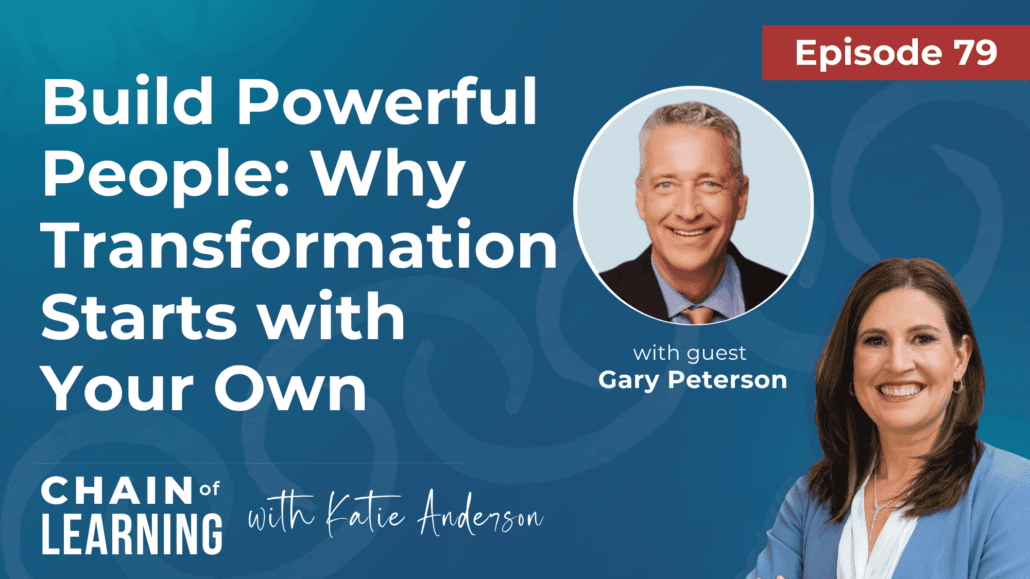





How do you build a people-first culture that gets lasting results?
On the Chain of Learning podcast, Katie Anderson talks with Gary Peterson, who spent more than 30 years building a people-first culture at OC Tanner.
His answer: stop cutting costs to chase efficiency and start building powerful people. Lasting results come when leaders create the conditions for their teams to grow, and that transformation starts with the leader.
Develop Yourself So You Can Help Others Develop
Efficiency and cost savings aren’t what make operational excellence sustainable. People are.
The leaders who create enduring, high-performing organizations are pursuing something beyond business results. They want people to leave work more capable, more confident, and more energized than when the day began. That’s the difference between a workplace that wears people down and one that develops people through people-centered leadership.
Gary Peterson spent more than 30 years helping build that kind of culture at OC Tanner led a remarkable culture transformation that earned the company the Shingo Prize. Yet the hardest part wasn’t creating systems or improving processes. It was his own leadership development — recognizing how, despite good intentions, he was sometimes getting in the way of the very growth and development he wanted to encourage.
Put people first, and the results follow.
And often, the most important transformation a leader can make is their own.
In this episode, you’ll learn:
✅ Why operational excellence only lasts when leaders focus on building people, not just cutting costs and eliminating waste
✅ Why the best leaders make an identity shift from being the expert with every answer to creating the conditions for others to solve problems
✅ What it takes to move managers from enforcers to coaches and make continuous improvement something your team never fears, even as roles and headcount shift
✅ How to influence real organizational change when you have no authority to make anyone follow
✅ Why so many leaders give up on culture change too soon, and how long it really takes
Listen Now to Chain of Learning!
Leadership transformation starts with self-reflection. Tune in to hear Gary Peterson’s honest journey of learning how to get out of the way so others can grow.
Watch the conversation
Watch the full conversation between me and Gary Peterson on YouTube.
About Gary Peterson

Gary Peterson is a respected manufacturing executive, advisor, and educator known for his people first approach to leadership and operational excellence.
With more than 38 years of experience, he has led transformative initiatives in supply chain, manufacturing, and continuous improvement while helping organizations build cultures rooted in empowerment, collaboration, and growth.
Gary previously served as Executive Vice President of Supply Chain and Manufacturing at O.C. Tanner and is widely recognized for guiding award-winning operational and cultural transformations. Today, he continues to mentor leaders, advise organizations, and share his expertise through consulting, speaking, and academic roles, driven by his passion for helping people and organizations become their best selves.
Reflect and Take Action
Gary genuinely cared about his people. He wanted them to succeed, grow, and do meaningful work. Yet despite those good intentions, he discovered that his habit of stepping in to solve problems was getting in the way of the very development he wanted for his team.
That insight can be difficult to see in ourselves.
Many of us care so deeply that we take on the thinking, the problem-solving, and the responsibility for others. We step in because we want to help. Yet when we do, we may unintentionally take away opportunities for ownership, learning, and growth.
The challenge isn’t caring less.
The challenge is learning how to redirect that care toward creating the conditions for others to think, learn, and discover their own answers.
The next time someone brings you a problem, pause before offering a solution.
Instead, get curious. Ask a question. Listen a little longer and create space for the other person to do the thinking before you step in.
Where might your caring be tipping into over-caring?
And what would it look like this week to support someone by stepping back just enough to let them own the thinking?
Important Links:
- Connect with Gary Peterson
- Follow me on LinkedIn
- Subscribe to my newsletter
- Check out my website for resources and working together
- Join us on the Japan Leadership Experience
- Episode 13 | 3 Ways to Break the Telling Habit® and Create Greater Impact
- Episode 44 | Master the Coaching Continuum and Become a Transformational Improvement Coach
- Episode 54 | The ROI of Elevating Strategic Positioning & Messaging for Lean Consultants
- Episode 57 | How GE CEO Larry Culp Leads with Lean to Build a Culture of Continuous Improvement
- Episode 71 | Own the Thinking Process, Not the Thinking: How Leaders Build Problem-Solving Capability
- Episode 77 | Lead with Joy: A Business Strategy for Success with Rich Sheridan
Listen Now to Chain of Learning
Listen now on your favorite podcast players such as Apple Podcasts, Spotify, and Audible. You can also listen to the audio of this episode on YouTube.
Timestamps:
03:44 – Why Toyota saw something different at OC Tanner
05:02 – The real purpose of operational excellence
07:19 – How Gary knew the culture was changing
09:00 – Creating people who change the world
10:13 – Leaving work with more energy
12:13 – The outcome every leader should want
13:07 – Two pillars that shaped the journey
14:26 – Breaking a culture of fear and control
15:35 – The five-minute habit that changed everything
17:15 – Redefining what it means to be a manager
19:12 – Why transformation takes longer than you think
20:05 – What to do when leaders don’t support the change
22:26 – The experiment that almost got shut down
23:22 – A CEO’s surprising admission
24:19 – Helping managers make the coaching shift
25:23 – When people outgrow their leaders
28:28 – Why improvement should never threaten jobs
30:23 – The manager who couldn’t stop yelling
32:23 – The leadership habit that destroys ownership
35:35 – Becoming the leader you never wanted to be
37:00 – The habit that was holding people back
38:01 – The executive behavior that shuts people down
40:07 – Proving your worth vs. creating conditions
42:40 – How to help leaders see what’s possible
45:37 – Showing results isn’t the same as showing people
47:07 – Why long-term thinking matters
49:53 – Where transformation really begins
51:16 – The question every leader should ask about their people
53:34 – When helping starts limiting growth
55:14 – The shift that made everything else possible
Full Episode Transcript
Gary: [00:00:00] We were able to move away from the manager being the specialist, the best at the job, and instead say, “Hey, the person closest to the job is the one best suited to make improvements to the job.” The manager’s job now becomes, uh, watching them problem solve, watching them work with their teammates and try to figure out, well, what else do you need from me to, to, to be able to be more creative in your problem-solving methodologies?
You know, can I teach you the improvement kata? Can I, can I teach you how to use data? And you seem to be a little frustrated. Let’s talk that through. I mean, all of a sudden, a whole new world of what managers needed to be.
Katie: Welcome to Chain of Learning, where the links of leadership and learning unite.
This is your connection for actionable strategies and practices to empower you to build a people-centered learning culture, get results, and expand your impact so that you and your team can leave a lasting legacy I’m your host and fellow learning enthusiast, Katie Anderson. Have you ever watched the [00:01:00] people at your organization walk out at the end of the day?
Are they leaving with more energy than they came in with, excited to be going home and to come back the next day? Or are they leaving exhausted, burnt out, like the day just took everything they had? We all want to be in the kind of workplaces where people, including ourselves, leave energized, where work lifts us up instead of dragging us down.
But too often, in service of deadlines and results, organizations drain people instead of energizing them, and sometimes without even meaning to. How we lead is part of that. So what would it take to build the opposite? A workplace that doesn’t just get results or focuses on efficiency only, but creates powerful people as the way to get there.
That’s the transformation that Gary Pedersen spent more than 30 years leading at OC Tanner, where he held leadership roles across manufacturing, marketing, and [00:02:00] operations, most recently as Executive Vice President of Supply Chain and Manufacturing. That people-first transformation earned OC Tanner the Shingo Prize, and Gary’s widely recognized for helping organizations build cultures rooted in empowerment, collaboration, and growth.
We started off exploring something Gary had recently shared with me earlier this year when we met for the first time in person at the Shingo Connect 2026 Conference. Jamie Bonini, the president of TSSC, the Toyota Production System Support Center, said that OC Tanner was one of the very few organizations that really gets what makes Toyota’s system work.
Most companies start operational improvements for cost or for efficiency, but OC Tanner understands that it’s about people first. I asked Gary to tell me more about that comment and what it means to him in his recent retirement from OC Tanner. Let’s dive in.
Gary: Well, you know, when, uh, when, when we first started working with TSSC, it was because we had taken [00:03:00] several stabs at standardized work, and, and because everything’s custom, uh, and all the cycle times are different, we, we could never figure it out And because we weren’t working to standardized work, uh, we were, we were missing a lot of opportunity for improvement.
We just couldn’t see abnormalities, you know, because we didn’t have that. And I was talking to Bruce Hamilton one day, and I was like, “Man, come out here and help, uh, you know, we’ve taken three runs of standardized work. I don’t know how to do this.” And, and he came out on the floor and he said, “Yeah, I can’t help you, but I know somebody who can.”
And so he, he sent me on to Jamie, and, uh, Jamie came out, and he spent a whole day with me, uh, walking around the facility, and it was really a test. He really wanted to make sure that are, are you the kind of leader, is this the kind of company who respects people, values people, uh, treats people the way we want them to be?
‘Cause I, I, I think they’ve got plenty of business. He, he’ll just turn [00:04:00] you down if you’re not a culture that behaves the right way. So it was very gratifying to have him work with us, and we worked together for, I don’t know, it was eight, eight years or something like that and, and fantastic relationship.
We became a showcase, uh, for Toyota. They came every year to do an annual review, and, uh, he came the last year in December. It was the last month of mine being at O.C. Tanner, and so it was kinda like a, “See you later,” you know? “Not so long.” Uh, but it was a great visit because it felt, it felt so, uh, Japanese and nazokashi.
It kinda felt like this turning back, this, this reminiscent of, of all the good times we had together. You know, bad times too. They took us to the wood shop several times. But, uh, I remember we were sitting, we were sitting, having our last session, and, uh, I prob- we probably had 15, 18 people in there from O.C.
Tanner. And, uh, we, we’d been talking all day and, and he said, “You know what?” [00:05:00] He, he made the most pivotal comment that, that I’d heard him make. He said that, uh, “A lot of people think that TPS is about efficiency, and it’s about, uh, making the business more profitable.” And he says, “It’s not. It’s all about helping employees thrive.
It’s all about helping people be their be- their best selves at work.” And then he looked at me and he said, “And you guys get that.” And I gotta tell you, I just got a chill just again when I said that. ‘Cause when he said it, it was like, wow. I mean, it’s, it’s nice to be seen that way, to be recognized that way.
You know, hats off to the people at OC Tanner for, uh, the great work they did i- in implementing, you know, the operational excellence, uh, the Tanner Operating System, so.
Katie: What a powerful comment from someone who’s so deeply immersed in the Toyota production system, the Toyota way. And that’s, and that’s so much of what I, [00:06:00] I try and help people see is that, of course, we want results, and we need to look at process.
You know, how, how are we doing the work and improving the work? But fundamentally, if it’s about people and people development and, and their contributions, and if we can unleash that, the rest will thrive. But if we don’t have that, we’re only gonna get short-term wins.
Gary: That’s right. You know, and, and, and we were, you know, we were making big gains, uh, in, in our efforts, and we started, what, 30, 35 years ago, uh, before, uh, the word lean had even been coined in The Machine That Changed the World, which is, you know…
I read that book and I was like, “This is what we’re talking about. You know, Toyota, this is it.” And, uh, the gentleman who took my place, Tolan Brown, as the executive vice president, uh, when I was interviewing him as a m- for a manager role, uh, to come in and be hired, uh, I’m– I quoted a line from The Machine That Changed the World to him.
And, uh, this is an [00:07:00] interview, and he said, “You know, I don’t… I think you’ve misinterpreted that. That’s not what it means.” And we had a debate in the interview about a line from The Machine That Changed the World. And, uh, he went home, and he told Jody, “I blew it. I blew it. I argued. I argued with the guy.” And I went home, and I told Lisa, “I found him.
I found, I found the next guy.” Yeah. You know, it’s like… But anyway, we were… You know, we’re, we’re doing lean way, way before, and it was, we were about seven years into the journey, and, and we were having lots of success, uh, lots of failure too. We were learning a ton. And, uh, I remember sitting in my office watching people go home at night.
I was, you know, I was waving at them and so forth, and it suddenly struck me how confident Uh, someone looked as they walked by. You know, it’s like, “I got the world by the tail, you know, and I’m gonna go home and, and, and make great things happen.” I was like, “Wow, look at that.” And then I noticed the next person had it.
It was [00:08:00] like all of a sudden I could see that everybody had kinda taken this big step up, and now I’m watching the second shift walk in, and I’m, I’m having the same experience. Okay, look what we… Look what’s happened. Everyone’s become powerful, and I realize that with these capabilities they had now, we weren’t just changing O.C.
Tanner anymore. I could see them walking out the door and going home and making things better i- in their families, in their schools, their communities, their churches. W- whatever the problem is, let’s fix it. You know, I can do it. I have the confidence. And, and I, that’s when I, I told my team, “What we’re doing here is bigger than operational excellence at O.C.
Tanner. Uh, we are, we are creating powerful people who will change the world.” And, and we started calling it our change… You know, we’re doing a change the world. And, uh, it kinda became a bigger… Is a mandate the right word? Kind of a, [00:09:00] a purpose.
Katie: Yeah, purpose, I’d say. Yeah. Well, it is a mandate, too, but one that’s felt with the heart.
Gary: Yeah. And so, so the whole idea of powerful people create, helping people be their best self became kind of the byword for, for everything we did.
Katie: I love that phrase, powerful people. It’s not like power, I’m gonna knock you down, but powerful, like energized inside of themselves. I’m thinking back to some of the recent conversations I had with John Shook, and he was talking about ye- yes, of course, we wanna transform organizations, but most importantly, think about all the individual transformation and how that has this ripple effect outside of the workplace for people’s individual lives, but also all the places that they touch as well.
And so truly, if we can create and lift up and generate powerful people, that’s how we’re gonna be able to really influence powerful change across the world.
Gary: Yeah. I, I, I love that. Those interviews with John, that, that was powerful stuff. Well done.
Katie: Oh, thank you.
Gary: Uh, take my hat off to him and to [00:10:00] you. Y- y- you know, when I was at O.C.
Tanner, I would ride the train into work, and, uh, walking through, you know, a 10-minute walk through a mostly blue-collar neighborhood at the end of the day, and I’d watch people coming home and getting out of their cars. Uh, they looked exhausted. They looked beat. They looked like they were at the end of their rope, and I was like That’s horrible, you know?
Why, why would their job do that to them? They, they’re kind of walking into the house bent over like, “Somebody save me. Somebody prop me up.” In contrast, you know, when I’m in one of the, in the, one of the conference rooms, uh, in our grand hall there, as everyone’s walking out at the end of the day, man, they’re, they’re, they’re, they look confident.
They look happy. They look, they look like they s- you know, we did something good today, and they, they look like they have more… You know, I wanna work at a place where people go home with more energy than they come with, you know, where, where work [00:11:00] actually is engaging and thrilling and, and exciting. Uh, I mean, I think that’s what we’re doing.
Katie: The words you’re using really align with how I talk about the difference between being revitalized versus extracted. You know, so, so much like, uh, the way lean has been used or continuous improvement’s been used by companies has been like, let’s extract the most out of our people and put in process, versus how do we revitalize the spirit and create vitality and energy?
And it’s interesting, when I go to Japan, you know, I, I continue to go back twice a year and live there. A word I hear that business leaders in Japan use about why they practice Kaizen or what we might call lean, even though they don’t have that word there, is, is they wanna revitalize the human spirit.
They wanna revitalize companies, industries, and community. And I, I, I… That energy is, is really in what you’re talking about, those powerful people leaving work with more energy than they came with.
Gary: You know, we became a, [00:12:00] a go-and-see site for McKinsey & Company be- Because of, you know, when people say, when their clients say to them, uh, “Hey, we wanna, we wanna figure out how to engage our people more,” they would say, “Well, let’s see if we can get you into the O.C.
Tanner factory.” And, and, uh, I’d walk their big clients out to the floor, and I’d say, “Go talk to people. Go talk to anybody you want to about anything you wanna ask them about.” Give them 10, 15 minutes to just go chat, and when they came back, they’d just be like, “Wow, this is amazing.” And, and the rest of the day, they were putty in our hands, you know?
It was like, you know, they were saying, “We– That’s what we want. We want people like that.” And I think that is the outcome that, that we’re all seeking.
Katie: I hope it’s the outcome we’re all seeking. It’s the outcome we all should be seeking.
Gary: Yeah.
Katie: I’m curious, Gary, you know, if you go back 30-ish years when you said you started this journey, what was it that originally drew you [00:13:00] towards putting in place some of the improvement systems?
And second question, when did something switch for you to really understand it was about people, not just the, the process outcomes that you were making?
Gary: So I had seen, I had seen a little VHS tape that Hewlett-Packard did in the ’70s on one piece flow and in, in my MBA school and operational class, and I…
It blew my mind because, uh, I mean, I thought that Batch was king. And here I’m seeing one piece flow, uh, not just faster, but more efficient and, and, and productive and good for people. I’m like, “Okay.” So knowing that the business, our, our orders were shrinking, and I knew how to fix that. I’d, I’d seen it. And even though I was a marketing guy, uh, I thought, “I can do that.”
Uh, and then I had an uncle, an unc- my uncle Dale, who, who used to work, he was the director of HR up at Crustese in, in Seattle area. I told him what I was doing, and he said to me, [00:14:00] uh, “Yeah, you can fix the operation like you’re talking about, but it’s really all about the people.” He caught my attention. I, I went up there to talk some more about him, to go see some of his factories and see what people were doing, and I realized, okay, I– we can get more out of people.
So that was kinda my two pillars, if you will. I didn’t realize that they were pillars, uh, at the time. But I, I banked on flow and people becoming stronger, and we started immediately changing both, training so that people could be more involved. We had a very, uh, top-down controlling culture. Manager was, you know, the king.
People just shut up and came to work. It was totally upside down and, and went to work on it. The biggest breakthrough we had I mean, I couldn’t even get people to speak. They were so afraid of the managers, the supervisors. Supervisors were there to enforce and intimidate. I mean, I don’t know. There’s a lot of fact– companies still like that, I think.[00:15:00]
I, I, I share that because people may think, “Well, you know, OC Tanner recognition company must have started from a really good place.” No, we did not. Uh, I don’t, I don’t, I don’t know that I’ve seen anything worse. It was clean So we did have that. I guess I have seen worse.
Katie: Sorry, yeah, that is, that’s good.
Start with the basic, yes.
Gary: I’ve seen some pretty filthy factories. Yeah, yeah. Uh, a few years into it even, people, team members still didn’t believe that they had any impact on quality or cost or safety. And, uh, so to help them kind of see that, we put some goals in place where as a team they had to work together to, to get improvements.
And, and they would sit down once a week with their manager for five minutes one-on-one and have a conversation about the results for that week. That became a huge catalyst for change. Totally accidental. Uh, I didn’t realize the power that comes [00:16:00] from a manager speaking one-on-one with somebody for five minutes every week.
Uh, six weeks into it, I could… You know, we had 1,400 people at the time. The managers had huge span of control, 100, 120 people, and it was ridiculous. No way you could have a personal relationship. No way you could connect, you know. But we were making them do it. I could feel the ice started to melt between management and people.
And I, I just, I just realized, you know, you can’t, you can’t talk to someone for five minutes every week for six weeks without finding some connections. You know, w- you fish, you have a dog, you have a cat, you, you, you have a daughter, you know. Whatever it is, it, it, uh, you can’t help but start to see each other more as human beings and, and less as objects.
And, and a manager realizing, “Uh, I’ve, I’ve never even heard you speak, and actually you’re pretty [00:17:00] smart, you know. Let me bounce this off of you.” That’s, that’s the whole new thing that starts to happen, and, and people starting to think, “Uh, my manager is a real person, you know. Uh, not as scary as I thought.
Uh, uh, I can joke around with them a little bit. Uh, maybe I’ll try an idea off them.” You know, it’s like, it’s like all of a sudden it started to, to, to melt. And, and a year later, the, the team members all could see that they did impact quality and, and cost and, and safety and so forth. So we stopped doing that, but we implemented our first system, coaching.
Uh, we just said, “Okay, from now on you will still talk to everybody. Not every week. Every other week is fine. And it’s gonna be 30 minutes, and it’s connection, and it’s helping them be their best selves, and it’s developing them.” And two things came out of that. One is connection. E- everyone just started rising up.
But two, a new standard for what it means to be a manager And instead of being the one who knows the process best and can [00:18:00] enforce things, uh, the manager became a, a person who can coach, who can talk, who can teach, who can mentor. And, uh, we just started raising the bar on, on what managers needed to be.
And as, and as that happened, uh, we were able to move away from the manager being the specialist, the best at the job, and instead say, “Hey, the person closest to the job is the one best suited to make improvements to the job.” The manager’s job now becomes, uh, watching them problem solve, watching them work with their teammates, and try to figure out, “What else do you need from me to, to, to be able to be more creative in your problem-solving methodologies?
You know, can I teach you the improvement kata? Can I, can I teach you, you know, any, uh, fishbone dia-? Can I teach you how to use data? And you seem to be a little frustrated. Let’s talk that through.” I mean, all of a sudden, a whole new world of what it means to be a manager. And that was our [00:19:00] first system, and I think it was the biggest, the biggest deal, the biggest thing we did.
Katie: About how long into your journey did this shift happen?
Gary: So that was, I’m gonna say in the first five years. Probably at about year four and year five is when, is when that started. So, so no surprise that two years later, at seven years, I’m noticing people become powerful.
Katie: What I really wanna highlight here for listeners is, like, this is a long journey that you’ve been on.
I mean, not short in the, in the grander scheme, but a lot of people expect these types of changes and– to happen in less than one year. And it’s about consistency, it’s about patience, it’s about showing up and ha-having that, that vision of where you’re going.
Gary: Yeah. You know, when I, when I– Usually, when I say four years, five years, seven years, nine years, 10 years, I get people going like, “Oh, I-” I, I don’t wanna take that long.
I’m like, “Well, I’m sorry.” But, but the fact is, I made– we made a lot of mistakes, so I mean, we, we could have [00:20:00] probably gone faster if, if we knew what we were doing. But we learned a lot too. Yeah.
Katie: Yeah. The learning comes through the mistakes, right? So, and I, I also wanna highlight, you were not the CEO at this time, like, when this was getting started, right?
Where were you in the organization, and how were you influencing this type of vision and change?
Gary: So I actually had no line authority. I, I had just been promoted to be a director of, of manufacturing, and, uh, was a change facilitator, basically. And our CEO handed me Schoenberger’s book, uh, World Class Manufacturing, but he’d never cracked it, ’cause inside that book, there’s a U-shaped cell.
There’s a picture of a U-shaped cell. And, uh, when I started, you know, taking processes and putting them together, he, he was not happy with me. And, uh, he… I, I constantly found myself in our CEO’s office trying to explain what I was doing. He asked about mini-factories. He asked about [00:21:00] flow of product. He asked about what, what is empowerment.
And, and, and often when we would experiment with flow, he would, he would come in and t- make me stop, take it apart, “Don’t do this anymore,” which was very frustrating. Um, so I, I share that not… And, and in the end, uh, he and I became very close friends, uh, as, uh, the outcomes we achieved, uh, together. I mean, despite the fact that he was pushing back against me and challenging me, he, he let me, he let me keep going And I have to acknowledge that.
Um, but I share it because, uh, you know, I hear a lot of people say, “Well, I can’t do it ’cause I don’t have executive support.” And, and I always say, “Well, you have a, a sphere where you have influence, and, and that sphere ought to be as powerful as you can make it. You know, make it a center of excellence, and rise those people up, and it will spread.”
And that’s kinda the way we did it.
Katie: [00:22:00] That’s great. I remember you telling this, a story at Shingo Connect, which was so great to finally meet, uh, in person, and talking about how the CEO is, like, basically, I think you used the word henchman, to come down and, like, shut that cell down. But, uh, it, you know … But, like, that’s, that’s such a visceral image and, and how great that somehow you were able to convince him to let you run that experiment and demonstrate its success, both from the business results, which sounds like maybe he was more focused on, and then from the thriving culture that you created.
Gary: I, I, I don’t know, but I think our controller, uh, was saying to the CEO, “Hey, s- there’s something going on that’s good for the books. Give him, give him some room.” And, and, and I think our CEO was just like, “Okay, but help me understand. I don’t get it, and I don’t like it.” So it was, it was just kind of a, kind of an interesting triangle where I think the, our, our controller was saying, “Let it go.”
And the CEO was like, “Let what go? What is going on?” And, uh, I, I don’t know if, if I told the end of the story that, uh, [00:23:00] he got called to be a mission president in Canada. He was gone for three years, and that was when we took apart all the departments.
Katie: You’re like, “It’s our time.”
Gary: Yeah. So when he came back, he came back as vice chair of the board.
When he came back, uh, he’s like, “Hey, tell me what’s going on.” I was like, “Ooh, boy. Hey, let’s go see it.” And, uh, he wasn’t much of a go to Gemba guy, but, um, I got him to go, and we spent an hour and a half just walking around the factory. He could see the engagement. He could see the people were solving problems using systemic thinking.
And, uh, at the end of that visit, he, he, he turned to me and he says, “You know what, Gary? This is really good. And, and if I’d been here, it never would’ve happened.”
Katie: Wow.
Gary: And for me, that was like, dude, that– You know, for the CEO to make himself vulnerable like that, I mean, that’s– I think [00:24:00] vulnerability is a huge part of success, uh, in this type of environment, and he d- he, he did it.
And, and anyway, we were really close from then on. Uh, he passed away a couple of years ago, but I appreciated that.
Katie: There’s so many things I wanna, so many directions I wanna go here. The two main questions right now are anchored in sort of that influence. So you, you talked about helping your managers make a shift from, they were these supervisors who were more, had to be more command and control, oversee in the process, and then now you’re asking them to be coaches and something different.
And then, so, like, what was– How, how did you help them make that shift from this more control-based leadership to more coaching and influence? And then I’m curious to follow up, what are some other things you’d recommend for trying to influence up to senior executives to give, at least allow that space? So let’s talk about the, the influencing down and helping leaders make that shift from command and control to, to more of a coach-like setting the conditions leadership.
Gary: Uh, the unfortunate [00:25:00] thing for us was because there wasn’t any message from above, my boss, the president of manufacturing, wasn’t supportive, and the CEO wasn’t supportive. There was nobody saying, “Hey, let’s do this.” And I, I think, I think in that environment, all the managers were kinda thinking, “This guy’s gonna burn out, you know, and, and when he’s gone, this all goes back.
We just, you know, we don’t have to worry about it.” They– And I told you I had no line authority over them. Uh, they, they were doing what I was telling them to do because I, I was making them do it. And then I kinda feel like I was kinda dragging them against their will. I’d like to go back and try it again, uh, be more patient, persuasive, teaching.
And I, I think in the end, what happened was the people were growing so fast, and they outpaced the managers. And the managers, all good people, but, but we, about half of them [00:26:00] were like, “You know what? I think I’ll, I think it’s time to retire. I think I’ll, I think I’ll just, I’ll just leave.” And they, they left on their own terms.
Uh, we lost half of them. And I was talking to, to Christian Hoborg out of Denmark, and he was telling me, “Man, we– Five years ago, we did a pharmaceutical firm. We didn’t lose a single manager I said, “How’d you do that?” Because I, I failed miserably. And he said, “One message. Everybody said the same thing. This is where we’re going.
Get on board.” Everybody had to figure it out. And so I think, I think the way we did it was unkind. I think it was unfair, um, to people. I never burned out. Um, I just, I w- I had, I just stuck to it, and I outlasted. So not… I don’t think it’s a great story for, you know, help, you know, helping the manager step up Every time one of them left, we replaced them with someone who had more of the skill set we were looking for.[00:27:00]
And we also, you know, once, once the gains started coming, uh, it was a mature product line, so it wasn’t growing. It wasn’t like I could use the efficiency gains to create more product or we’ve added new lines now. But we w- for about 10 years, we just didn’t hire. Uh, we just let attrition take its toll. The teams kind of made it a matter of, um, personal pride that, “Hey, when so and so retires in a year and a half, we’re gonna hit the same output without them.”
That’s kind of the way they approached us. We went from 1,400 people in that value stream down to 150-
Katie: What? …
Gary: people.
Katie: Wow.
Gary: We just didn’t, we just didn’t hire. Very… So, so efficiency… But, but here was, here was the point I was gonna make was, we, we actually held management at the same number of people. So I replaced every manager who retired with a new manager, and now the ratio is more like every manager has [00:28:00] 18 to 20 people, which is perfect for us.
Uh, they’re sitting down every day with one of those people, spending an hour coaching them, good use of their time. I think the ratio is better now, and we just, we kept the management. We used the gains we got to pay for, you know, a, a, a better balance of managers and people. Yeah, let the headcount just kinda slip away.
But now, now we have, uh, new value streams, we have new product. I left, I left manufacturing, um, about 18 years later, and I went to marketing and, and created a team where we were creating new products. And then I came back after Harold retired to be the executive VP, and, and, and now we have several different value streams making lots of different products.
So that’s, that’s healthy.
Katie: I love that you didn’t fire people. You let them choose. They opted in. I remember you telling the story of the woman who realized she can’t [00:29:00] stop yelling, and she, you know, she was at the end of her career anyway, and so she’s like, “You know what? It’s better for me to opt out.” And then just over time, knowing that you wanted to reduce the scope and scale as you were getting greater efficiencies through the process, but you weren’t firing people, just let the natural attrition.
And, uh, that real commitment to people, I’m sure, also gave your team members confidence that they were being cared for, and they w- you know, innovating wasn’t going to reduce their job. That was gonna just happen as part of the natural opt-in process or their natural course of their career.
Gary: You know, and I forget sometimes as I’m talking with other companies, uh, that there is that fear Uh, that improvements will lead to loss of my job or somebody’s job, because we never had that a-at O.C.
Tanner. So it’s not in my mind that that’s something I have to counter. But I, I think it’s, it’s critical that that’s never something someone considers, that somehow an improvement is bad [00:30:00] for me or bad for us. It always has to be whatever improvement we come up with is great. Everybody loves it. Um, it makes our job easier.
It creates more value for the client. That’s the way they’ve got to be talking. There can’t be any fear
Katie: No, the quickest thing for, to diminish any kind of engagement or ideas coming forward is, is fear or, you know, insecurity.
Gary: Yeah.
Katie: You were laughing when I, when I mentioned the woman who had said, “I can’t stop yelling.”
What… Go back to that conversation. What, what did you, what was that like, and what did you learn from that, um, about culture and about transformation and, and people?
Gary: She totally, she totally understood where we were going, that, uh, she was the first of the managers who, who thought, “Yes, let’s engage people.
Let’s let them be their own bosses and, and drive the work.” And, and, and she was my poster child for, uh, you know, she gets it. And she was very senior, so it was [00:31:00] good. And then she, then she said, “I’m gonna retire.” And I was like, “What? Why?” And then that’s when she told me, “Yeah, I have to retire. I can’t stop yelling at people.
I’m, I can’t do… I, I totally buy into what we’re, you’re trying to do here, and I can’t do it. I’m the wrong kinda leader.” I had never heard her yell. I didn’t know what it was. Um, uh, I talked to some of her people, and, and it was horrific. You know, it was like, um, uh, if there was a quality error, she’d, she’d find out about it in her office.
She’d get up and just start screaming. And, and as she walked towards the person, past everybody else, she was just yelling and, and denigrating them and, and talking about how stupid they are. And, and, and the whole point was for everyone to understand you don’t make mistakes. Mistakes will be penalized, and, and you should live in fear of making a mistake.
And, and I, [00:32:00] and I’m– Kudos to her for realizing that was anathema to, to what we were trying to do. I, I, I would have rather have hoped that she could have just stopped doing that.
Katie: Yeah, and stuck with making those, those changes. Because I believe we, we can, with intention, figure out how to overcome that initial impulse to blame or react.
Gary: In fact, to that point, uh, you know, when I first moved to manufacturing from marketing, I, I didn’t know anything about any of our processes. Um, but they made me a director, and I had an office, and my door said Director of Manufacturing. People just assumed that, “I don’t know who this guy is, but if he’s the director of manufacturing, he must know all the answers.”
And I had a lady from final assembly walk into my office with a tray full of product and put it in front of me and said, “What do I do with this?” And my first instinct was the wrong one. I started thinking, “Okay, think. Look at this. Figure it out. You [00:33:00] know, give her a good answer.” And I was looking at the product and it all looked good to me.
So I was like, “I… Well, what the…” Because she asked it, and I thought, “Wait a sec. She, she knows what– She knows enough to ask me. She probably knows what to do about it. Why is she even asking?” And so, so I asked her, “Well, what do you think you should do about it?” And she literally stepped out of my office and looked at the title on the door.
“Well, he’s a director.” And came back in and asked me the question again. I realized, okay, that’s, that’s what we’re fighting against here. And I said to myself, “I am not going to be the guy who knows how to answer that question. I’m not, I’m not gonna work to become the smartest at it. I’m gonna be the one who says, ‘You tell me.'”
And I intended to do that. About five years later, uh, the managers were all kind of disengaging. It’s like, what’s going on? You know, the team members were still rising up, but the managers weren’t. I, I, I finally brought in a, a psychologist, sociologist guy from one of the local universities [00:34:00] and had him just talk to people and, and I was paying him, and he’s hanging around for like a month.
I’m like, “Dude, do something,” you know? And, and then he comes into me and he says, “I’m done. I figured it out. I figured out what the problem is.” I said, “Well, what’s the problem?” He says, “It’s you.”
Katie: Whoa.
Gary: I said, “What do you mean it’s me?” He goes, “Yeah, y-you have… You are solving all the managers’ problems for them-
Katie: Hmm
Gary: and it’s disengaging them.” And I was like, “No, I’m not. I, I purposely was not gonna do that. What are you talking about?” He goes, “Oh, yeah, you are. And this is what we’re gonna do, Gary. I’m gonna walk around with you all day today. I’m gonna walk out on the floor just behind you to your left-” And every time a manager comes up to you with a problem and you take it off their plate, I am gonna kick you in the butt
Katie: How, how many times you get kicked in the butt?
Gary: I was like, “Wait a minute. Is this like a, a metaphysical thing?” Yeah. He said, “No, I am, I am literally gonna kick you.” Well, I, I, I was convinced I wasn’t doing it, so I thought, I’m in… I’m safe. [00:35:00] We walk out of the office. Within the first minute, uh, Ralph Sainsbury comes up to me, brilliant, brilliant manager, knows everything, and he, he shares this problem with me, and I have to catch myself because I was about to tell him what to do with it.
And instead I said, “Well, what do you think we should do, Ralph?” And he says, “I think maybe this.” I says, “Okay, you know, if that’s what you think, go do it.” He walked away, and Larry said to me, “Man, that was close. That was close.” I was like, okay, maybe, golly, maybe I am doing it. Maybe I have become what I hated.
Maybe I started doing… Maybe I became good enough that now my pride is showing up every day. I gotta prove myself or something. Literally walked around for hours, and it happened repeatedly, and I realized he, he was absolutely right. I had moved in the wrong direction and had become disempowering. And that was a huge wake-up call.
That was, um… I, I, [00:36:00] I’m so grateful to him for pointing that out. I’ve worked really hard ever since not to become that guy.
Katie: What a powerful story and experience. I, I, I personally had a, not the same situation, but very much a similar situation where I had an outside coach and she held up the mirror to me saying, “Katie, you’re, you’re jumping in and interrupting or sharing all your ideas.”
And I was like, “Oh, my God,” because I knew better, and I was coaching other leaders to do differently. I- and I’ve been reflecting. This is actually much of the focus of what the book I’m working on right now is about. We, we can care, but we’re not even aware how deep our, our habits run, and so we’re invisible to this, and it’s this time when we care.
You actually… Clearly you’re such a caring leader, but that caring flips us somehow into doing or owning or overstepping, and we end up carrying it all and then having the opposite impact that we actually want. And so my goal is to help other leaders see [00:37:00] this invisible, like, pull towards control and ownership, and we don’t even mean to be doing it.
I think that’s such a, such a great example there.
Gary: Well, I started to realize… And so now then I started watching everything I did, right? And everything I said, and, and it became very apparent to me that, I mean, I had become powerful enough, you know, I mean, title means something, and it should, um, that if I asked about something, it became the focus.
If I pointed at a result on the board and I, you know, I looked at a number, everyone would focus on that. And I just found out I had to be very careful, uh, about what I said and what I did And, and so when, you know, we would go visit every team every three months, and they’d report on their strategy deployment projects and what they’re working on and so forth.
And I told my, my 10 directors and vice presidents, “We’re gonna walk in there, and not one of you is going to make a [00:38:00] comment that shows how smart you are. Not one of you is gonna say something that, that, that says to them, ‘I…’ you know, ‘I get, I get this,’ because instead, you’re just gonna let them talk, and you’re gonna smile, and you’re gonna nod, and you’re gonna appreciate them.
You’re gonna say, ‘You guys are amazing,’ because they are. That’s all we’re gonna do. Um, we’re not gonna correct them. If there’s something that needs to be fixed, we can go back later, talk to the manager.” And, and so that was always our mentality when we went to the floor, was, uh, tell us the amazing things you’re doing.
And, and so teams just, they loved to have us there because we weren’t there to second-guess. We weren’t there to push against them. We weren’t there to challenge their thinking. I mean, they could do that to themselves. They can challenge each other’s thinking. The manager can help them challenge their thinking.
Uh, they don’t need executives out there doing that. I mean, I’ll challenge them on, you know, I’ll go and do Gemba assessments and make sure they’re, they’re using the systems correctly. They should know the five S’s. They should be able to give me an example of a [00:39:00] waste. They should be able to tell me about their metrics and, you know, their visual management.
That should all be up to date. I mean, that’s fair. But, you know, what are you working on? And then, and then challenge that thinking, that’s, that’s not any good in my mind for an executive to do.
Katie: No, it just shuts… again, just shuts it down. And, and then how are you coaching your managers to actually coach their team members?
You can talk to them offline about what did you see and how are, you know, how are you helping them? We, we jump in too much and just– To me, I, I think this is one of the most hidden reasons that we don’t truly have these flourishing, thriving, learning organizations because of these invisible habits that we have.
Some of them are more visible and more obvious, maybe with your, like, manager who is, like, yelling and, like, very explicitly creating a culture of not, you know, no psychological safety. But you’re showing up with the answers, we’re undermining the very thing you wanted to create.
Gary: Well, I wonder if, if the, the human being, that our natural tendency is to [00:40:00] try to prove our worth, try to show that we deserve to be in the leadership position or something like that.
I don’t know. But, but I think that all backfires i-if you’re trying to create, you know, a, a culture of operational excellence. So I didn’t spend any time trying to show how awesome I am, and yet somehow that’s what everyone thought You know, I mean, so it’s like, yeah, you, you don’t… If you have to prove it, if you have to show it, then I think you’re, you’re, you’re in the wrong, you’re making a mistake.
Katie: I, I’m, I’ve been reflecting on this a lot and, and I, I, in most of my own experience in talking with other leaders like yourself and Rich Sheridan and, and many others who’ve, who’ve had to make this shift, is that it’s, it’s truly an iden- like an identity shift from being the one with the answer, being, you know, seeing our, our self-worth and our identity as being that superstar in whatever capacity it is, to really, as you’ve described, you’re there to create the conditions for other people to [00:41:00] thrive and feel safe and contribute their ideas.
And if you can anchor on that, it can really help you hold back, right? I heard you say, like, you were just like, “Okay, I just, I just wanna repeat this mantra. Great work. What are your ideas? How are you thinking?” And now we have to practice each and every day because it’s such a, such a… Our habits are so strong, and that identity, that sense of identity is just so ingrained, I think, in how we were raised as in school and early careers.
So it’s not like we’re bad, it’s just that we have to work on it.
Gary: Well, and I, and I’m, you know, I’m grateful I had Larry to help me. Uh, you know, you mentioned Rich Sheridan. He mentioned taking, he take, took his daughter When he was, like, an executive and he asked her partway through the day or at the end of the day about his role, and she said, “Oh, I, I get what you do.
You, you tell people what to do. Uh, they come to you and they can’t do stuff unless you tell them,” or something like that. He was like-
Katie: I know. He’s like mind blown … ”
Gary: Is that what you got from watching me today?”
Katie: You, you and I were paying coaches, and his daughter did the same thing for [00:42:00] him, right? But yeah, I just, I just interviewed, uh, Rich, and he’s gonna be coming out in one of the episodes right before this podcast.
So for listeners, go back and you can hear Rich Sheridan share that experience as well. I think we… It’s important. We all have… Someone needs to hold up the mirror to us sometimes because we’re not aware. And it’s like we may have the heart, we have the, better intention, but it’s misaligned. I mean, my… one of my signature words in the kanji behind me, um, and I actually wanna ask you a question about your, your, um, Japanese scripts behind you, too.
My word is intention. Uh, it’s actually on my, my cup that my, my team mem-members made for me. But it’s, it’s around the strength of your heart and then what, what actions align with it. And so many leaders like yourself and, and others, we have the heart. We have that sense of purpose, but our actions are not necessarily aligned, and we’re just…
So how do we realign and create those habits that really, really make the impact that we wanna have? You know, I, I said I had the question about how to influence, like, up. If you were thinking back, like, I mean, so how lucky you were that your senior executive [00:43:00] stepped away for three years, so you had a little bit more free reign.
But if you reflect on that experience, what were some things that you were trying to do to influence him to either give you space to experiment or to, to come on board and, and… Because I think so many listeners are in that similar space. Like, how do I influence up as well to get the, quote-unquote, “buy-in” or support or at least space to try?
Gary: Well, you know, I put a, uh… One of the first things we did in terms of changing the way people were, were working, I, I put a little four-person cell together, and they did a one-piece flow with a kanban in between them. It definitely… It flowed at this pace of the slowest process. We hadn’t fixed any of the processes yet, and so it wasn’t very efficient.
It didn’t look efficient. But they were doing one-piece flow, so it was… the quality was off the charts, and the rest of the factory had awful quality. And so, in fact, this four-person cell was working at a fraction of the pace of the rest of the factory. It was more efficient Than the rest of the factory.[00:44:00]
They were slowing down, you know, to get better, to get smarter. The data was obvious, and I should have brought everybody over to show it to them and talked it through it, you know, and, and not just talked about it, but, but talked with people about it. Because what if I, what if I had taken the CEO’s henchman over there, then he could have talked to the CEO.
Let me tell you what I saw. Uh, this is what’s going on. Let me tell you what I saw on the faces of the people who were doing it. Uh, there’s something different here. There’s something big happening. I could have talked a lot more. I could have talked to my boss about it. And I, you know, I always felt like, golly, how come he didn’t have my back?
How come I didn’t engage him more? I should have been showing. Um, I was just kind of going at it kind of at a, kind of a lone wolf thing. I probably deserved all of the, uh, the kickback that I got. And, uh, so yeah, I think, you know, I mentioned if I go back, I’d, I’d try to be more, uh, [00:45:00] polite and… But, but maybe I’d also be more informative.
You know, maybe I’d teach more, help people see the impact, uh, ’cause I didn’t take anybody down there to see it. And then when– And then the cell that the CEO took apart, uh, that was also very cool. It was 15 people Everything before plating, and, uh, same result, very efficient, and the people were just… They loved it.
The people were having a good time. All of a sudden, work looked joyful. That’s what I should’ve brought people in, let them see, you know, “This is what’s happening. This is where we can go.” Uh, I, I should’ve spent more time doing that.
Katie: I hear from what you said before and just now, like, so demonstrate some impact, some real s-su- some success, and then bring people to go see.
So use that as, as the learning point, not just talking about it. When I was talking to Rich Sheridan, uh, a few weeks ago, before I went to Japan, he had told me about his involvement in the Tugboat Institute and, uh, Dave Wharton’s [00:46:00] book, Another Way, and in my– I read that on the plane coming back from Japan and saw so many parallels of what, uh, they’re calling, you know, evergreen companies with the concept of tree ring management that I talk about here, and so many of the companies that I take people to on my Japan leadership experience are actually these smaller, private held companies, multi-generational, have been around or have the vision to be around for over 100 years.
And I saw that O.C. Tanner is also recognized as one of the model evergreen companies. And, uh, I’m assuming, Gary, that you were instrumental in getting connected with the Tugboat Institute, and I’m really curious to hear, like, what appeals to you about those concepts in, in your leadership and we talk about lean in, in, in Dave Wharton’s book.
He tells us, talk about Kaizen, but it’s something more, and I feel like that’s truly what the essence of Japanese business management’s about as well. So I’d love to hear your perspective, especially ’cause you have also lived in Japan and have some perspective there.
Gary: I, I was not instrumental in- Oh … in getting us associated with, with Tugboat.
That [00:47:00] was our CEO, uh, previous to the current CEO, Dave Petersen, uh, who did that. A great vision on his part.
Katie: Okay.
Gary: He, he saw a-a-and read in and saw in Tugboat the things that we believed in, the things that, uh, we aspired to be and that we connected with and, uh, wanted to be associated with other companies like that.
We are, we are big believers in, in what Tugboat teaches, what they talk about. A-and I, I think there’s, there’s power in, in O.C. Tanner being a private company in that we don’t have the quarterly shareholder call. Uh, we don’t have to hit certain results every month. We can, we can take a longer view. We can, we can, we can figure out what is the best thing for the business this year.
We don’t have to worry about s- what someone else is going to say. Sure, we have a board that we’re accountable to. Sure, sure, we have to talk about what we’re doing, but as long as it makes sense, as long as it’s reasonable, you can [00:48:00] do the right thing for the business, the right thing for the customer, the right thing for the employees And I, I think a lot of companies who are dependent on shareholders or, or outside money, uh, people who are pushing them for results, they, they just don’t have that…
They don’t have that freedom. I, I believe that we are doing operational ef- efficiency the right way, and I think the problem with, uh, a lot of the money that flows into industry is it’s not doing operational excellence in the right way. It is, it is slashing and burning, and it’s, it’s, it’s just dragging what you can so that you can, you can reap a benefit and sell the company.
And I, uh, it’s very shortsighted, and it’s not good for people, and I don’t think it’s good for companies. So being part of a tugboat for us says that we are, you know, p- putting a stake in the sand saying, “We’re part of this type of mentality, this type of thinking, uh, that says you can run a business [00:49:00] in a way that’s good for everybody.”
I, I… We’re very pleased to be with them. We, we’ve had a lot of interactions with them. Very pleased to get the award last year. Ha- have, have hosted a tugboat at OC Tanner multiple times, and I love it when, uh, these business owners c- circle back with me afterwards, say, “Hey, I want to spend more time in your factory.”
I’m like, “Yes, I would love that. You know, let’s do that.”
Katie: That’s great. And, and, and you, and you said with- in your words really what this concept of, from traditional Japanese management, sanpo yoshi, which is goodness in three ways: goodness for customer, goodness for company w- employees, and goodness for the community.
And if we can have that, it gets back to the focus of building powerful people so that we can make the world a better place. So I’m, I’m, I’m all for that, too. And, and not to… For, for people who are listening who are in companies that are very large and have shareholders, it is still possible. I mean, go back and listen to my conversations, uh, with Phil Wickler and with Larry Culp of GE Aerospace and how they’re [00:50:00] using these, these principles and mindset to lead a very large publicly held company.
So it is possible. It just there’s different constraints and challenges.
Gary: Yeah. No, absolutely. And I, you know, I, I love working with large companies, uh, who do have shareholder concerns. I still think the best way to approach it is the same way we’re talking about, and that is engage the people and get them solving the problems and, uh, see the operational excellence, uh, get better and better.
Katie: So as we wrap up, what’s your one piece of advice for, like, a leader who’s, you know, maybe come visit it or is listening to this, that they’re like, “Oh, this is, this is a better way,” or h- and believes maybe intellectually but it has… don’t know where to get started? What would your, be your piece of advice for a leader who wants to start leading this transformation and, and where it starts for themselves?
Gary: Yeah. I would suggest that they, they, they begin by looking at their heart. You know, “Why am I doing this? What do I want?” [00:51:00] And I really think it needs to be people, people-centric And, uh, you know, I started with the two pillars, the flow and the people. I think in the end, I came with, you know, let’s do what’s best to grow people, and the rest takes care of itself.
Now, moving to flow gave the people something to solve. It gave the people something to work on. It gave them something to focus on together and accomplish and allowed them to grow. So I think, I think doing a si– If I had to go and do it again, I, I would do it ex- that’s those same things. I have a list of fifty mistakes I’d, I’d not make next time.
Yeah, I would say, I would say think about your people. Do you, do you trust your people? Do you like your people? Do you care about your people? Do you see your people as, as each– the wonderful individuals that they are, so unique, so different from each other, and that is all good. Uh, part of, part of the strength at O.C.
[00:52:00] Tanner is, is the diversity of thought, the diversity of, of ways of being, of different people working together to solve problems. So my challenge would be to, to do that, to s- to see people as they really are.
Katie: Oh, that’s beautiful. And my last question, ’cause I forgot to ask earlier, w- tell me one of y- the, the Japanese scripts behind you, what it says and what it, what it means.
So for those of you who are listening, you can go onto the website for this episode or go to the YouTube channel, and you can see Gary’s in my background. So what is, um, what’s one of the ones behind you, and what does it mean to you?
Gary: Um, so I, I am, uh, forty years removed from, from living in, in Japan, and, uh, I don’t, I don’t s- I, I have a tough time speaking the language, and, and reading is even worse.
I, I’m pretty sure, though, that that one in the middle is love. You know, the, the, the heart, the family, the home represented in, in, in the three different pieces of the kanji there. That’s, that’s [00:53:00] really important to me.
Katie: That’s– It all gets back to the heart, right? Yeah. So- And the heart- Yeah, the heart is right there
is right there. Well, thank you, Gary. Uh, there’s so much more we could talk about. I’m excited for the book, book you’re working on with Peter Hines and Sarah Jekyll and to learn more about that. And when that comes out, I’ll be, of course, um, spreading the word. And thank you for, you know, making connection, leading with the heart, and sharing your insights here on Chain of Learning.
Gary: Thanks, Katie. Always a pleasure. I’m so glad that, that we’re connected now, and I look forward to your new book.
Katie: Thank you. Likewise. As I reflect on this conversation with Gary, there are so many powerful insights that he shared about how to lead change, influence team members and senior leaders, and the habits that can get in our way of achieving the impact we really want.
I love Gary’s final comments, that it all comes back to the heart, and this is what I firmly believe as well. Believing in people, their capabilities, and who they are as individuals, and building on both real human connection with our team members [00:54:00] and creating the conditions that allow them to thrive, be lifted up, and leave work at the end of the day energized, revitalized, not depleted.
And as Gary shared here, and I’ve seen in my own experience and heard from countless other guests on this show, including Rich Sheridan most recently in episode seventy-seven, and Larry Culp, the CEO of GE Aerospace, in episode fifty-four, and probably you too, knowing our heart isn’t enough to realize the impact we want.
Gary cared. He had the right intention. He told himself he wasn’t gonna be a leader with all the answers. Yet he wasn’t aware of how strong his habit was of jumping in to solve his managers’ problems for them. As the consultant he brought in to help fix the organizational culture told him, he was the problem.
Gary was disempowering the very people he was trying to grow without even realizing it. He didn’t see it until someone held up the mirror. This [00:55:00] aha moment is the heart of what I’m exploring in the new book I’m working on right now. We care so much that we step in, and our caring becomes carrying the responsibility for everything.
We take on the thinking and the doing, and in doing so, take away ownership, growth, and purpose. The solution isn’t to care less. Caring from the heart is the foundation. It’s to redirect our caring to a new identity, from the one owning the thinking and the doing to creating the conditions for people to find their own answers.
That’s how you build powerful people. And that’s why I’d say the most important transformation that Gary led at O.C. Tanner wasn’t the work cells, it wasn’t the operating system, it wasn’t the culture, it was his own As you reflect on this conversation, ask yourself, where might your caring be tipping into over-caring?
And what would it look like this week to hold back by [00:56:00] showing up with curiosity and support and let someone else own the thinking? If you’d like some tips on how to do this with intention, go back and check out episode thirteen on three ways to break the telling habit, episode forty-four on how to master the coaching continuum, and episode seventy-one about how to own the thinking process, not the thinking.
If you’ve enjoyed this episode and gotten value from Chain of Learning, I’d love for you to follow the show wherever you’re listening so you never miss an episode, and to leave a rating or review on Apple Podcasts, Spotify, YouTube, wherever you listen or watch. It helps connect the show with other leaders who could benefit and grows our Chain of Learning.
Thanks for being a link in my Chain of Learning today. I’ll see you next time. Have a great day.
Frequently Asked Questions
What does “building powerful people” mean?
Building powerful people means developing a team that grows more capable, confident, and energized over time, instead of depending on the leader for every answer. For Gary Peterson, it meant creating a workplace where people leave each day with more energy than they came with. The business results follow from putting people first.
Why does a people-first transformation have to start with the leader?
Gary Peterson found that, without realizing it, he had become the expert who solved every problem, getting in his own team’s way. Real change asked him to transform how he led first, learning to step back and create the conditions for others to grow. In his words, he had moved in the wrong direction and become disempowering.
Does focusing on people come at the expense of business results?
No. Gary Peterson’s people-first approach at OC Tanner earned the Shingo Prize and a place in the AME Hall of Fame. The premise of the episode is that operational excellence lasts when you build people, not when you cut costs to chase efficiency. Put people first, and the results follow.
Subscribe to Chain of Learning
Be sure to subscribe or follow Chain of Learning on your favorite podcast player so you don’t miss an episode. And share this podcast with your friends and colleagues so we can all strengthen our Chain of Learning® – together.