




Why is my team resisting change when the workload hasn’t gone up?
Every change initiative lands on top of what people are already carrying. Managers can see what they are assigned. They can’t see the rest, which is why pushback gets labeled resistance when it’s really a lack of capacity.
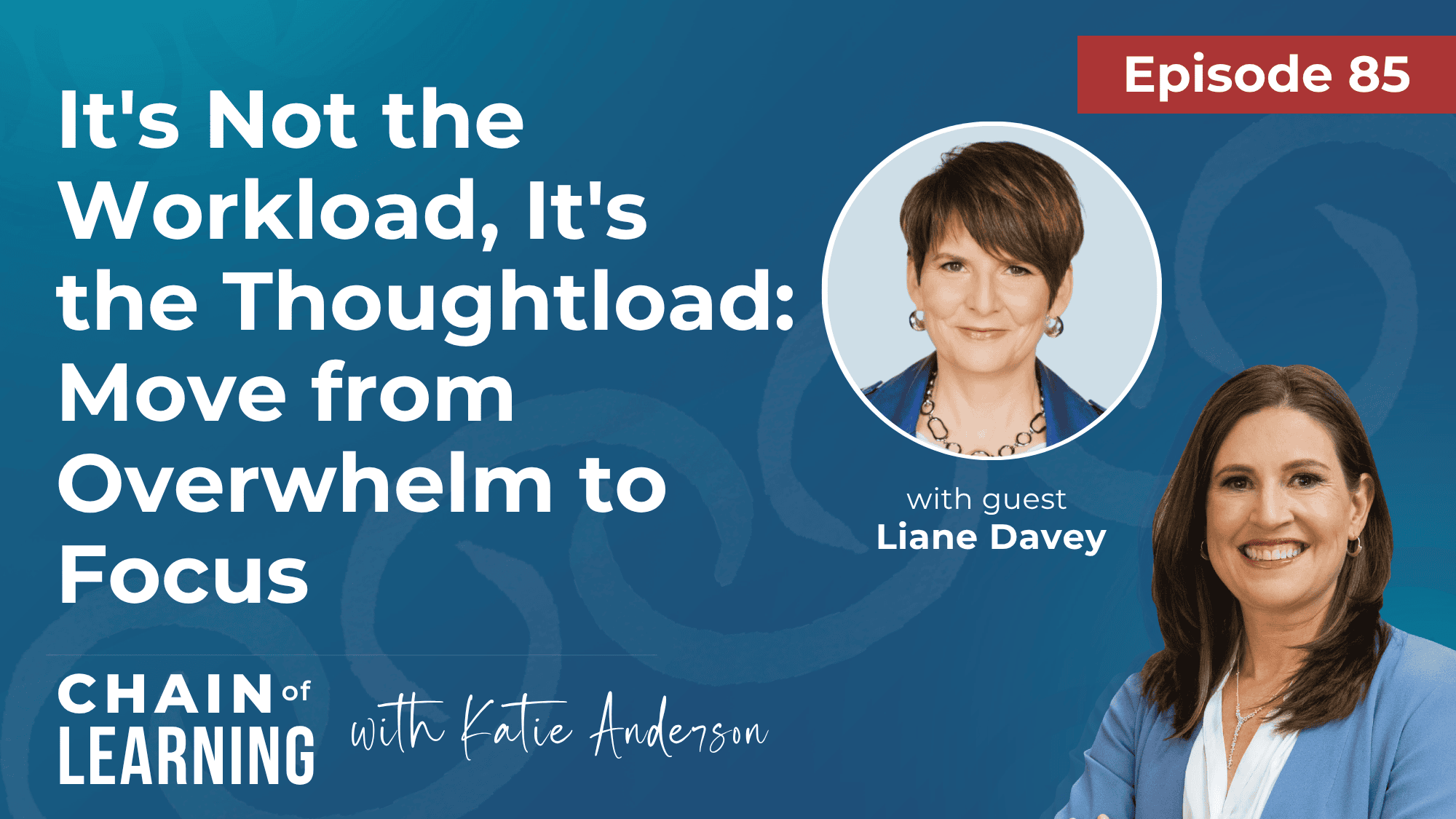
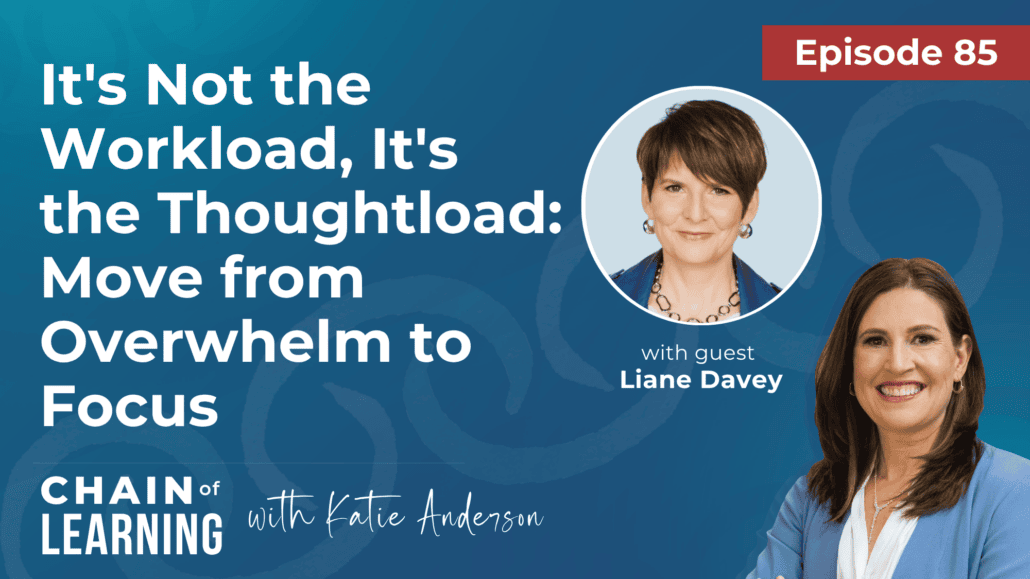
On this episode of Chain of Learning, Katie Anderson, transformational leadership consultant and author of Learning to Lead, Leading to Learn, talks with organizational psychologist Liane Davey about thoughtload — the invisible tax on our performance and presence that sits underneath the visible workload.
Book Giveaway – Thoughtload
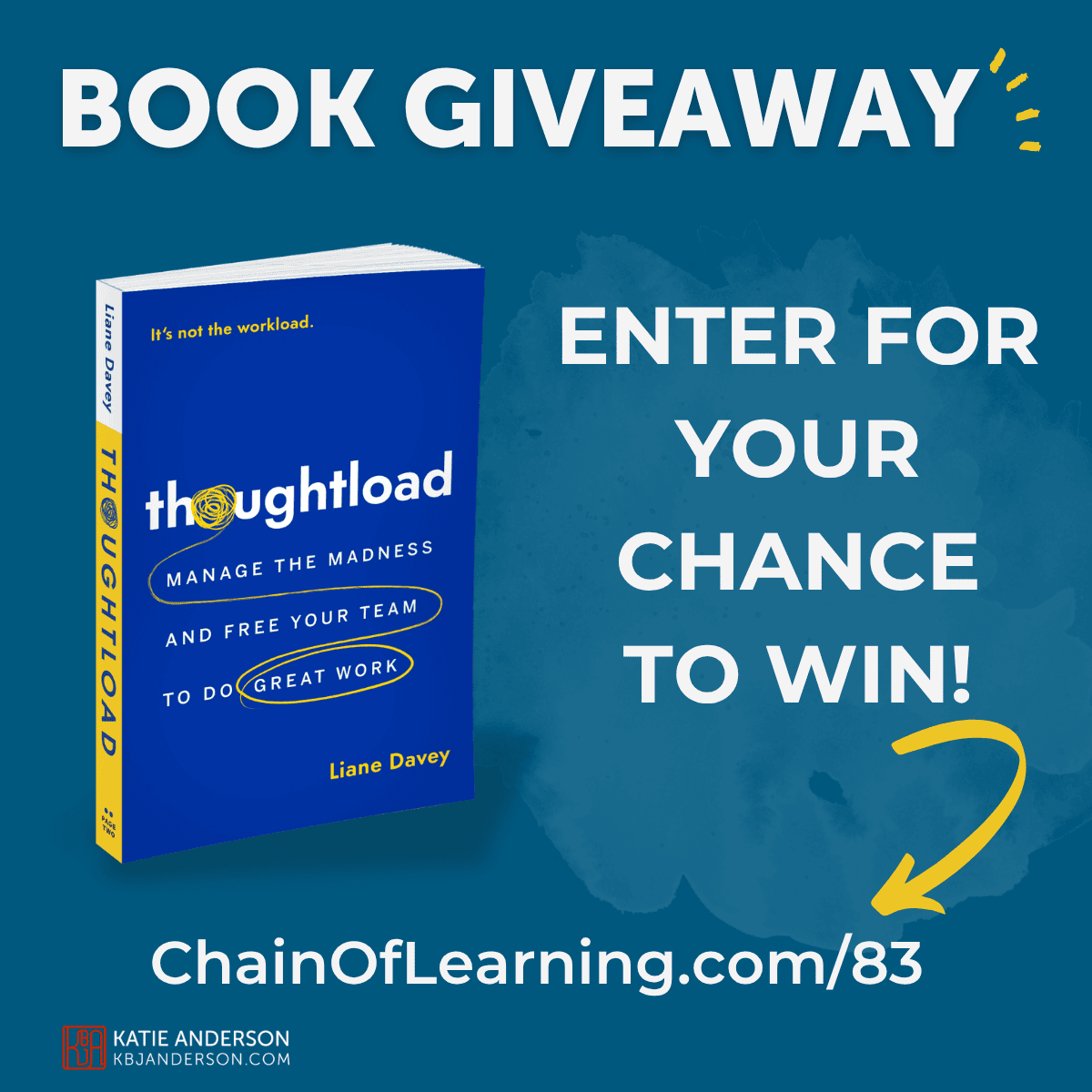
Liane Davey has generously donated copies of her new book, Thoughtload, for 3 lucky listeners of the Chain of Learning Podcast!
Thoughtload explores the invisible cognitive and emotional burden that can drain our attention, energy, and effectiveness. Liane offers practical strategies to help you focus on what matters, manage what you’re carrying, and create more capacity for yourself and your team.
Enter to win a copy! Register by October 9th at 11:45pm PT and be sure to share your lucky URL to increase your chances of winning.
The Invisible Workload We Bring to Leadership
Your team may not be resisting change. They may simply not have room for it.
It’s not only our workload that’s overwhelming us. It’s everything we’re carrying in our heads, what Liane Davey calls our “thoughtload”: the invisible weight of decisions, worries, complexity, and emotional demands that can drain our performance and presence.
Liane is an organizational psychologist who works with CEOs and executive teams navigating organizational transformation and change. In her latest book, she explores how decision fatigue, workplace overwhelm, and emotional weight can leave us feeling like there’s too much to do—and no space left to think.
And what we’re carrying doesn’t stay in one place. We bring our work worries home, and we bring what’s weighing on us into the next meeting. We can be physically present but mentally somewhere else, making it harder to focus on the people and problems right in front of us.
Liane shares practical ways to reduce your thoughtload: focus your attention, process what you’re carrying emotionally, and restore your energy.
Urgency, complexity, and the pressure to deliver aren’t going away. But we can get more intentional about what we’re carrying—and what might not be ours to carry—before workplace overwhelm becomes leadership burnout for us or our teams.
In this episode, you’ll learn:
✅ Why the person pushing back on your organizational change isn’t a resistor, and what is actually going on inside their brain
✅ Why we’ve become intolerant of iteration, and how to position a decision so that correcting course doesn’t land as flip-flopping
✅ How your team can be busy, productive, and still not moving toward the outcome
✅ How a heavy thoughtload keeps you from having a hard conversation, and how avoiding productive conflict makes your load heavier
✅ What it means to “metabolize your thoughtload”, and why filling every walk and commute with input leaves no room to think
Listen Now to Chain of Learning!
Tune in to discover what’s adding to your thoughtload, how it affects the way you lead, and practical ways to create more space to pause, think, and respond with intention—especially when the pressure is high.
Watch the conversation
Watch the full conversation between me and Liane Davey on YouTube.
 About Liane Davey – Author of “Thoughtload”

Dr. Liane Davey is an organizational psychologist and New York Times bestselling author who advises executive teams on strategy, decision-making, and team dynamics. She is co-founder of the firm 3COze and the author of The Good Fight and Thoughtload. Her doctoral research on how team dynamics affect innovation has shaped three decades of her work with senior leaders.
Reflect and Take Action – Thoughtload
What are you carrying that isn’t yours to carry?
Thoughtload gives us a word for something so many of us have been feeling but couldn’t quite describe. Start using the word thoughtload to make visible the invisible things going on for you and your team—and to help you reflect and make different choices.
When our thoughtload is high, we don’t feel like we have the space to pause, think, and reflect. We act more on reflex. We jump in and tell people what to do because it feels faster than asking questions and helping them work it out. And we can start taking on more ownership of doing and thinking than is ours to own.
As you go through your week:
- Notice what’s actually in your thoughtload. Not your to-do list or your calendar. What’s running in the background?
- Reflect on what’s yours to own. How much of what you’re carrying is actually yours? What are you holding onto that belongs to someone else?
- Make thoughtload visible with your team. Ask about one of the other hats someone is wearing and how it’s contributing to their thoughtload.
- Take something out of someone else’s thoughtload. What is one thing you could say out loud this week? It might be, “I’m not going to put that in your thoughtload right now.”
What are you holding onto that belongs to someone else?
Important Links:
- Connect with Liane Davey
- Liane’s book Thoughtload and resources
- Liane’s website
- Follow me on LinkedIn
- Subscribe to my newsletter
- Check out my website for resources and working together
- Join us on the Japan Leadership Experience
- Episode 71 | Own the Thinking Process, Not the Thinking: How Leaders Build Problem-Solving Capability
- Episode 83 | Keep Ownership at the Right Level: How to Sustain Organizational Transformation with Anna Pessah
Subscribe to Chain of Learning
Be sure to subscribe to Chain of Learning on your favorite podcast player so you can build high-performing cultures of continuous learning. And share this podcast with your friends and colleagues so we can all strengthen our Chain of Learning® – together.
Frequently Asked Questions
What is Thoughtload and how does it work?
Thoughtload is a concept developed by organizational psychologist and author Liane Davey, which refers to the mental burden that people carry at work, beyond just the physical workload. It represents the cumulative cognitive demands, emotional stress, and depleted energy reserves that affect how individuals and teams function. Instead of workload alone, it is this “thoughtload” – the mental clutter, emotional drain, and constant context-switching – that leads to distraction, burnout, and reduced productivity in the workplace.
How to reduce employee workload burnout
Liane Davey emphasizes that reducing employee burnout isn’t only about reducing workload; it’s about reducing the thoughtload created by competing demands on attention, emotional burdens, and depleted energy. Leaders can help by making those invisible demands visible and helping employees triage what deserves their attention, emotional investment, and energy—and what can be taken off their plate.
Why do employees resist organizational change?
Often they aren’t resisting at all. Liane Davey’s research-based view is that a change adds cognitive demand, emotional burden, and energy cost on top of everything a person is already carrying, and the brain reads unfamiliar territory as a possible threat to competence, credibility, or connection. Labeling that person a resistor misses what’s actually happening. Katie Anderson, transformational leadership consultant, points to the same pattern in her work with change leaders: what looks like pushback is usually a capacity problem, not a willingness problem.
What is conflict debt?
Conflict debt is the accumulation of necessary conversations a team keeps postponing. It’s a loop: when thoughtload is high, people avoid the hard conversation, and the avoided conversation adds to the thoughtload. Liane Davey’s book The Good Fight makes the case that productive tension is what keeps that debt from building.
Timestamps:
03:00 – Why it’s not the workload—it’s the thoughtload
06:00 – How thoughtload undermines team performance
08:00 – Why overwhelm shifts leaders from reflection to reaction
11:00 – Three ways to manage your thoughtload
12:00 – Why being productive doesn’t mean you’re effective
16:45 – The problem with having too many priorities
19:00 – How leaders can lighten their team’s thoughtload
20:45 – Why your brain needs space to process, not more input
23:00 – What change leaders miss about resistance
24:30 – Why labeling people “change resistors” gets it wrong
29:30 – How avoiding conflict makes your thoughtload heavier
32:30 – Why managing thoughtload means saying no to good things
36:15 – When changing direction is learning—not flip-flopping
37:25 – What deserves to be in your thoughtload?
Full Episode Transcript
Liane: [00:00:00] The emotional burden of a change is very, very high, and normally we immediately label somebody who resists as, you know, not a good team player, not on board, right? A resister. I’m like, no, that’s their brain telling them this is unknown territory. This might not be safe. This might threaten our, our competence.
It might threaten our credibility. Um, it might threaten our connection. Um, and so the person who is s- throwing on the brakes and having that reaction to change is somebody whose brain is trying to keep them safe, and so we gotta be way less quick to label that person as a change resister.
Katie: Welcome to Chain of Learning, where the links of leadership and learning unite.
This is your connection for actionable strategies and practices to empower you to build a people-centered learning culture, get results, and expand your impact so that you and your team can leave a lasting legacy I’m [00:01:00] your host and fellow learning enthusiast, Katie Anderson. What happens when the thing draining you or your team isn’t just the amount of work you have to do?
It’s what you’re carrying in your head. It’s tempting to blame your overwhelm on the long list of to-dos and action items, but underneath managing all the things you need to do sits that mental clutter, the emotional drain, and the constant switching from one thing to the next. You’re holding in your mind all the loose ends that need to be tied, the anxiety before a hard conversation, the frustration that’s still there after the meeting ends, the worry that something’s slipping through the cracks, and this is where performance breaks down, and it’s a big part of why so many people around us and ourselves are burning out.
Focus is split, patience is thin, and we have nothing left in the tank, and when we’re leading change or really in any of our roles, as a parent, a partner, a colleague, we aren’t only carrying [00:02:00] our mental load. We’re often holding onto theirs, too, their worries, their unfinished decisions, the problems they haven’t worked out yet.
So what’s actually weighing us down, and what can we do for ourselves and our teams to lighten it? To help explore this question, I invited Liane Davey to the show. Liane is an organizational psychologist and New York Times best-selling author who has spent more than 20 years advising executive teams on strategy and team dynamics.
She’s the co-founder of the firm Three COs and author of, “The Good Fight,” and the newly released book, “Thoughtload.” We started off a question exploring this challenge that Liane says it’s not the workload that’s really killing us, it’s the thoughtload. I asked her to take me back to when she landed on that insight and what she means by thoughtload.
Let’s dive in.
Liane: Yeah. So it, it was a very specific moment. I was giving a keynote in a hotel ballroom, and I had been taking folks through how you have to lead [00:03:00] differently in times of perpetual change, and somebody put up their hand and said, “Okay, but, you know, I don’t even know how to do this because the workload is killing me And I just thought about it for a sec, and it’s as if something, like, came from the universe through me and it just came out of my mouth.
It’s not the workload that’s killing you, it’s the thoughtload. And, and so that’s literally where it came from. And what I meant when I said it is the difference between the workload, the stuff we do that moves the needle on the outcomes we’re, we’re paid to create, versus the invisible tax on our performance that we’re paying all the rest of the time.
And, and unfortunately, the balance between our workload and our thoughtload is tipping further and further toward thoughtload. Um, so that’s what thoughtload is, an invisible tax on our performance. It comes from three places: rising cognitive demands, just how much we have to pay attention to, the [00:04:00] complexity, the decision fatigue, just the ugh Plus the emotional burdens, how frequently, um, things in the workplace these days or things at home are, are, you know, really feeling very emotionally invested.
So that’s kind of the load, and then carrying that load with declining energy reserves, and how some days we just don’t have any gas in the tank for it. So that’s where it came from. It all came kind of in this blinding flash of a moment on a stage, and that’s what it is.
Katie: I, I love the word ’cause it’s so, like, descriptive of, like, what we actually feel.
I was like, “Thoughtload. Oh, yes, that’s the- that’s what it is.” I’m like, I’m really good at doing all the tasks and prioritizing, but it’s like how to compartmentalize the thoughtload and really filter it so that we can be present in the moment that we need to be so that we’re not distracted or overwhelmed, and I…
It- it’s real. We were just talking before we, we recorded. Like, [00:05:00] you know, we have our per- personal life thoughtload, we have our professional life thoughtload, and all of it just can take up so much space.
Liane: And neither is respectful of any boundary between the two, right? Yeah, no. So you’re at home at night at the dinner table, and something weighing on you from the day, so you, all of a sudden you catch yourself and, and, and a family member has said something, and you’re like, “Oh, oh, sorry, what was that?”
‘Cause you’ve been carried away by the thoughtload of work. But equally as much, how often, how many times a day, a week, is something from home, from our home thoughtload, you know, weighing on us when we’re at work. So yeah, they’re very disrespectful of our boundaries. Our thoughtload comes with us everywhere we go.
Katie: Well, that’s some of the great things about your book, uh, “Thoughtload,” because it gives some really practical tips on sort of how to, how to start creating those boundaries or p- processing it for, for yourself. So we’ll dive into that a little bit more on this conversation. I’m curious, what are… You know, you work a lot with teams and team dynamics, and as you’ve been exploring this idea of thoughtload [00:06:00] with teams, what are you seeing is the impact on teams and team performance when thougtload is so high in addition to workload?
Liane: Okay, a few things. So the first one I would say is just people are less present, right? They just, their, their bodies are sitting in the room, but you’re like, “Hello?” Hello. Um, and because they’re less present, they tend to be less collaborative. So they’re like the hang-in-there kitty just trying to keep up with their own work.
So trying to stay abreast of what their colleagues are doing or be able to contribute to something that their colleagues are doing, that’s way too big an ask. Interestingly, ’cause my previous book was called, “The Good Fight,” and it was about the importance of productive conflict, I’m seeing the, the conflict go in one of two directions.
Either we’re getting into more and more conflict debt because we just… W- we can’t, we can’t even bear the thought of broaching an uncomfortable discussion, so we, we rack up this [00:07:00] conflict debt of things we need to be addressing that we aren’t, or we try to suppress this thing, sweep it under the rug, and at some point it becomes explosive.
And so the conflict becomes very unhealthy, very… So I think a high thoughtload is really detracting from our ability to have healthy conflict, making us less creative. So it’s like, look, here’s a playbook I’ve run before. You know, it worked then, and that’s really scary right now because not much of the world is the same as when you ran that playbook, so that’s a little alarming.
So, you know, a variety of things. I, I think what’s really interesting is we’re, overall teams are just becoming less effective. Um, they’re kind of doing more activity Maybe even being more productive, but the productivity is not leading to the outcomes. It’s sort of empty calories of productivity. So those are some of the things I’m seeing.
How about you? Like, what, what are you seeing? Where are you seeing it show up with your clients?
Katie: I, I see that for sure, what you described there, [00:08:00] too. But one of the things that I’ve, I, and I’m working on my next book as well, and one of the things about how we get reactive when we feel like this sense of urgency and there’s so much to do, and I really see that like, yes, it’s our workload, but it’s also our thoughtload.
When we feel like we’ve taken on the burden of all the thinking, all the doing, or maybe we haven’t addressed those conflicts or things, we then don’t… Then we get into that reactive space, a bit like let’s just do the old playbook, but I’m gonna just jump in and tell people what to do. I don’t have time to coach.
I don’t have time to do things, so we’re just kind of like running around, doing, doing, doing, and not creating the space or the conditions in our organizations to help other people take on ownership or thrive or solve a problem.
Liane: Yeah, so much more reflex and so much less reflect, right?It’s just like this reflex kind of response, um, very primal, as opposed to, “Okay, I’ve thought about that and I’ve thought about what this situation calls for or what this person calls for.”
Yeah, so much more of that. We are very reactive.
Katie: Yeah, and the, and just the burnout that [00:09:00] it feels when we’re, like, taking on the thoughtload of problems that aren’t, not truly ours to own, but we’re just, like, we’re starting to think about someone else has a problem, and now I’m taking on the ownership and I’m trying to solve it and do it, maybe ’cause I care, but then it’s also impacting my own capacity for managing my own thoughts.
Liane: Absolutely, and I’m gonna say that’s another one where that happens at work all the time, but boy, does it happen at home, right? So we’re raising the most socially anxious generation of children in history, and, you know, how often are we trying to make things easier for them by taking on their thoughtload, whether that’s cognitive or emotional thoughtload?
And it, first of all, it doesn’t work in raising children.Like, they have to learn how to manage their own thoughtload. But, but it really makes us so much less effective, right? So I’m with you there. Whether it’s a, a colleague who’s struggling and you’re trying to prop them up, a direct report, or of course somebody at home, you know, our thoughtload is high enough.
It’s really problematic if [00:10:00] we take on too much thoughtload on, on behalf of others.
Katie: I have a 12 and a 15-year-old, and really, with the 15-year-old, I am working, like, all the things I talk about and practice in my leadership world is, is, like, right there with, um, how do you keep ownership with the person? How do you guide them, but not take over?
Give them the space to fail. We can care about them, but, but not trying to solve their problems for them. So that’s, I mean, that’s the same in the workplace.
Liane: Yeah, and if we really care about them, do we want them, either a direct report or a kid, do we want them to be dependent? And, and so, y- you know, I, I think if we really care about them, we care about them in a, in a more holistic, more long-term way.
But of course, if you go back to high thoughtload, in the moment, feeling very reactive, you just wanna fix the problem. Fix it, make it go away, get it out of my thoughtload. And so that tends to cause us to take an expedient route that, uh, tends to be a sub-optimized choice.
Katie: Well, we… So we’ve talked about the challenges, and we all, I think everyone listening can relate to thoughtload.
Um, let’s, let’s [00:11:00] explore some of the things in your book that you ha- some of the practices that you’ve described that really can help leaders or anyone really manage some of their thoughtload, ’cause there’s some really great, great things in here.
Liane: Okay, so we’ll just say there’s three pieces of the puzzle.
So, um, learning to focus your distracted attention, learning to process your triggered emotions, and learning to restore your depleted energy. So those are the three things, and the book goes through each of the three, both for yourself and then for how do you lead a team in a way. But, but if I, if I were to pick a couple of things out, one would be the starting point, which is we have all in our high thoughtload, crazy world, kind of lost sight of, of the prize.
So I think the best place to start is do some kind of reevaluation of how you’re spending your time and energy, and it takes looking at three different things. Activity separately from output, separate from outcomes, and so many of us get trapped into just, [00:12:00] you know, paying attention to activity. How much can I do?
Can I get through my inbox? Can I get to all the meetings? There’s a lot of activity, and if you pay attention to activity, all you become is busy and probably burned out. So the first shift we have to make is to, from activity to output. What do I need to actually produce? You know, what’s the, what’s the actual thing that I’m after here?
And which of these activities support that, and which of these activities do not? So that’s the first shift, and if we do that, we go from being busy to being productive. But unfortunately, productive is not as great as it sounds in a knowledge economy. Um, so we may be producing a lot, but the, the next question is, is it creating the outcomes, the changes in the world that we’re here to create?
So that might be changing the mix to higher margin products or reducing the cyber attacks on your company’s website or whatever your outcome is. What we wanna do is go from thinking about what are the [00:13:00] outputs and, and what makes us productive to what are the outcomes and what would make us effective.
And only if we can kind of get our eyes on the prize can we then start to say, which outputs have I been producing that aren’t moving the needle, that I can at least deprioritize if not totally delete? And which activities are really not helping me create the outputs that make a difference? So that’s one of the most important places.
And so the start of the book takes you through this really simple but important process of going from, you know, activity to outcomes and then looking at, uh, your life not as one long to-do list the length of your arm, but three different to-do lists, three different priority lists. One, the most important things, what’s the first, second, and third most valuable thing I can do to move my outcome?
That’s, that should be its own list. Not on the same list as the watch the compliance training video. A second list is how do I support other people in accomplishing their outcomes? And a third list [00:14:00] is what are the things I gotta do to keep the li- lights on, the side quests that, that you have to do. But when we have one long to-do list and we have a heavy thoughtload, we pull the wrong thing off the list.
We start our day with a bunch of that administrivia instead of starting it with something that will move the needle. So the book kind of takes you through this practice of figuring out the outcomes, um, figuring out these three different lists, then figuring out different slots in your calendar that you put list one into the really great high quality time, list two into second tier time, and that administrivia, put that, you know, in the time when you’ve got the attention span of a, of a goldfish, right?
So I think that’s, that’s an important place to start ’cause the whole world right now is after our attention In a way that, uh, is so unproductive, unhealthy, um, really, really bad for us. So I think the first thing is to kinda, uh, you know the metaphor I’ve been using lately? Been using Google Maps a [00:15:00] bit this, um…
And, and, you know, you get- you put in the place, you, you look for directions, you see the route, and then at some point sometimes y- you, you kinda scroll, right? You scroll off, and you’re like, “Oh, let me- what’s over here? What’s…” And you kinda, you kinda get way over. And Google has this wonderful thing, this little button that says recenter.
You just push the button, and you go, and it takes you back I feel like this exercise, and, um, on the Thoughtload website, uh, I, I have a whole worksheet and whatever to help you do it. It’s just like pushing your recenter button. I caught myself doing a whole bunch of activities that I’m not sure why or what they’re contributing to.
I need to push my little recenter button, reconnect to the outcome I’m here to create, the outputs that, that deliver it, and the activities that make a difference. So that’s kind of, that’s probably a good place to start.
Katie: That’s so powerful ’cause we can get so distracted, right? And carry so many things.
Although sometimes I find to re- to, like, free up my thoughtload, I do need to, like, just do [00:16:00] all the tasky things that… ‘Cause I’m like, they’re, like, hovering there. And so if I can just, like, say, “I’m gonna spend two hours and just knock all those tasks off,” then I have freed capacity to focus on the real priorities.
Um, I actually wanna build on that word priorities ’cause I know we, uh, we’ve both had talk about this, and, like, I always hear, like, “Oh, we need to work on our priorities,” right? And, like, there’s a list of, like, 50, 50 priorities at a company, you know, which means there’s nothing. Really, priority should be singular, although, you know, probably having a few key things in different areas is, is fine.
I’ve had to… I’m, I’m actually really been focusing on that for myself ’cause I can, I can chase all the different squirrels, and I love to be involved in so many things. But, like, this year, I’m clear on, like, the top three things, and it’s meaning I’m having to say no to some things I would love to say yes to.
Otherwise, I, my calendar’s gonna fill up, and then with the calendar filling up, my thoughtload’s gonna fill up even more as well.
Liane: And that sentence is so bang on, Katie. Uh, like, I think we think about our calendar filling up and don’t [00:17:00] realize that that equates to our thoughtload filling up, and not just to it filling up, but also to having no space to, to empty it and, and to process it.
Katie: Yeah, the creative time. How do you think about that word priority versus priorities?
Liane: So I love when I learned that priority existed in the English language for 500 years before the plural came in the 20th century. Um, so priority comes from the Latin priori. It means first, and you can’t have multiple firsts.
And I think what happened was we really diluted the meaning of the word when we started to use it to mean important. And you can have 50 important things, um, well, maybe not 50, but you can have a really long list of important things, but you cannot have, you know, 10 firsts. So it’s really important. And when, when folks tell me they’re struggling with a leader not being able to help them prioritize, I say, “Okay, stop asking them what’s important because they, they don’t know.
Their thoughtload’s too high. They haven’t figured it out. It’s all [00:18:00] important, and that’s not helpful.” So it’s much better to switch your question to what has to be done first. So in the book, I take you through a triage of, of how do you figure out what comes first, how do you prioritize your priority list, but that, to me, is the most important thing.
You can only have one thing in the number one slot, and if you want uh, the second priority that comes when you finish the first or the second priority that has less weight in a decision relative to the first. All of that is fine, but without order There is no prioritization. So if you’re a leader, uh, and you’re, you know, having a conversation with your folks about prioritization and there are not numbers attached, slots, you are not helping.
Katie: And then there’s the cognitive load of t- for people trying to decide, “Well, which do I put energy first?” and this trade-off there, too. It’s like if you can help them truly understand where the priority lies, then you remove the cognitive thoughtload of like, “Which one should I be spending my [00:19:00] time on?”
Liane: Exactly, and that’s a gift. Like, anything you can do for a family member, for a colleague, for a boss, for a direct report, anything you can do to, to lighten someone’s thoughtload, you will become the most popular person in town, right? Because all of us are just crushed under our thoughtload right now. So every time someone on my team does…
And, and of course, with, on our team, we talk about it that way. They’re like, “I’m not gonna let that in your thoughtload right now. I’m gonna take that away. I’ll bring it back,” y- you know, when you, y- you just become the most popular kid in town if you can reduce someone’s thoughtload.
Katie: I mean, as you were speaking, too, I’m, I was thinking about another way of, like, reducing thoughtload.
Something I notice that I get stressed about if I don’t know the loop has been closed, I’ve handed it off to someone, and I don’t know if they’ve res- like, actually taken it on, what, if they’re actioning it, and what the follow-up is. So, like, being able to have those k- clear c- like, clear loop communication of when things are gonna happen because then I feel like I’m still thinking about it or wonder- or [00:20:00] tracking it, and, and so I really work with my team to be very clear and specific, like, “I have that.
This is when it’s gonna come back,” so that we have… I’m not still holding on to, “Do I still need to own this? Do I need to follow up?” and all these things.
Liane: And I don’t need you to have the answer yet. I need to know that on Tuesday you’re gonna tell me where you’re at. Then I won’t think about it till Tuesday.
Katie: Another thing, too, I, we were, we were commenting on another post on, on LinkedIn, and I was… I think it was with Elizabeth Swan, who’s a good friend of mine. I’m excited that you both are speaking at, at the same TEDx event this fall.
Liane: I know.
Katie: Elizabeth and I both commented we’ve stopped listening to podcasts on our walks because we’re both working on our next book, and I, I like to read books and, and get input, but I also need that space.
And so, like, we tend to fill, feel like we need to have input all the time, which is then not allowing us to have that, like, space to sort through our thoughts.
Liane: Yeah, so the, the new thing, the new word that’s really helping me is the word metabolize.
Katie: Hmm.
Liane: So meta- we, we think about metabolism, so metabolism is [00:21:00] just a, a series of processes that allow us to extract nutrients and remove both waste and toxins to do three things, you know, create energy, fuel growth, and support repair, right?
That’s what metabolism is. And so we think about metabolizing our food. But if you are a knowledge worker, you know, one of the most important things we ingest is, you know, thoughts and feelings, right? Where is the time to metabolize those thoughts and feelings? And if you have input coming in all day It’s like if you never stop eating, right?
It’s like, when are you gonna actually digest this? Um, so if you have input all day, if you’re on that walk, which is a great time to metabolize your thoughtload, but you’re putting in a podcast, you are just putting more into an already full brain pantry and stuffing more in and not figuring out, like, [00:22:00] what was already in there that I haven’t y- you know, got the insight from yet?
What kinda scary stuff is in the back of the cupboard that needs to be cleaned out, right? So, um, that’s the big thing about taking that walk without the podcast or doing some form, and, and I really recommend at least three one-hour chunks a week of no input. So that may be when you go on your run. It may be when you’re on a long commute.
It may be… I, I’ve taken… come back to my, um, adult coloring book at night. So what- whatever it is that works for you, but we need to metabolize our thoughtload just as much as we need to metabolize the food we eat.
Katie: I love that metaphor and, or analogy to, to, like, digesting it and processing it. I think some of my best thinking comes when I have the space and there’s time for input and processing, but, uh, yeah, I need to process my, my own thoughts.
I actually wanna talk about, you… we’ve talked some about, like, leading change and leaders. Uh, a lot of my, my listeners are leading transformational change in [00:23:00] organizations, and how does a, a change add to someone’s thoughtload that maybe the person, like, out there in front leading the change never, never sees?
And, and ’cause I wanna– I’m asking this in part because of, like, this, “Oh, so people don’t have buy-in, and they’re not doing it,” and, like, I’m curious of your, your perspective on how this concept of thoughtload relates to leading change.
Liane: I think it is so directly right in the crosshairs of why we’re having a challenge in leading change.
So first of all, let’s think about the cognitive piece of thoughtload, right? So most people are expected to internalize a change while doing their regular job, right? So we’ve increased the amount they need to pay attention to. We’ve probably added a whole bunch of new emails or new processes or new whatever else.
Um, we’re increasing complexity because there’s novelty. They’re doing something a way they’ve never done it before. Um, we’re probably creating some level of decision fatigue. So we’re really upping the cognitive demands when asking someone [00:24:00] to do something novel, unfamiliar. We can’t… So the, the easiest thing we can do as a human is something that’s habit because we don’t need our frontal lobe online to, to do that.
A change means that no, no, we have to be deliberate about it. We’re in a new ERP. We have to find the new screen or the new page or whatever else. So first of all, I want change leaders to think about the cognitive demands and, and how do we simplify, how do we chunk those out? Of course, in addition, the emotional burden of a change is very, very high, and normally we immediately label somebody who resists as, you know, not a good team player, not on board, right?
A resister. I’m like, “No, that’s their brain telling them this is unknown territory. This might not be safe. This might threaten our, our competence. It might threaten our credibility. Um, it might threaten our connection.” Um, and so the person who is s- throwing on the brakes and having [00:25:00] that reaction to change is somebody whose brain is trying to keep them safe And so we gotta be way less quick to label that person as a change resister, um, and start having the empathy and the place to safely have a conversation about what s- you know, what’s this terrible story that the person is telling themselves about this change, to work it through.
So I think what we often do is we, we kind of encourage people to suppress that emotional reaction instead of working it through. So how do we think about the opportunities to surface those things, to interrogate them, um, and then to separate out… A big part of the book is the science of understanding we’re, we’re, we’re really poor at emotional literacy, understanding that a, an emotion is a pre-conscious physiological reaction that people can’t control.
But w- the feelings are these cognitive, conscious narratives that we place on top of the emotions to try and rationalize them. As a change leader, if you can [00:26:00] help, help people lean in and, and interrogate the emotion, learn from it, but prevent these narratives that are… That’s really important. So those are the first two pieces.
Of course, the third piece of the puzzle in thoughtload is about restoring depleted energy. And if I’m a change leader, I gotta realize I’m probably asking somebody to sprint a marathon, and that doesn’t work. So we know methods more like the agile product development methodology where we have sprint and rest and learn and reflect and sprint again, that those kinds of things are much more effective.
So thoughtload, I think, is an incredible tool for a change leader in, in assessing the situation differently, thinking about, what are the cognitive demands of this? What are the emotional burdens? What are the energy costs, but also inputs and outputs? Um, and, and if you can use that, you’re gonna manage a change process in a way that’s so much more digestible that it’ll allow people to metabolize the change, as opposed to what we’re getting [00:27:00] right now, which is just, like, “Too much.
No.” Right? Yeah. So I think it’s really directly related, and hopefully a really helpful tool for people trying to lead change. And bringing that emotional
Katie: side is, is really powerful in the workplace, ’cause we’ve been taught we shouldn’t have emotion in the workplace or talk about caring or what’s really going on here.
And, you know, as you explored in your first book, like, we have to be able to talk about conflict. We have to be able to talk about the challenges and the, the real emotional experiences that we’re having as human beings in the workplace. We’re not just like… Well, hopefully we’re not just robots doing, doing a task, but that’s the humanity we- Soon
Liane: enough.
Soon enough.
Katie: Yes, that’s the humanity we bring to the workplace. And so to, to acknowledge that and figure out more effective ways for us to, um, have those conversations and reveal emotions and feel safety in being able to do that as well is, uh, so important.
Liane: Yeah, and one of the things people might find interesting is I…
There was a study published in the UK recently that shows that men have more emotional episodes at work in a day than women.
Katie: Interesting.
Liane: Yeah. [00:28:00] Fascinating. But, but because they are frustration, anger, you know, impatience, all those sorts of things, like somehow they don’t get labeled as emotional, but they’re equally as disruptive to decision-making, to, uh, an effective team dynamic.
So we just all need to stop kidding ourselves that emotions aren’t in the workplace or don’t belong in the workplace. Emotions are in the human operating system. But what people are really talking about is the feelings and the drama and the false narratives and the fiction. I agree that that is really counterproductive at work, both for individual stress levels, but, and for the productivity of the team.
But the problem is, when we try and ignore the emotion, which is non-negotiable, that’s when we get the drama. So if we could realize that taking the data and the insight out of the emotion, working with it, is gonna be way less likely that we end up with the drama, and we’ve [00:29:00] just really got it backwards.
But, you know, it’s often the people who are, like, very much these hot-headed, you know, very much impetuous kind of people who are like, “There’s no place for emotion.” It’s like, um, um, mirror?
Katie: You’re being a bit emotional here.
Liane: Yeah. H-
Katie: how, what are some ways, and maybe this is going back to your, your previous book, “The Good Fight,” but about how, how leaders can start having more effective conversations bringing in, uh, you know, about overwhelm or what happens, or the emotions that are happening, or even conflict that they need to address, but they’re like, “Uh, let’s, uh, let’s just, like, keep moving on.
Let’s do the doing. Let’s not deal with it.”
Liane: Like do the doing, not feel the feeling. Yeah. Uh, so in The, in, “The Good Fight,” what I talk about is that, you know, we need to differentiate between healthy and unhealthy conflict. So healthy conflict is tension. So think about the stretch of having to look at a problem through a different stakeholder’s lens, or, um, y- you know, I’ve been trying to optimize this for finance, but if I, [00:30:00] you know, if I had to understand it, um, for how it plays out for marketing, I, I’m gonna come to a different answer.
So we want that tension. So it’s still uncomfortable, right? If you’re in finance and you’re having to really, you know- Give something to make sure that the answer is, you know, really optimal for the whole instead of just for you. It’s uncomfortable, it’s painful, but it’s painful kinda like yoga is painful, right?
You’re like, “Oh, I’m not sure that my leg goes that way.” But it’s a pain that makes us stronger, makes us more agile, versus the kind of conflict that is like a blister, which is the friction of you’re not listening, we’re going around the same problem for the third time, um, it’s dismissive, it chafes. So what we’re trying to do is get more tension and less friction.
So one of the things that’s a really practical exercise that’s in, “The Good Fight,” is an exercise to map out, what should those tensions feel like on this team? How should [00:31:00] finance and marketing be disagreeing with one another? And the more we understand that, the more we, we see that that’s a sign we’re doing it right, that discomfort, that’s good discomfort, the more likely we are to, to have people feel willing and psychologically safe in having those hard conversations.
So mapping out the productive tensions can be a great place to start. Um, and, and when you do that, when you feel like working through those things is the, you know, the right thing to do, then you move it out of your thoughtload. So right now I’m seeing a very strong link between when your thoughtload’s too high, you avoid the hard conversations.
When you avoid the hard conversations, the emotional and cognitive demands increase your thoughtload, and we go in the death spiral. So we really have to be willing to get out of conflict debt if we’re gonna keep our thoughtload down.
Katie: Yeah. I, and I- I just, as you’re talking, I, I, I relate to that feeling of like it’s building and building and building, or that sense of overwhelm, and you just start to be in [00:32:00] this vicious cycle and it’s like you have to have like a, a true like pause, a break, like break the cycle.
Okay, now let’s address it. I think it’s just easy to get in that down world. Like, I can’t, I can’t, I don’t even have time to address any of this. I just gotta keep going, and it’s, it’s no good.
Liane: No good. I always use the word it’s ungood.
Katie: It’s very, very, very ungood. Yeah.
Liane: So. Exactly.
Katie: Well, I, I find when I write books or speak about things, it’s because it’s something that I have had to practice and learn for myself.
And so I’m curious for you, Liane, what are some things that you have had to either give up or change or address for yourself, um, in managing thoughtload or conflict?
Liane: Yeah, well you… the conflict one is hard, but the, the, you alluded to one which is, right, you have to say no to things that would be really great to do.
That’s really hard. The FOMO is real. I, I think confronting your FOMO is probably the hardest part of managing your thoughtload. That’s, that’s really a big one. [00:33:00] And, and just even having that conversation with yourself to say that I’m gonna have to say no to some things that are worthy. I’m gonna have to say no to some people who I like or what
You know, it’s can I go for dinner with every person I know at a frequency that seems right? Probably not Probably not. Can I have that coffee chat with all the other authors or speakers out there who I would get so much from, it would be so interesting? No. Right? Um, but if I get clear on the outcome I’m trying to create, then can I select the dinners?
Can I select the coffee chats? Can I select the books I’m gonna read in a way that gets me the best outcome? But, you know, the FOMO is really hard. Yeah. Really hard.
Katie: I am a major FOMO person. Yeah. And especially right now, because I’ve really had to, like, I’ve said no to some events that I would really love to be at, ’cause I’m gonna see some great people in my network, [00:34:00] and I love going to conferences and talking to people, and all the social things.
But right now, if I’m going to write my book, I have to have protected time. So, you know, my book, my client activities, and my, my family have to be the top three filters. And if I’m not speaking at an event, I need to unfortunately not go this year. Um.
Liane: But that- Yeah … that’s a great, great example.
Katie: Yep.
Liane: Right?
Yeah. So if I’m speaking at it, then I know it’s contributing to building the platform so that my book succeeds when it comes out. Like, that’s, uh, that’s an activity that’s going to directly tie to the outcome you’re working on. So it’s, it’s a great way of doing it. And then once you’re clear on those filters, then it gets a lot easier, right?
If w- it’s if we don’t have them that then you come, “Oh, I’d really like to go to that event. That sounds amazing.” But, you know, when you’re clear, no, this year is about giving this book the best trajectory out of the gates as possible, and that’s about the quality of the content, so [00:35:00] things that I can do to make it better quality content.
It’s about building the audience for it. Um, and, and if I can do one of those two things, great, and if not, it has to be a no. Um. Yeah.
Katie: And I keep reminding myself, and I think this is important too, that choices can change. So I always say, well, not yet or not now. So not now, not this year, but next year I look forward to being there.
Or-
Liane: And next year you’ll have to be at every conference.
Katie: Yes, I hope to be at all the conferences. Yes. Watch out, world. Here comes Katie Anderson. Uh, and hopefully Liane and I will be at the same event so we can meet in person. Yeah.
Liane: We, we absolutely will. I know we will. Because, yeah, once you switch to that mode, then all of a sudden…
And then it, then when you’re in that mode, you’re like, “Oh, I’m not reading as many scientific papers as I would like to,” or whatever, ’cause now I’m in transmit mode. Um, yeah, but that’s, there’ll be a time and a place to, to go back, yeah.
Katie: Everything ebbs and flows in life as well. So we have to constantly be adjusting-
Liane: Right
Katie: and, like, reflecting too. Going back to s- a comment that you made [00:36:00] earlier, like, what has changed? Where do we need to adjust? Like, how do we reflect? You know, because what the Maybe the top priority or two that we made is, has adjust- has changed because our situation’s evolved. And so how do we have a process for that, too?
And in our gr- organizations and teams, how do we have a way of communicating that or assessing is that still the, the way we should be going so we can be aligned in, on that?
Liane: Exactly, and it’s interesting ’cause I’ve heard some… I think people are just so overwhelmed that I hear people say like, “Well, we’re flip-flopping,” or, “We’re changing.
Like, didn’t you s-…” And I was like, wow. Like, we’ve become really intolerant of iteration or of, like, learning and course correction. So as a leader, I think you have to be really careful to position things so that people are clear that this is a decision we’re gonna make, and it’s gonna hold for the next quarter.
A- and at the end of the quarter, we’re gonna reexamine it, and it’s possible we will make a different call. But, it, you know, we’ve… It’s so easy to label that as like, “Well, we’re flip-flopping,” or… I’m [00:37:00] like, “Uh, we’re learning.” But you have to position it up front that this, this decision has got a shelf life of a quarter or two, and then we’ll revisit it.
Katie: Right. There’s a process for, for that rather than feeling- Yeah … that the decision-making’s reactive.
Liane: Right. Exactly.
Katie: Well, as we wrap up, I always ask or I like to ask: What is one recommendation or piece of advice you have for listeners who are, you know, wanting to start manage their thoughtload with themselves personally and/or with their teams?
I,
Liane: I think it’s just use the word. Give the word to your team. Use it yourself. What I’m finding is that as soon as people have the word, they’re making different choices with it. It’s so interesting. And so use it and have the conversation with yourself and with others about what deserves to be in your thoughtload.
So what deserves your attention? What’s worth being emotionally invested in? [00:38:00] What is, uh, worth using, spending your energy on, and what isn’t? And so the… I think the biggest gift of the book is on the cover, right? And just that one, it’s not the workload, it’s the thoughtload. Um, and if, if we could just start using that word to understand where somebody else is at.
I, I have a icebreaker exercise called Many Hats, and it’s when you start a meeting to just say, “Okay, I know the hat that you officially wear on this team, but, but tell us one hat you’re wearing this week that we don’t know about.” Um, just a chance to say, “Look, there’s a lot of other stuff in my thoughtload.”
And so when you start to use that word, start to… Then you can say, “Let me help you triage, like, what we can take out of your thoughtload or, or when that deserves to be in.” So I think the biggest advice really is on the cover, um, and hopefully people will, will make use of that word to really validate not only their own experience of thoughtload, but other people’s as [00:39:00] well.
Katie: Super powerful. I really like the word thoughtload because it makes sense and is so descriptive of what we’re all experiencing. So I really appreciate you coming on to Chain of Learning, and, uh, look forward to many more great discussions. I’ll be putting the links in the show notes to the book and other ways to connect with you.
Uh, and congratulations on your TEDx talk that’s coming up as well.
Liane: Thanks so much, Katie, and I look forward to being at all sorts of conferences with you once your book is out.
Katie: Yes. thoughtload gives us a word for something so many of us have been feeling and couldn’t quite describe. As Liane suggested, start using the word thoughtload to reflect and make different choices.
Use it as a way to make visible the invisible things that are going on for ourselves and our team members. Say to someone on your team, “I’m not gonna put that in your thoughtload right now,” or ask about one of the other hats they’re wearing and how it’s contributing to theirs. There’s so much of this conversation that resonates with me.[00:40:00]
One line in particular that sticks out is how we’ve become habituated to acting on reflex and so much less on reflect. When our thoughtload is high, we don’t feel like we have the space to pause, to think, to reflect, and our reaction when we’re engaging with other people, we jump in and tell them what to do because it feels faster than helping ask questions and have them work it out.
We become reactive and start taking on more ownership of doing and thinking than is ours to own. And this challenge is really at the heart of the book that I’m currently writing. So much of what we’re carrying isn’t ours to carry, but it comes from a place of carrying, and that ends up taking on our thoughtload.
As you go through your week, reflect on some of the tips that Lianne and I both shared in this episode. Notice what’s actually in your thoughtload, not your to-do list or your calendar. What’s running in the background? How much of it is actually [00:41:00] yours to own, and what are you holding onto that belongs to someone else?
And then what is one thing that you could say out loud this week to take something out of someone else’s thoughtload? I’ve dropped the links to connect with Lianne and get her new book, “Thoughtload,” in the show notes. If you’ve enjoyed this episode, be sure to follow or subscribe now on your favorite podcast player and share the episode with your friends or colleagues so we can all strengthen our Chain of Learning together.
Thanks for being a link in my Chain of Learning today. I’ll see you next time. Have a great day.
Subscribe to Chain of Learning
Be sure to subscribe or follow Chain of Learning on your favorite podcast player so you don’t miss an episode. And share this podcast with your friends and colleagues so we can all strengthen our Chain of Learning® – together.