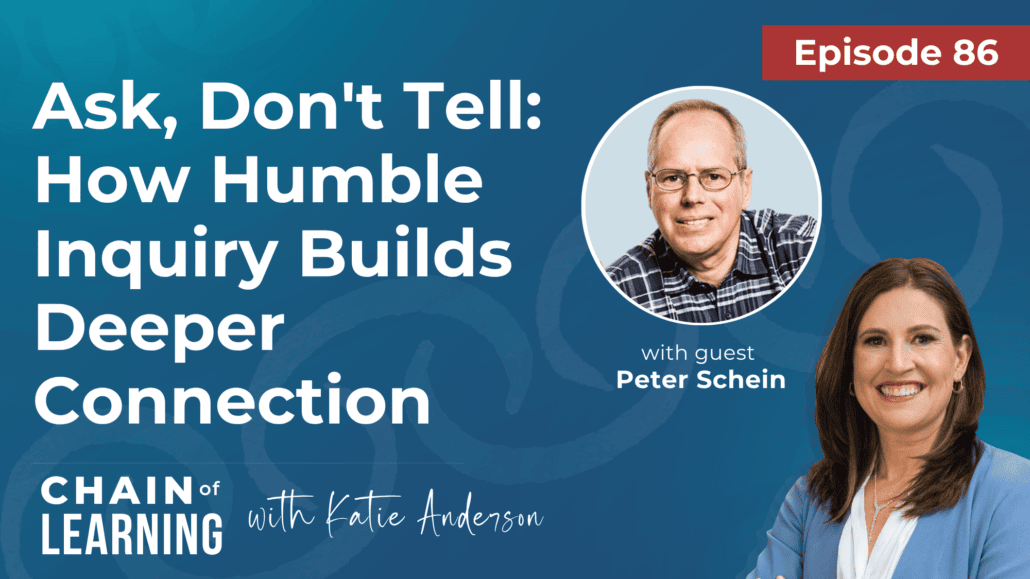





What is humble inquiry and how do leaders practice it?
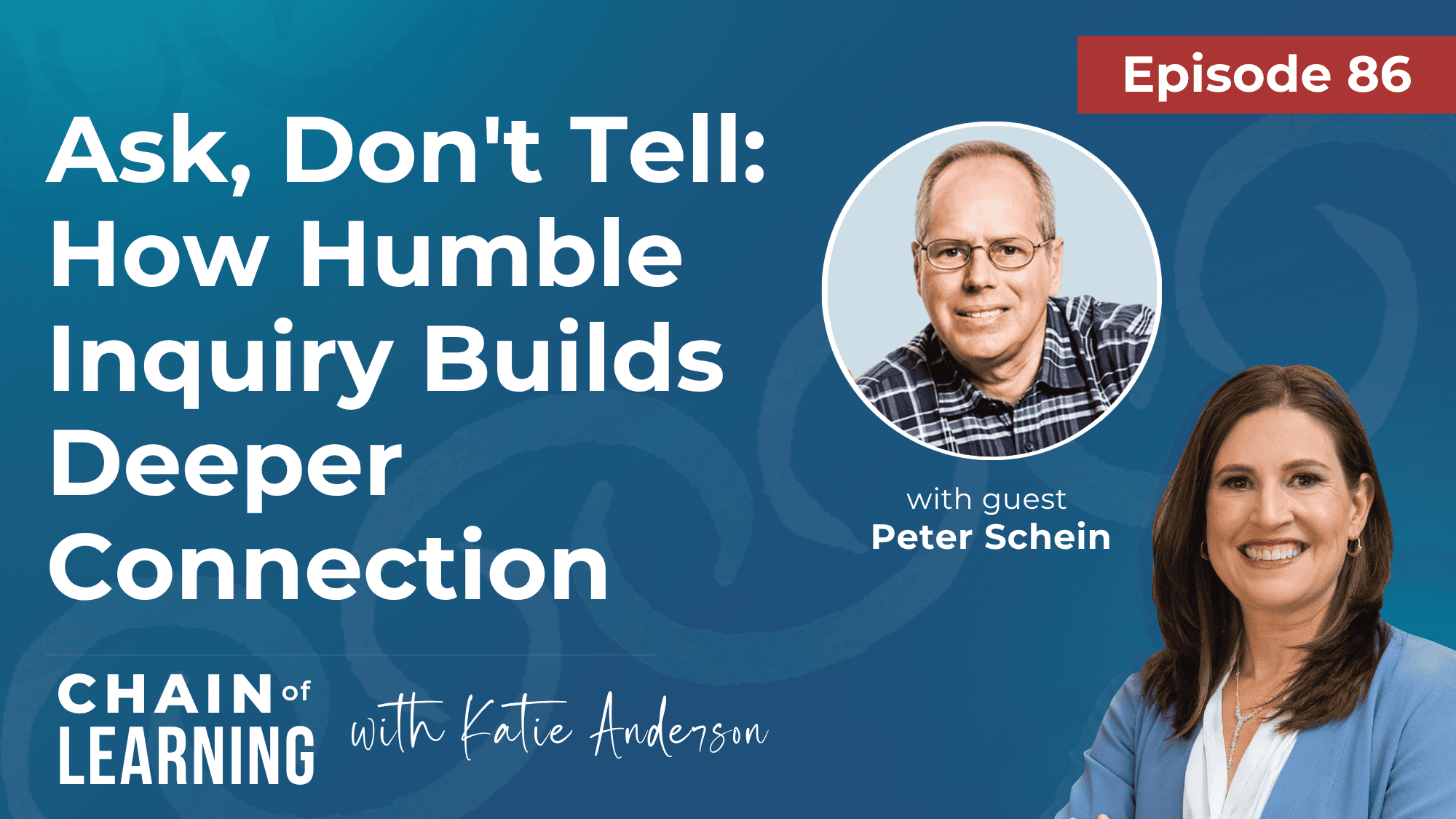
On Chain of Learning, Katie Anderson, transformational leadership consultant and author, talks with Peter Schein, co-founder of the Organizational Culture and Leadership Institute. Peter co-wrote Humble Leadership with his father, Edgar Schein, and has revised Humble Inquiry through its newest editions.
Humble inquiry means asking questions you truly don’t know the answer to, rather than leading someone toward an answer you already have. It is the foundation of building personal rather than transactional relationships at work.
The Leadership Shift from Having the Answers to Asking Better Questions
How do you build deeper human connection at work so that you can more effectively lead change, develop people, and help others?
That question sits at the heart of some of the most influential books in my work, including Helping and Humble Inquiry by Edgar Schein: how we help, not as the expert with all the answers, but by asking better questions as a leader and creating the conditions for other people to develop their own ideas, strengthen their problem-solving capability, and take ownership.
Edgar’s work has profoundly shaped how I think about leadership, learning, and helping. And in the later years of his life, his son Peter Schein became an important partner in continuing to develop and evolve these ideas of Humble Inquiry, humble leadership, and organizational culture.
Peter spent 30 years in Silicon Valley in corporate strategy and development before partnering with his father to co-write seven books. He recently released the third edition of Humble Inquiry, continuing to bring these foundational ideas forward for how leaders build relationships, create cultures of continuous learning, and lead change today.
In this episode of the Chain of Learning podcast, Peter and I explore how leaders can move beyond transactional relationships to build genuine personal ones and why human connection matters for organizational effectiveness and transformation. We get underneath the meaning of many of the words we use in leadership today — curiosity, vulnerability, and psychological safety — and what these concepts actually look like in practice.
In this episode, you’ll learn:
✅ Why “don’t bring me a problem, bring me a solution” teaches people not to speak up
✅ Why you’re most vulnerable when you don’t know what you’re missing
✅ How “Sharing the MIC” makes humble inquiry practical: Motivation, Intervention, Contribution
✅ The difference between helping as the expert with the answer and helping as the process consultant who creates the conditions
✅ Why going to see isn’t the same as transparency
Listen Now to Chain of Learning!
If your instinct as a leader is to have the answer, solve the problem, or jump in to help, this conversation will challenge you to rethink what being helpful really looks like and show you the power of asking instead of telling.
Watch the conversation
Watch the full conversation between me and Peter Schein on YouTube.
 About Peter Schein

Peter Schein is a strategy consultant in Silicon Valley and is the cofounder of the Organizational Culture and Leadership Institute (OCLI.org). Peter’s writing draws on over thirty years of industry experience in product marketing and corporate development at technology pioneers including Pacific Bell, Apple, Silicon Graphics, Inc., Packeteer (BlueCoat) and Sun Microsystems. Inc. (Oracle), with a focus on the underlying organizational culture challenges that growth engenders in innovation-driven enterprises.
He is the co-author of six books with Ed Schein including Organizational Culture and Leadership 5th Edition (2017), Humble Leadership (2018), The Corporate Culture Survival guide, 3rd Edition, Humble Inquiry 2nd Edition (2021), the upcoming release of Career Anchors Reimagined (2023), and the second edition and revised Humble Leadership (2023).
Peter was educated at Stanford University and Northwestern University, as well as the USC Marshall School of Business Center For Effective Organizations.
Reflect and Take Action
You don’t have to express vulnerability to be vulnerable. You are vulnerable to what you don’t know.
The people around you will always know things you don’t. They have visibility to ideas you don’t, the reality of what’s going on in the work that you don’t, and context you can’t see. If you don’t ask with open, humble inquiry, that information may never reach you.
As you go through your week:
- Notice how you’re showing up to help. How often are you giving your opinion or your great idea when you want to help?
- Ask open questions you genuinely don’t have the answer to. Hold the space for someone else to think through their problem and generate their ideas.
- Go see. Ask why. Show respect. Check in with people and check on the process. Seek to understand what’s actually happening.
- The next time you feel the urge to give your answer, pause. Reframe your idea as an open-ended question. One that doesn’t assume an answer.
- See what happens. See what you learn, and see what they come up with.
Where might your certainty be keeping you from seeing what you don’t know?
Important Links:
- Connect with Peter Schein on LinkedIn
- Learn more about the Organizational Culture and Leadership Institute
- Read Helping, Humble Inquiry, and Humble Leadership
- Follow me on LinkedIn
- Subscribe to my newsletter
- Check out my website for resources and working together
- Episode 13 | 3 Ways to Break the Telling Habit® and Create Greater Impact
- Episode 34 | Why Change Initiatives Fail (And What You Can Do) with Michael Bungay Stanier
- Episode 71 | Own the Thinking Process, Not the Thinking
Subscribe to Chain of Learning
Be sure to subscribe to Chain of Learning on your favorite podcast player so you can build high-performing cultures of continuous learning. And share this podcast with your friends and colleagues so we can all strengthen our Chain of Learning® – together.
Frequently Asked Questions
What is humble inquiry in simple terms?
According to Peter Schein, humble inquiry is asking questions you genuinely don’t know the answer to, with the intention of learning what the other person knows. It’s not asking questions to steer someone toward your answer or confirm what you already believe. It’s being open to the fact that other people know things you don’t, and drawing them out so that everyone has a fuller picture.
What are the key differences between transactional and relational leadership styles?
Transactional relationships keep people in their defined roles at professional distance, sharing only what the role requires. Personal, or relational, relationships mean people know enough about each other to adapt when something changes. Peter Schein explains that transactional relationships can look more efficient, right up until conditions shift and there is no resilience to draw on.
Who is Edgar Schein and what are his main contributions to organizational culture?
Edgar Schein was a pioneering organizational psychologist and longtime MIT professor whose work shaped the fields of organizational culture, leadership, and process consultation. Through influential books including Organizational Culture and Leadership, Process Consultation, Helping, and Humble Inquiry, he explored how leaders and consultants can create relationships where people openly share what they know and develop their own solutions, rather than relying on an expert to provide the answers.
Timestamps:
Timestamps
03:06 – Transactional vs. relational leadership—and why connection matters
08:10 – Why efficiency without relationships limits effectiveness
12:19 – When expertise gets in the way of seeing the bigger picture
16:24 – Why clarity matters more than certainty
20:31 – When curiosity, vulnerability, and psychological safety become buzzwords
22:08 – Why you’re vulnerable to what you don’t know
24:36 – What Humble Inquiry actually looks like in leadership
27:26 – How Humble Inquiry builds both trust and better information
28:35 – Why “bring me solutions, not problems” keeps people from speaking up
30:35 – How to “Share the MIC” and make Humble Inquiry practical
36:21 – Helping as the expert vs. helping as a process consultant
38:33 – How AI is changing where leaders and consultants add value
44:03 – Making invisible team dynamics visible
49:35 – Why being open to what you don’t know changes how you lead
52:26 – What going to Gemba teaches us about Humble Inquiry
54:29 – Why transparency and openness aren’t the same thing
Full Episode Transcript
Peter: [00:00:00] We’re using the words like vulnerability and curiosity, and maybe even psychological safety so much that they’re just becoming like gobbledygook that we don’t really fully embrace. You, you may be the smartest person in the room, but if there’s five other people in the room, there’s stuff they know that you don’t know.
So you are vulnerable to what you don’t know, even if you don’t feel like you’re touchy-feely vulnerable.
Katie: Welcome to Chain of Learning, where the links of leadership and learning unite. This is your connection for actionable strategies and practices to empower you to build a people-centered learning culture, get results, and expand your impact so that you and your team can leave a lasting legacy.
I’m your host and fellow learning enthusiast, Katie Anderson. What are some of the books and concepts that have influenced you the most? For me, two of the most transformational have been the work of Edgar Schein, including [00:01:00] two of his seminal books, “Helping and Humble Inquiry.” They have profoundly influenced my life and work, including so much of what I talk about here on the podcast.
How we keep ownership at the right level by owning the process, not the thinking. How we help, not as the expert with all the answers, but by asking questions humbly and creating the conditions for others to develop their own ideas. Along with my coach holding up the mirror to me and a lot of introspection, these concepts help me make simple but powerful shifts in how I show up to help, and how leading with humble, open inquiry is so much more powerful than leading as the expert with the answer.
It’s how I learned what I now call Break the Telling Habit. Edgar Schein was professor emeritus at MIT’s Sloan School of Management and is recognized as one of the founders in the field of organizational psychology. His work shaped how we understand organizational culture, process [00:02:00] consultation, and career development.
He was active professionally until he passed away in two thousand twenty-three at the age of ninety-four. And for many years after his retirement from MIT, he partnered with his son, Peter, including writing seven books together. Among them, Humble Leadership and updated editions of books like, “Humble Inquiry,” and the, “Corporate Culture Survival Guide.”
Peter Schein is the co-founder of the Organizational Culture and Leadership Institute. Before that, he spent thirty years in Silicon Valley as a strategy and corporate development executive at companies including Apple, Silicon Graphics, and Sun Microsystems. Peter studied anthropology at Stanford, my alma mater, and brings this lens to how he sees organizations and the people inside them.
I was delighted earlier this year to discover that Peter and I live fifteen minutes away from each other, and we’ve met up a few times locally. I was excited to invite him to Chain of Learning to share his insights that he’s gained from his partnership with his father and through his own work with [00:03:00] organizations.
We started off our conversation on a topic that’s close to both of our hearts: why human connection and relationships matter, both in our personal lives and for organizational effectiveness and transformation. And specifically, one of the concepts that runs through his father’s work and his own, transactional versus relational leadership.
I asked Peter the difference between the two and how he sees it showing up in organizations today. Let’s dive in.
Peter: You know, it’s interesting that you bring it up in those terms because I’ve often had to explain to people as– ’cause we, we have this four l-level model of relationships. Rather than getting too bogged down in what the different levels are, let’s start with that distinction between a transactional relationship, which tends to be, in our observation and definition of it, tends to be sort of arm’s length.
It’s characterized [00:04:00] by withholding information maybe more than sharing information. It’s characterized by people acting in their roles rather than acting as their whole human selves. And, um, there are many places in, in our world and in our economy where that’s entirely appropriate. But one thing that we’ve seen and learned out here in Silicon Valley, where the, the premium is on creation, on design, on innovation, is if everybody’s just staying in their roles and, uh, maintaining that professional distance, you know, this is what I do, that’s what you do.
We have an API between us, and we’re not gonna break the API. We’re just gonna maintain that, that transactional relationship. What happens when something breaks? Maybe not what you thought was the relationship, but something [00:05:00] outside of you changes, and you don’t ha– realize you don’t have any resiliency in that relationship.
You just have this two defined roles interacting as if they were, you know, AIs. What we really try to emphasize in going to that idea of the personal relationship is that you recognize that in, you know, in our life, you know, life and work are intertwined. We can pretend that we’re gonna leave the office and go home, but those worlds are connected.
There’s the, you know, we- we’re long past the, you know, the Mad Men days of, of separating home from work life. We’re connected twenty-four seven and spend a lot of time on our fully functional supercomputers in our pockets or our palms. So we have to recognize that our whole lives are a part of work, [00:06:00] and we benefit by allowing those lives to be connected to other people who will also share a part of what’s going on in their lives, so that when some crisis does come up, we know more about each other, we know enough about each other that we can adapt better.
Um, and it’s, it’s not, this is not some sort of fancy theory specific to, you know, innovation driven companies. This is just sort of, you know, human interaction, that if we feel closer personally because we’ve, you know, allowed people to, to see all sides of us, express a little, little bit of vulnerability, and also express a, a fair amount of empathy with another person who maybe is going through a tough time, and that could be professional, it could be personal.
The point is it benefits our relationship to be a little bit more personal [00:07:00] And maybe in some cases you don’t wanna take it too far, but that recognize that the value has shifted from transactional to personal. We are more successful more, if we’re more personal. We’re less successful if we try to maintain that, that strict transactional relationship.
Katie: I see that so much too. Actually, one of the… Uh, as you were talking, I was thinking back to one of the very first episodes I recorded here for Chain of Learning. I talked about the, this contrast of being and doing, is that often in organizations, in our work, we get so focused on the doing and the execution and what could be more of the transactional side, “You need to do this, I need to do that,” that when we forget about the being, which is more of that personal and the relational side, we actually are less effective.
And, you know, if only we define ourselves by, like, our name and our roles and the things that need to happen versus who we are as human beings, uh, I just feel like we don’t [00:08:00] get as much done as well, and it’s, we- we’re, we’re so much better if we can really hold precious what it means to be human and how we then work together.
Peter: Uh, you know, you said less effective, which is good, because it so often gets balanced against what’s more efficient, and transactional relationships can seem more efficient You know, we’re, we’re, we’re again, we’re sticking to that API. We’re not, you know, we’re not sort of wasting time on, on peripheral or ancillary facts or ideas or, or opinions.
Again, if everything is working along as it did yesterday, then maybe that is more efficient. But if something is different today, whichusually it is, something happens, uh, you don’t know what or where, where it came from, but something happens. And if you’re unable to sort of adapt in your relationship with people, you may be able to maintain efficiency within a bounded space, [00:09:00] but all of a sudden you’ve lost effectiveness outside of that bounded space.
Katie: That’s so important, uh, this distinction between efficiency and effectiveness, and I see this for a lot of people in the continuous improvement space as well as, like, we wanna get the project done and be efficient about it and improve, like, maybe the process efficiencies. But over time, we’re less effective ’cause we’re not building, you know, competency and capability and confidence within the organization to sustain and continue to grow, and that’s that relational side.
So if we’re just getting the project done, maybe that’s efficient in the short term, but not truly in the longer term. And so, like, how do we constantly… It’s not either/or. It’s how do we hold both together, be effective and efficient and relational, and get the job done at the same time?
Peter: I guess, you know, the other thing I’d say about transactional versus, versus personal is that at the end of the day, personal is more fun.
Katie: Yeah, that’s true.
Peter: mean, you want to enjoy work? Then get to know people. [00:10:00] Because they’re humans, too, and, you know.
Katie: Yeah.
Peter: You wanna just sort of do a good day’s work for a good day’s pay, then maintain your role, stay, stick in your lane, you know, be transactional and recognize that it’s just not gonna be as fulfilling We’re human.
Katie: Totally, and even in today’s world, you know, when the pandemic hit, we all went to online and remote, and a lot of organizations haven’t come back. But there’s still ways that we can be relational, even just, for example, right now, we’re in two separate places. Although I have to say, it has been more fun. So a side note, Peter and I realize we live less than 15 minutes away from each other, so we’ve gotten together in person a few times, which is, I have to say, has been a lot of fun.
And we can still, you know, get, get things done and figure out ways to find connections, um, either way.
Peter: And, you know, we would be doing this, you know, back at Rosatti’s Alpine Inn, but it- there’s just too many distractions there.
Katie: Yeah, it’s too noisy. Too noisy. Another time, I think maybe we’ll do one of our bonus episodes, [00:11:00] just like a, a in-in situ real time.
I’ll bring my microphones. That would, uh, that’d be a great follow-up, uh, for the podcast. Uh, well, speaking of the last time we got together, um, in the local, uh, beer garden for a chat in the afternoon, we… You were reading a copy or looking through a copy of my book, “Learning to Lead, Leading to Learn,” and, um, noting that you’d found a lot of connections in the stories from Toyota leader Isao Yoshino’s 40 years at Toyota and the work, um, of yourself and your, your fathers around humble leadership and humble inquiry.
So I- I’m curious to hear some of those things that you were seeing that connection between, in those concepts.
Peter: Yeah, I mean, I, I wanna bring one out immediately, and I actually don’t know if this was y- your framing on, on top of his, or if this was, this came out in your, in your discussion. But the discussion about the, the process of weaving.
The image is clear in my head. I’m not [00:12:00] sure I have the terms right, so fill me in on the terms again.
Katie: Yeah, so it’s the warp and the weft. So the warp are those, the strings that are laid down on a, a loom that are, like, stable and set in the beginning, and the weft threads are the ones that are interwoven.
And it’s this metaphor that I discovered in talking to Mr. Yoshino, but I took it another level in thinking about our purpose and how it’s the connection of the known and the discovered. So I- I’m curious of your, uh, what, what resonated with you on that.
Peter: Well, I, I mean, I think it did resonate, and it sort of echoed the, um- That polarity of content and context.
We get so focused on, in our work on being experts in a particular content area, which I guess are the, you know, those are the vertical fibers. You know, we live in a complex world, and having some s- very specific, um, probably fairly [00:13:00] structured knowledge is important. But if we’re so focused on that and we miss the crosscurrents, we, we miss the crossweave and don’t see that context, then we’re bound to make mistakes.
We can be expertise-driven. We can be full of diag- what we would call diagnostic inquiry, um, where we’re interrogating situations. You know, honestly, it’s a, it’s– there’s a fair amount, uh, of that in the A3 because the A3 is supposed to be social, but it’s, it’s fact-based, it’s, it’s research-based, it’s analytical.
And then the, the question is, do we end up being so seduced by that content that we don’t see The context. We don’t see the, the, the crosscurrents. We don’t see the, you know, the, the counter facts, the other [00:14:00] alternative facts, if you will. I hate that term because of where it came from, but it’s an important idea.
Uh, the, the other angles or just the, the, the deeper, broader human context. I mean, the thing that, that’s so amazing about, about, you know, Toyota Production System and, and the A3 process is that you do– you are required to get down deep in the analytics, but it forces you to, to, you know, to look at the horizon a little as well.
So that weaving to me is, um, it’s easy not to. It’s easy to get seduced into the, to the, to that specific content and then miss other cues that are in those, again, in those sort of crosscurrents, uh, or the weft. Um, now, I may be completely misinterpreting that [00:15:00] metaphor, but it worked for me.
Katie: Yeah. Well, I, I love that.
So that’s not– I didn’t use the metaphor for we– that the warp and the weft in that exact way in the book. I talked about your known and discovered parts of your, I guess, your purpose and your life tapestry. Yet, I think this concept of the interrelation of different elements and the weaving of different elements is r- can be applied in many different places, and I think that what you just said there about the content and the context, we always have to be looking at the interconnection between those two, and so you could really bring that metaphor to, to that problem-solving.
And for listeners who don’t know what an A3 is, although I, I believe, I imagine many of you do, it’s a structured problem-solving format that Toyota developed, and I actually have talked about it with John Shook on past episodes and in episode seventy-one talked about how our role is to own the thinking process, not the thinking, especially when coaching someone through, um, a structured problem-solving process like an A3.
But, uh, let’s explore [00:16:00] more of that, the difference between the content and the context. I wanna, I wanna go there ’cause I’ve heard you talk about this before, and I, um, um, love you to share with listeners as well.
Peter: Yeah. Well, I, I guess the, the one other, um, polarity I’d like to add to it, and we learned this from, uh, our friend Bob Johansen at the Institute for the Future.
This is quite a few years ago. Um, but the polarity still, I think, is even more relevant today than it was then. Is that, um, one of the risks of the A3 process is that you end up with this confirmation bias leading towards certainty about a flow or about a direction or about a, you know, a root cause, and that compulsion to sort of be certain and then structure our investigation or our, our inquiry around that need to be [00:17:00] certain.
And the contrast that Bob taught us is it’s much more important to seek clarity than it is to seek certainty, because clarity is open to what’s ever actually going on. Whereas certainty, our, you know, our need to be certain ends up meaning that confirmation bias allows us to disregard things because we don’t think they’re relevant.
Well, they may well be relevant, and so if you can be clear that they’re there, you may not have the answer exactly on how those other factors are creating disruption or cr- or creating some discontinuity in what you believed, but at least you… The clarity is you know they’re there, um, and you haven’t disregarded them because they were discontinuous with your concept of certainty.[00:18:00]
So seeking clarity over certainty, I think is a very important thing for us to be thinking about. And I guess the problem that, that a lot of us will struggle with is that you’re sort of saying, “Well, it was complex before, and now I’m gonna allow it to be even more complex.” Because I’m gonna say, “Yes, I know these other things are relevant.
I don’t know exactly how they’re, you know, impacting my root cause analysis, or they’re impacting, you know, my understanding of a, of a sequence of events.” But if you disregard them, the, you know, the odds of a Type II error, you know, as in, in those terms, go way up. Um, so, you know, as we’re thinking about error rates and safety, I would argue we’re– it’s– it may be statistically anomalous, but [00:19:00] if we’re disregarding some of those other factors And we’re, we’re not allowing us ourselves to be clear that those things are there and they’re influencing whatever it is that we’re studying.
Um, and we’re so, again, we’re so focused on our hypothesis that we miss stuff. That’s to me where error rates increase and, and risk increases and safety decreases. Uh,
Katie: 100%. If it’s how do we, instead of leading with certainty, how do we lead with curiosity and openness to the potential?
Peter: Exactly.
Katie: And then how do we, through that process of inquiry, and I wanna really get into concepts of humble inquiry and helping, ’cause they’ve been so fundamentally transformational for me in terms of how I think about leadership and parenting and life.
But if, if we can so lead with curiosity instead of certainty and then help others develop competence, confidence, and clarity, that’s what– that’s like the secret [00:20:00] sauce and to our organizations. And to me, that’s the whole process of, you know, coaching someone through a problem-solving process like in A3.
It’s like if we can instill that and have the outcomes being higher levels of competence, competent, uh, confidence and, and clarity, wow, we have so much. But it means that we have to let go of that certainty of going into it as well. So, um, yeah, a lot of, lot of dualities, but I c- that we have to hold in our, our mind.
Peter: You’re, you’re absolutely right to bring up curiosity. But I will tell you, Katie, I’m at this point now where I just worry that we’re using the words like vulnerability and curiosity and maybe even psychological safety so much that they’re just becoming like gobbledygook that we don’t really, we don’t really fully embrace.
Yes, I know. I know. I’m, I’m, I’m a, you know, I’ve been out of business school for five years, and I know to be a good leader I need to be curious Are [00:21:00] you really– I mean, are we really, really embracing what that means? Um, I know that psychological safety is important. Do we really– Are we really training people?
Are we really training ourselves to fully embrace what that means? Um, and so when we’re… A-a-again, it, it’s, it’s all over the literature. It’s all, you know, the, the, the biggest voices in this sort of rehumanizing organizations, people like Brené Brown and Amy Edmondson. It’s great stuff. It’s, um, you know, this is, this is exactly where people like my father wanted this industry, this world to go.
But we just– I, I’m worried that we’re, we’re sort of almost oversaturating those terms and not stepping back and saying, “Okay, what do we really mean by that? Um, what is it, you know, what does it really mean to be vulnerable?” [00:22:00] Well, d- is vulnerable, uh, does that mean that I am going to, you know, talk about my cat, or I’m gonna talk about my uncle who’s not well?
Our definition around vulnerable is it means you recognize there’s a bunch of stuff you don’t know, and you’re, you are vulnerable to what you don’t know. So if you do- if you wanna feel like, you know, I’m the toughest kinda hard-ass manager in my division, I’m not embracing this whole vulnerability thing Well, you may not feel emotionally, psychologically vulnerable, but I guarantee you, you are vulnerable to what you don’t know, and the room around you knows more than you do.
You, you may be the smartest person in the room, but there– If there’s five other people in the room, there’s stuff they know that you don’t know. So [00:23:00] you are vulnerable to what you don’t know, even if you don’t feel like you’re touchy-feely vulnerable. You know, this is a, you know, we live in a sort of data-driven decision-making world, and embrace vulnerability just in the fact that you should be out there, you know, trying to figure things out as much as you can, and you are vulnerable to what you don’t know.
Katie: I, I think that’s an interesting reframe too, Peter, because you’re actually, by not demonstrating vulnerability like that you actually are, are becoming more vulnerable because you’re closing yourself off to the things that you don’t know and that are now getting hidden in the room because you aren’t creating a sense of humility and curiosity and openness.
And so it’s, it’s sort of a ver– Well, in some ways, maybe being vulnerable is a virtuous cycle because if you open yourself up to say, “I don’t know what I don’t know,” you’re actually getting more information, and [00:24:00] so you’re actually less truly vulnerable to the potentiality of what that information is out there.
So that’s sort of a big meta. Well, yeah, let’s dive into humble inquiry.
Peter: Quickly to put a wrap on that, you know, you, you, you’re not showing weakness when you’re asking questions to learn more. I think there is this, this sense that if I’m out, I, I, you know, I’m in a tough group, I’m in a new, you know, new job, tough group or whatever, um, I need to, you know, I need to look tough.
I need to look like I’m on top of my game. I know what I’m talking about and whatever. But I don’t know. I got to say, some of the most powerful people that I work with, I had a 30-year career in Silicon Valley, were people who were sort of disarmingly quiet and would ask questions that I think deep down they didn’t know the answer to.
Because if they were asking questions that were just sort of [00:25:00] leading our responses to their conclusion, then it didn’t– wasn’t really getting them anywhere. Whereas if they were asking questions that they truly didn’t know the answer to and sort of expanding the information frame that we’re trying to make decisions in, then that idea became sort of the essence of what humble inquiry is.
It’s about trying to draw people out, trying to get those other people in the room to share what they know and what’s on their mind. If you set up a context, may- if you’re the manager and they’re– you, you’re with, you know, five other direct reports, and you don’t embrace the fact that they know stuff that you need to know, and you just sort of, um You know, keep them on their heels.
Um, maybe you’re a little intimidating. Maybe they don’t feel a little s- of that, that sense of psychological safety to share [00:26:00] information with you. Because again, you needed… You, you, you learned that you needed to be their boss. You didn’t wanna be vulnerable in that sense. But again, you are vulnerable to what they know that you don’t know.
The idea of being willing to ask questions that you truly don’t know the answer to, because then everybody’s gonna know more. That was where we wanted to get with humble inquiry.
Katie: It’s such a powerful, like, reframe in, in our mind about what, quote-unquote, “leadership” is. And I’ve had so many people on this podcast, like senior executives, talk about the shift they had to make.
Larry Culp saying, like, you know, “In business school, you’re taught to be the one who assesses things and gives the answer,” and he has… As a, as a true lean leader, executive CEO, he’s had to really learn how to ask questions. And, like, Gary Peterson and Rich Sheridan recently shared, like, that same thing.
It’s like people, like, said, you know, leader on the door, and they just come. They’ve– They– You’ve taught them by giving your [00:27:00] answer that they shouldn’t even… That you’re not even gonna ask a question, or they should just expect that. And so we have to have this. It’s, it’s the unlock to me, as, like, h- if we can shift this and lead with that humble inquiry, uh, that you don’t know and you’re not trying to lead the witnesses is, is powerful.
Peter: There are two main intents. One is trying to create a situation where you’re not, y- y- you’re not operating in s- in some sort of withhold information economy or a information deficit kind of economy. You’re, you’re trying to expand what everybody knows by sh- by, uh, making it possible for everybody to share what they know.
So there’s an information benefit, but also there’s a relationship benefit because the, the point is that you’ve made it safe for people to share what they know, and you’re gonna share back. So the next time around, when [00:28:00] there’s some crisis, they feel comfortable sharing because you s- you set up, uh, the context that it’s okay to, to share.
A- and that creates this sort of substrate of resiliency that’s based on, in our terms, again, back to that sort of difference between transactional and personal relationship. That’s a level two relationship. I saw an… There… I think I saw something on LinkedIn recently that, that Amy Ed- Edmondson, uh, who’s an old friend of ours, was a, was sort of a mentee of my father’s, um, said something I could not have agreed with more, which is one of the worst Um, sayings in sort of, you know, I call it like turn-of-the-century management practice, was, “Don’t bring me a problem, bring me a solution.”
You know, sorry, but maybe that came from GE.
Katie: [00:29:00] Yeah, that was before Larry’s time. That was a different… That was before Larry Culp’s time.
Peter: The, anyway, that, uh, that’s kinda, it’s, it feels a little bit sort of like ’80s, ’90s kind of re-engineering, m- you know, sort of mindset. But it’s… I could not agree with Amy more that that is just, if, if that’s where your organization is, then you are motivating people to not You know, say something if they see something.
You’re motivating people to withhold information, and you’re motivating people to, um, create solutions that y- th- you know, they, they may not have really vetted, and they may feel like the solution benefits them more than just saying what they saw. Or, you know, sh- bringing facts to the table, not opinions.
Solutions are opinions. I don’t want your opinion. I want you to tell me [00:30:00] what you saw.
Katie: Well, in bringing this full circle, too, you know, if really that humble inquiry and leading with not certainty, and then asking those open questions, that is what leads to psychological safety, right? And so, it, like, people feel like, “Oh, I c- you are asking.
I can bring this forward. It is safe for me in the future. I’m not getting blamed. I’m not being told, ‘Just bring me solutions.’ You know, I’m being asked for my ideas or flagging issues.” And so it’s these specific actions that we can take that really then end up creating what we might call psychological safety or, you know, vulnerability.
Peter: W- in, in some of our work, um, with clients and then it, it, it made it into the third edition of, “Humble Inquiry,” we created an acronym called Sharing the Mic, where the M is the motivation, right? You actually do care. You actually are curious what’s going on with the other [00:31:00] person. And, you know, the, the, the alternative is that you fake it, but humans are so good at reading fake curiosity or the fake motivation to, to actually engage in, in a, in a constructive dialogue that, um, you really…
Y- there’s a gut check there. Are you really motivated to help this person or to, to help a group get through a situation? Um, so but it starts with that. Do you actually care? Because maybe if you don’t, then, then humble inquiry or not, it’s, it’s, you’re not gonna, you’re not gonna make a difference.
Katie: I always say, yeah, caring, curiosity, and courage are the essential elements in, like, starting with caring, right?
Humans, we gotta care.
Peter: Totally. And, and you’re, you’ll, you will benefit-
Katie: Yes …
Peter: even if, you know, you’re, you’re a self-interested coin-operated capitalist.
Katie: Right. No, [00:32:00] right. It doesn’t all have to be a first singing kumbaya. It also can be like, “I’m, I care about you, but I also care about the result, and therefore I’m gonna ask, and I’m motivated to have the best possible-” culture and problem-solving process so that we can get there.
And I’d love to hear, too, the rest of, you know, what you and your father did to revise and update Humble Inquiry and, and that, and that process as well of collaborating on that.
Peter: Yeah. Well, I think that the thing that was probably most beneficial is that we, um, had a, a book and, and honestly this was, “Helping,” and then the first edition of, “Humble Inquiry,” that Ed wrote both of those by himself.
Um, and Humble Inquiry is a chapter in Helping. That’s where it came from. But then we started talking to people about it, and we started getting their feedback. We started hearing stories, and it just made it easier to start to kind of, A, broaden, but B, refine what we were [00:33:00] talking about. And so this, this acronym I’m telling you, you know, the, the MIC, where motivation, then I is intervention, where you recognize…
And this was very important for Ed as a social psychologist, um, and arguably me as a social anthropologist in undergrad training You know, later in MBA, but the, the, the idea that, uh, you, you, you are not separate from anybody that you start to help. You are intervening in their process. It’s the old physics thing.
You can’t, um, you can’t touch something without changing it. Well, humans are the same way. Once you sort of step in, um, you may be very good as a, as a, as a therapist or as a helper, but you are changing them, um, by, by, you know, that intervening. The thing that you have to do if you’re recognizing that you’re changing them, is that [00:34:00] deep listening, listening to everything that they’re saying, not just what you think is on their mind, again, avoiding that confirmation bias, um, you’re intervening and your, your way of not, as we would say, crossing the net, is by focusing on deep listening, not predictive listening or diagnostic listening.
And then this– the, the C is, and this in a way is the tricky one, is contribution. Because you have to recognize that in order to really help somebody, you might have to share a little bit of yourself, because you’re trying to create that, that, that sense of openness and trust that if you’re coming across as just purely the interrogator or the questioner and not sharing a little bit of your own self, um, you don’t end up building that, that [00:35:00] substrate of openness and trust.
But that one’s very tricky. That– in, in some respects, that’s the hardest because it’s very easy to overshare. It’s very easy to cross the net. It’s very easy to sort of lead the witness because you think you know what they’re talking about and, and so you start sharing, you know, “Well, when that happened to me, this is what I did.”
Well, that may not be that helpful. On the other hand, you can’t just be an inquirer. You also have to be a sharer So that’s what sharing the mic means, and it’s, you know, it’s complicated, and it’s not, not, it’s not gonna come naturally to everybody. But at least having that framing in your head thinking, “Oh, how might I be, how might I be helping this person more effectively?”
Katie: Uh, I like, I like the acronym and in the past I’ve used the phrase that we, when we talk about the process of A3 thinking or coaching questions, it’s the [00:36:00] gentle art of asking and receiving, right? So you’re not… It’s, it’s catch ball, not dodge ball. It’s not just question, question, question, question, question.
It, there’s a relationship of truly, like, going back and forth and, and being responsive to what the other person needs to be helpful, but without taking over the ownership of the thinking process. And I think this is the real… Like, I’ve talked about this a lot on the podcast, and I learned so much from your dad’s first book, “Helping,” uh, around how we can– we end up showing up as the expert, you know, with expert with the answer ’cause we wanna be helpful, but we’re actually taking on the ownership of the problem-solving process.
So how do we share the mic while keeping ownership of the thinking process with the other person? And that, that’s, to me, the crux of, um, really effective leadership and human relationships, I’d say.
Peter: But, you know, it sort of goes back to that in the early days of management consulting, you know, sort of ’60s through ’80s, there was always that tension between are you [00:37:00] helping with the process or are you helping with your expertise?
And where that sort of… I think where that evolved is that, um, a lot of the, the sort of the top tier management consulting firms, um, were able to bring a lot of data to clients that they couldn’t access otherwise, whether it was from, you know, lots of young people, and this was my first job out of college, going out there collecting t- collecting data that, that the clients didn’t have either, um, the anonymity or the just, you know, person power to go out there and collect all that data.
So that sort of draws you into this our, our value add is in data and expertise. Versus where my father was from, from the beginning. Um, one of his earliest books is called, “Process Consultation,” and it’s– [00:38:00] he recognized that, you know, his value was in the process of helping them figure out how to solve their problems, not just in the, you know, “Here’s the way…
Here’s what our research shows, and here’s the way to solve your problem.” A lot of times ends up just as shelf wear. Like, “Oh, that’s an interesting bit of data, but that’s not really gonna help us.” Whereas the process consultant gets in there and, you know, helps people figure out how to solve their issue, and the data is valuable, but what they really need is help with those interpersonal relationships, those group dynamics that are– that, that become logjams for acting on the data.
I think we’re at an interesting phase now too with, with generative AI that I don’t know if you’ve had the experience, but boy, is generative AI able to assimilate Um, data in a way that, you know, would’ve [00:39:00] taken us a long time 10 years ago. Um, and it’s done in like, you know, 30 seconds. Leaning on that, how can I add value by helping them with the process, not by helping them with a solution?
That- that’s what w- Ed was going through with the writing of Helping and then the, the, the first edition of Humble Inquiry, and then the, uh, the subsequent editions as well.
Katie: They, they were really honestly transformational for me when I was first exposed to these concepts. I mean, they, they made a lot of sense.
I’ve talked about this podcast, two of my aha moments of like, wow, like, my role really has to shift and if I’m the expert with all the answers, even though I have this deep desire to be helpful, that’s actually not serving the outcome that I really wanna see in the long run. And so, actually, that’s sort of the crux of the book I’m working on right now.
But I just wanna say thank you to your father, and thank you to y- the two of you together for continuing to [00:40:00] revise and update these books, and they are, they are super powerful. And Michael Bungay Stanier, who came on my podcast, um, in the past too, has written the new forward for, “Humble Inquiry.” These are like, must reads for anyone in our field of leadership or, um, change management, change leadership.
Peter: Yeah. I really appreciate that. And, and, uh, Michael had the, had the good fortune of doing some, some work with my dad back in Cambridge, I think like, 20 years ago or something. But, uh, they got to know each other and changed a few things in his way of thinking, and so I asked him if he’d write this, this, uh, forward, and he was happy to, so I was, I was honored.
Yeah.
Katie: Well, there’s so much synergy in, in all the work that we do, you know, around how do we, you know, the coaching habit and asking more effective questions, and when I say Break the Telling Habit, it’s like h- it’s all, it all comes from this genesis of, of insights that your, your father had and that you’ve been carrying forward.
I wanted to [00:41:00] go back to this concept of helping and how we help as experts or we help as process consultants. And, you know, you’ve worked with a lot of organizations and leaders as well, and how do you help, whether or not they’re change practitioners like, you know, the internal pr- process improvement teams or the executives really think about how they’re showing up more as keeping the ownership of the, at the right level, at the right place, the ownership of the thinking and the doing with the right level, and not coming in as this expert?
What have you seen and how do you help these, um, teams and leaders?
Peter: Well, my experience, uh, so often has been that I’m, I’m not just, you know, consulting with or helping one person. I’m showing up and helping a group And I feel like so often what happens is you start to see things that’s, that’s going on in that group that [00:42:00] the client, you know, the, the, the person who’s, you know, writing the check, sorry to be so crass transactional, but
Katie: The, the person who brought you in to help the organization.
Peter: The person who brought me in. Yes, that’s better, Katie. Outside
Katie: perspective.
Peter: Is so sort of embedded with this, this group that they’re not necessarily seeing the things that we see. So a lot of our job as process consultants, again, it’s getting out of that, we’re gonna help with the content of the problem And trying to sort of salt in, yeah, but there’s a bunch of, you know, group stuff going on here.
There’s a bunch of contextual stuff that’s going to create a headwind for working on the, the content. We can identify a bunch of ways of approaching a, a problem, uh, because we did share information that created a [00:43:00] tailwind for change, but we realized that some of the dynamics in the group, and these are, you know, these are, say, the, the, the key managers that have to act on some of this stuff, are gonna get in the way.
And so, so much of what we have to do is not just kind of help them figure out what to do, but also help them figure out how to get around some of these prickly group dynamics problems. Because, you know, there’s, there’s no group that’s, that’s just works perfectly and, you know, like, you know, a bunch of gears and, and, you know, perfect synchrony.
They– it’s– don’t work that way. Everybody has… You know, there’s plenty of conflicting agendas out there. And so, how can we help them start to see that, you know, these are things around the edges of the, of the solutions that we’ve come up with that are going to absolutely interfere with the solutions if we don’t, if we [00:44:00] don’t help the, um, the leaders recognize those obstacles.
Katie: So much of that value, and I, I find this too in, in the work that I do with organizations, it’s both coaching leaders and teams on the behaviors about how to show up more this way in humble inquiry and listening and, and not just always telling and sharing, you know, being the expert with the answer. The other value of being the external consultant or whether…
You can also be an internal consultant, but really external where you don’t have as s- as much of a stake in the game, is being able to hold up that mirror to dynamics that they may not be seeing. And that’s the power of having a coach too, someone who can hold up the mirror to maybe behavior that you don’t see and you don’t recognize as well.
And, and then not necessarily telling you you have to change this certain way, but like, “Here’s the evidence of what’s going on,” or, “Here’s what I’m observing. Okay now, how do you think that that’s going to impact things?” So you’re still not putting together all the, you know, the, the must-dos behind the scene, but really raising the questions, raising the [00:45:00] visibility on things that maybe they…
Making the invisible visible that they hadn’t seen yet.
Peter: Yeah. And one of the, one of the dilemmas I had in rewriting this third edition of, of Humble Inquiry was whether or not to include the Johari window, which is this way of thinking about your, your open self, your closed self, your blind self, and your hidden self And because all of those, you know, uh, those selves are present in, uh, in our interactions at work and at home.
And the reason I, I– it was a little bit of a dilemma is because this is a very old concept. I mean, this was com- comes from out from the ’60s, I believe. You know, it was very influential to Ed, my dad, and I realized, you know, as antiquated as the concept is, this is, you know, human interpersonal psychology stuff that’s absolutely relevant today.
It, it– even though it’s a very old [00:46:00] concept, it’s, um, it’s something that just You know, ju- you don’t have to understand it deeply, but just to recognize, yeah, there’s, there’s parts of me that I’m intentionally hiding. There’s parts of me that I’m unintentionally hiding. And to sort of recognize that that same thing is happening with that other person that I’m working with or negotiating with, you know, those, those are concepts that, that, that people should take to heart because we are human brains, and we’re doing this to ourselves and to other people.
Um, and the more we can sort of contextualize and, and, and be open to those forces that are, are, you know, maybe irrational, but they’re there. Um, and, uh, yeah, the more we can be conscious of them and then intentional around them, the better off we’re gonna be.
Katie: 100%. And it’s [00:47:00] something I’ve been reflecting on a lot as I’m working on my next book.
It’s like there are not that many truly new ideas as it relates to us being humans and leadership and thinking. It’s just a different framing or a different angle to look at it. It’s how do we, we keep needing to learn the same lessons and hear the same things, um, and really powerful. So yeah, just because it was from 50 years, 60 years ago, doesn’t mean it’s not relevant today.
And the same with, like, your father’s original work, like so powerful, right? And, you know, we have to update things, but the, the essence is still fundamentally true. When we went to lunch the other week, you were telling me about some other things that you, when you were doing the revisions or the new editions for the book, that you had to think about did, did this still stay in there or not, or change things.
So the SAT was a great example of something you kept in. You shared with me an example of something that you felt like you needed to change, and maybe you could give an example of one of those.
Peter: Yeah. [00:48:00] Uh, you know, my dad and I, we wrote something like seven books together and, and we just, we never struggled.
We n- we never, you know, we never were at each other. We were always… It was very easy to just sort of edit each other’s language and, you know, we, we could push each other, but it never got awkward. And, and I think that was probably super fortunate. I probably don’t realize how, how blessed we were to be able to just do that easily.
We were– We’ve always had a close relationship, so it wasn’t… There’s nothing particularly surprising the f- in the fact that we could work together easily. But, but I did recognize that there were some cases where our language you know, as North Americans has evolved. And, and, you know, my dad’s first language was German, and he came to Chicago in [00:49:00] the, um, in the late ’30s.
And as a basically non-English speaking kid of German parents, it was a very healthy, comfortable place to be, Chicago at that time, because there’s a lot of German immigrants in Chicago. And so he learned English… He learned a different English than I did. You know, I learned my English in Cambridge, Mass in the, you know, 1970s, so I, I probably picked up a hippie dialect that he didn’t have.
He had a term that really always rubbed me the wrong way, and I didn’t push it in the second edition of Humble Inquiry, but I ended up purging it in the third edition. And that term was accessing your ignorance. And, um, what, what struck me is that I completely am bought into the idea. And again, it’s sort of being open to what you don’t know, um, that [00:50:00] we talked about how you may not feel emotionally vulnerable, but you are vulnerable to what you don’t know Accessing your ignorance was Ed’s way of expressing that idea.
Be, allow yourself to not know things and inquire about what you don’t know, because that way you end up, you know, with, with a much more whole set of facts and, uh, and ideas and dimensions in order to make better decisions. Um, but the problem is that ignorance has a resonance in our sort of last 20 or 30 years that I was worried might set people off, might set the wrong tone.
Um, I’m not suggesting that anybody is or is not ignorant. I am suggesting that you are vulnerable to what you don’t know. So that was the, the, the turn of phrase, and [00:51:00] I don’t think he would’ve objected to that change. Um, but it got… It- I read it one, one more time when I was re- rereading some of our work together and I thought, “I got to change that,” because, again, ignorance is a tough word.
It’s gonna, you know, it’s gonna mean something to somebody, and I don’t want the concept of being open to what you don’t know to be obscured by the fact that I’m offended by the word ignorance. So it’s, you know, these are subtle things, but I think we have to be open to that subtlety.
Katie: Right. Well, and language is both a door and it can be a barrier as well.
Peter: Yeah.
Katie: So I, I like that. That’s the simplicity. Be open to what you don’t know, and that’s how you demonstrate vulnerability and curiosity and, you know, for the Japanese word, I call that shoshin, which is the beginner’s mindset. So approaching everything that I’m, I don’t totally know. I’m not the expert in everything, and even if I have [00:52:00] expertise, I may not be the expert.
And so how do we, how do we hold that, uh, beginner’s mindset even when we do have experience and expertise?
Peter: You know, the- there’s one that’s not in, in our books, but I’m, I’ve always been so intrigued by it and I think this is the, the anthropology training and the idea, the participant observation idea of going to Gemba Um, and I, I, you know, in some respects, I would love to have that concept in our books, but I don’t really feel qualified to, uh, to use it, because I know that it, it means a lot in the Toyota Production System.
It means a lot in the, in the sort of the, the annals of, of writing about Lean. So I didn’t wanna trivialize it, but the idea of going back and walking around and being open to what’s going on in context [00:53:00] is so powerful, um, is so fundamental to everything that we talk about. Um, but again, it’s like that’s, that’s a turn of phrase that means something very specific to a lot of our audiences.
And so I didn’t wanna throw them off by using a term out of turn, as it were.
Katie: Little play on words there, too. Uh, well, and some people don’t know what Gemba means, and you don’t wanna throw that off. So Gemba, for those of you listening, uh, it means the place something happens, or in our context here, the place the work happens.
This is a good full circle moment to where we started, you know, the connection of my first book, “Learning to Lead, Leading to Learn,” and one of the tenets is, is go see, go to Gemba. And there’s a famous, uh, quote form– from former, uh, Toyota chairman and president, CEO Fujio Cho, “Go see, ask why, and show respect.”
And I think that’s a nice bow on our whole conversation here. It’s going to see, not relying just on data and reports, [00:54:00] but going to see the ac-what’s actually happening and going to see with true curiosity, asking why, but not from the diagnostic inquiry, um, but really the what’s happening here. So the true humble inquiry.
What’s actually happening here? What’s the truth in this moment? And then showing respect. So going back to where we started around ca- genuinely caring about people and the personal and the relationship. So go see, ask why, show respect is the essence of what humble leadership and humble inquiry truly is all about, so.
Peter: And you know, Katie, I’m sorry to do this, but this brings up one other just little rant for me that I think is hopefully is memorable for people, is that we get caught up on this idea of transparency, and transparency is so much different from the openness to what you might learn on Gemba, right? Um, uh, you know, on going to Gemba.
You, you are, you are open to [00:55:00] what’s there. Transparency is this thing where we’re kind of agreeing that we’re going to share, but we’re gonna share what’s going on within that frame of transparency that we’ve agreed upon I always thought it was kind of interesting that, and I’m not an, you know, etymologist or anything, but that fact that transparency and transactional share that root.
I, I think we, we over-rotate on the idea of transparency, whereas, you know, I believe transparency is when there’s a tasked agreement to share information between two parties that are not necessarily aligned with each other. Going to Gemba and, and being open is the, in some respects, is the opposite of that.
Um, that it’s not about [00:56:00] transparency. It’s about openness.
Katie: Well, thank you. Openness and curiosity and knowing that we are… Well, and being open to what we don’t know, right? And so, and fostering that is the foundation of our relationships and the organizational culture, too.
Peter: We’re, we’re proving that.
Katie: We’ve- Yes.
Yes … we’ve,
Peter: yeah.
Katie: We’ll continue, we’ll continue the conversations, getting together locally, and, uh, continuing the conversations h- here. And I wanna say thank you again for coming on Chain of Learning, and to both you and your father, Edgar Schein, for all the work, um, that’s been so foundational to my practice and my life, both professionally and personally.
And I’m so grateful to know you, um, personally now as well.
Peter: I, I love it. It’s a great conversation, and thank you so much for the, the interest. You know, and I know my dad influenced a lot of people, including me, and so, well, you know, I, I, uh, I appreciate that gift he gave us.
Katie: Yes. Yeah. Me too, and that is really what I mean by a Chain of Learning, and that we all learn things and pass them [00:57:00] on and continue the chain.
And so, um, your dad is a strong link in my legacy of learning, and he’s connected n- to so many people together as well. So thank you for being part of that chain too, Peter.
Peter: All right. Thank you. It’s a great pleasure.
Katie: Peter reframed a word in this conversation that I thought was powerful: vulnerability. You don’t have to express vulnerability to be vulnerable.
You can be the most confident person in the room, certain you have it handled, not wanting to be, quote-unquote, “vulnerable” by sharing feelings or by letting on that you have questions rather than answers. You are still vulnerable to what you don’t know. You’re vulnerable if you don’t show vulnerability, the humility to show that you don’t know it all.
Because whatever posture you take, the people around you will always know things you don’t. They will have visibility to ideas you don’t, the reality of what’s going on in the work that you [00:58:00] don’t. They will have context you can’t see. And if you don’t ask with open, humble inquiry, that information never reaches you.
This reframe matters because, as Peter highlighted, we’ve worn a lot of these words out. They’re starting to feel like buzzwords sometimes without real depth. Curiosity, vulnerability, psychological safety. We say them so often that sometimes we can stop meaning so much by them. So how do we restore the concepts that underlie these very important things?
What does it mean for us to show up, to demonstrate vulnerability, curiosity, and how do we create psychological safety as a result? Another key takeaway for me in this conversation is clarity over certainty. Leading with certainty makes us set aside whatever doesn’t fit in with what we already believe.
We almost have, like, our blinders up. When we seek clarity, it allows us to [00:59:00] hold what’s there, even if we don’t know what it means yet. And as leaders, when we show up with curiosity over certainty, we can help others develop the clarity that they need as well. And underneath that all is a distinction that we started with: how we interact, transactional versus relational or personal.
In the book I’m working on right now, I’ve been calling this extractive versus revitalizing leadership. Whether we’re focused on getting the most out of people from a transactional level, results short-term, do, do, do, get it now, whatever it takes, or on creating the conditions for others to learn and grow and contribute to collective and individual success.
This is revitalizing leadership. Which brings me back to where Peter and I ended our conversation, the importance of the beginner’s mindset, shoshin, and leading with humility. Go see. Ask why. Show respect. Help by going to see. Check in with [01:00:00] people, the relational and the personal, and check on the process.
Understand what’s actually happening and asking why. Humble inquiry and showing respect by caring about people and the way we get to outcomes As you go through your week, reflect and notice how you’re showing up to help those around you. How often are you giving your opinion or your great idea when you wanna help versus asking open questions that you genuinely don’t have the answer to, holding the space for someone else to think through their problem and generate their ideas?
The next time you feel the urge to give your answer, pause. Reframe your idea as an open-ended question, one that doesn’t assume an answer. See what happens. See what you learn, and see what they come up with. For more tips on how to ask humble inquiry questions, go back and check out episode 13, where I talk about three ways to Break the Telling Habit and where I break [01:01:00] down different types of questions, and episode 71, where I talk about own the process, not the thinking, and highlight different questions that you can ask to create conditions for better problem-solving.
I’ll put the links to these episodes in the show notes, as well as some other ones that I reference in the podcast, including episode 34 with Michael Bungay Stanier, where he and I talk about why change initiatives fail, and of course, the importance of asking coaching questions. If you’ve enjoyed this episode, please share it with a friend or colleague, and thank you to everyone who’s left a rating or review on Chain of Learning on Apple, Spotify, or YouTube, or wherever you listen to this podcast.
Your comments mean a lot, and they help others discover the show. Thanks for being a link in my Chain of Learning today. I’ll see you next time. Have a great day.
Subscribe to Chain of Learning
Be sure to subscribe or follow Chain of Learning on your favorite podcast player so you don’t miss an episode. And share this podcast with your friends and colleagues so we can all strengthen our Chain of Learning® – together.