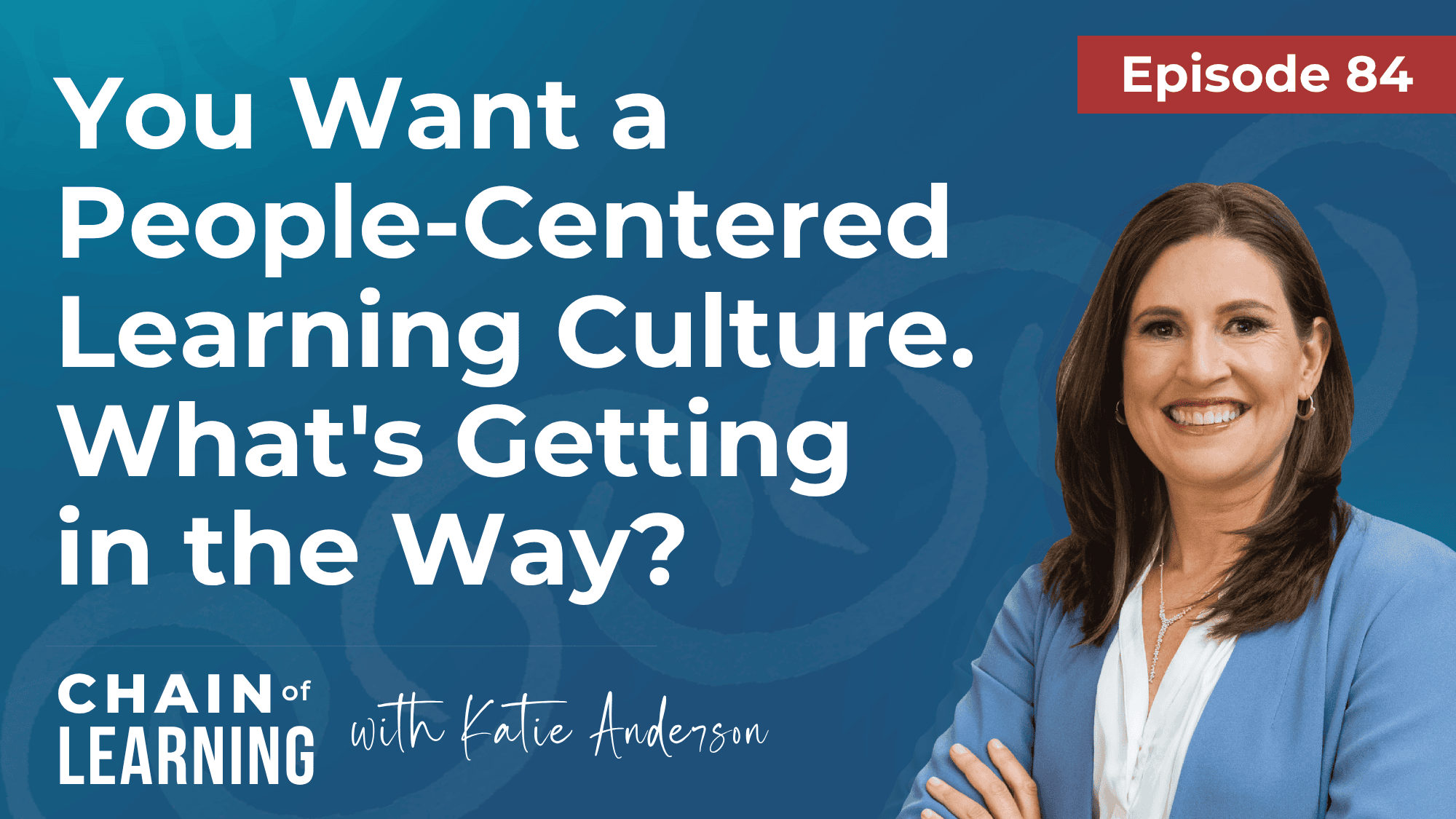





What gets in the way of building a people-centered learning culture?
Urgency, firefighting, short-term pressure, leadership ego, organizational systems, and psychological safety all came through as barriers. Yet the biggest impact comes from something we can influence: our own leadership behavior. And it starts with us.
Leadership consultant and international keynote speaker Katie Anderson explores survey results from leaders and change practitioners around the world and shares how you can still build a people-centered learning culture.
What Leaders Say About Creating a Culture of Continuous Learning
People-centered leadership. Learning organization. Culture of continuous improvement. We use different words to describe what we’re working to create.
But do we actually mean the same thing? And if we all want a people-centered learning culture, what’s getting in the way? What is the one thing that could have the biggest impact?
So I asked. And you answered.
Nearly 80 leaders and change practitioners around the world responded.
There wasn’t one shared definition or set of words for a people-centered learning culture. But the same essence showed up in almost every answer.
You’re frustrated. Urgency, firefighting, short-term pressure, leadership ego, organizational systems, and psychological safety all came up as barriers to creating a culture of continuous improvement.
Yet the biggest impact comes from something we can influence: our own leadership behavior.
And it starts with us.
In this episode, you’ll learn:
✅ Why “people-centered” and “learning” are intertwined concepts that support each other in creating a learning organization
✅ How to describe what we’re trying to build to leaders who never ask for a people-centered learning culture
✅ Why “respect for people” means more than treating people well, and how it’s fundamental to developing people and organizational success
✅ How urgency, firefighting, and short-term pressure to deliver results exacerbate our pull toward doing rather than developing people
✅ Why the environment is seen as the barrier, and leadership behavior is the lever for change
Listen Now to Chain of Learning!
Tune in to explore what a people-centered learning culture really looks like, what gets in the way of creating one, and why the biggest opportunity for change may start with how you show up as a leader.
Watch the conversation
Watch the full episode on YouTube.
Reflect and Take Action
The pressures and systems around us are real.
But rather than focusing on the system, your CEO, or the other leaders who aren’t doing things right, look at what you can influence: how you show up.
This week:
- Pick one thing that’s yours. Look back at what you identified as getting in the way and what could make the biggest difference.
- Choose one way to show up differently. What could you do differently—or more patiently—to demonstrate respect for people and support learning?
- Notice where you step in. Where might you take over rather than giving someone else the opportunity to think and learn?
- Run an experiment. Decide what you will do and what you expect will happen as a result.
- Reflect and adjust. Put intention into practice, learn from what happens, and get a little better every day.
What’s one thing you can change about how you show up that could start to change the world around you?
Important Links:
- Follow me on LinkedIn
- Subscribe to my newsletter
- Check out my website for resources and working together
- Join us on the Japan Leadership Experience
- Episode 52 | What You Love About Lean and Operational Excellence — And Your #1 Frustration: How to Get Executive Buy-in
- Episode 71 | Own the Thinking Process, Not the Thinking: How Leaders Build Problem-Solving Capability
- Episode 77 | Lead with Joy: A Business Strategy for Success with Rich Sheridan
Subscribe to Chain of Learning
Be sure to subscribe to Chain of Learning on your favorite podcast player so you can build high-performing cultures of continuous learning. And share this podcast with your friends and colleagues so we can all strengthen our Chain of Learning® – together.
Frequently Asked Questions
What are the core principles of a successful learning organization?
According to leadership consultant and keynote speaker, Katie Anderson, a successful people-centered learning organization is built not on tools, but on creating the conditions where people are cared for first and free to keep learning together. Her Leading to Learn® approach calls on leaders to set direction, support their people, and develop themselves—while Breaking the Telling Habit® by asking and listening rather than having all the answers. Ultimately, no one learns alone: a strong Chain of Learning® connects people to build capability in one another, shifting a culture from “doing” to continuous, shared learning.
How do leading companies implement respect for people in their workplace culture?
Leading companies treat respect for people not as a slogan on a wall but as a daily, lived practice — at its core, “holding precious what it means to be human.” They implement it by shifting their energy from managing results to developing people: building trust, creating psychologically safe environments, connecting people to purpose, and engaging everyone in problem-solving and continuous improvement so they can grow and do their best work. Respect for people and continuous improvement are the two inseparable pillars of real, lasting change and when a company creates those conditions, engagement, capability, and results follow, rather than the other way around.
Where can I find online courses about people-centered leadership?
If you’re looking to grow as a people-centered leader, you can find all of my on-demand courses in one place on my courses webpage. A great starting point is the Leading to Learn Masterclass, a self-paced workshop where I walk you through three practices — Purpose, Intention, and Reflection — for aligning who you want to be as a leader with how you actually show up every day. And when you’re ready to go deeper, the Leading to Learn Accelerator is a comprehensive, self-paced eCourse that takes the lessons from my book off the page and into your daily leadership, so you can grow yourself, grow your people, and build a lasting, people-centered learning culture.
Timestamps:
02:03 – What leaders actually want from their teams
04:31 – Why urgency gets in the way of developing people
06:17 – How ego and leader behavior limit ownership
08:22 – When fear makes it harder to speak up and learn
10:37 – The biggest lever for creating a people-centered culture
12:35 – Why we can’t wait for the system to change
14:08 – How caring pulls us into the Doer Trap
15:47 – What “respect for people” really means
17:28 – What people-centered leadership looks like in practice
18:07 – How learning happens through the work
20:49 – What people need to solve their own problems
22:35 – Start with what you can influence
Full Episode Transcript
People-centered. Learning organization. Culture of continuous improvement. We use a lot of different words for what is essentially the same destination, but is it? Do we actually mean the same thing? So I asked, and you answered. In this episode, I hold up the mirror on what nearly 80 leaders and change practitioners around the world told me, what people-centered learning means, what gets in our way, and what would make the biggest difference to getting there.
Welcome to Chain of Learning, where the links of leadership and learning unite. This is your connection for actionable strategies and practices to empower you to build a people-centered learning culture, get results, and expand your impact so that you and your team can leave a lasting legacy. I’m your host and fellow learning enthusiast, Katie Anderson.
I’ve used the term people-centered learning organization for a long time. The phrase is even the standard intro of this show that you just heard. It’s how I describe the [00:01:00] culture that the leaders and change practitioners I work with are trying to create. It’s the heart of what I described about Toyota’s culture in my first book, “Learning to Lead, Leading to Learn,” and it’s the foundation of my next book, too.
In my focused writing process this year, I decided to take a step back and look at this language. What do we all actually mean by the phrase people-centered learning organization? I’ve been talking with clients and colleagues about what the concept means to them, and one of them, a senior change leader at a large international organization, told me, “I’m 100% sure that no one at my site ever says, ‘I want to create a people-centered learning culture.'”
And he’s right. These aren’t the words that many people commonly use. It’s us, the change practitioners and leaders. It’s our language for the destination we’re trying to help our organizations reach. The executives, site leaders, and operational leaders we work with aren’t likely saying they’re [00:02:00] setting out to build a people-centered learning culture per se, although some of them might, but they’re probably asking for what we’d consider to be a people-centered learning organization, just in different words.
Maybe they say they want people solving problems at the right level. They want their teams to stay at the company and be engaged and contributing. And of course, they want results. This is exactly what my client said, too. He hears the operational leaders say all the time, “Man, I wish my employees would just solve their own problems,” and, “I just want my team to perform, that they do what they’re supposed to do without me telling them to do it.”
Hold on to this, because we’ll come back to it at the end of this episode. So as part of my research for my book and to help you understand what this destination is as well, earlier this year, I created a survey to help uncover how much alignment we have in our understanding and use of these words. What do we actually mean when we say people-centered and learning?
And what are those [00:03:00] cultures, those organizations actually look like? And what’s getting in the way of us getting there? I sent the survey out to my network, and nearly 80 people responded: executives, internal change leaders, consultants, coaches, operational leaders from different industries, different functions, different countries.
And if you’re one of the people who shared your insights in the survey, thank you so much. I promise to share what came back and the insights I’ve gained, and that’s what this episode is. Before we dive in, I want you to reflect on these questions for yourself before I share what I learned from the survey responses.
One, how would you define a people-centered organization? Two, how would you define a learning organization? Three, what gets in the way of leaders being able to create these types of organizations? And four, and if one thing changed that would make the biggest difference, what would it [00:04:00] be? Go ahead and hit pause.
Go back, make a few notes, and then come back to listen to the responses. I’m going to start with what gets in the way, and then the counterpoint of what would make the biggest difference. That’s where the answers were most consistent and where the real conversation is for us as change leaders. Then we’ll come back to the destination, what we actually mean by a people-centered learning organization.
Let’s dive in So what gets in the way of leaders being able to create these types of organizations, whatever language you use to describe a people-centered learning culture? From the survey, two barriers came back well ahead of everything else, basically tied. So number one, the overwhelming top barrier did not surprise me.
About half the survey respondents said some version of the same thing. Urgency, firefighting, daily pressures, short-term demands. It’s what I call our do, do, do world. Get it done. Deliver [00:05:00] results. Put out the fire. Just do it. People said things like survival mode, being busy. Everyone feels stretched, and developing people can seem less urgent than delivering.
Urgency. When everything feels on fire, the pressure to just fix it and move on overrides the slower, more intentional work of developing people. And it’s hard to be people-centered if leaders are drowning in reporting, firefighting, meetings, bureaucracy, and conflicting priorities. And this barrier, this do, do, do world, the urgency, the pressure comes up in almost every conversation I’m having right now.
Recently, another change leader at a multinational company told me that the leaders in her organization are so focused on results, move faster, more, now, that it’s hard not to be in execution mode or default to what I call the doer trap. She’s trying to build problem-solving capabilities across the system.
But everyone from change practitioners to [00:06:00] operational leaders feel like they have to step into doing or giving answers or just get it done because their jobs are on the line if they’re not seen as the ones delivering results. And that urgency, that pressure to keep doing more to deliver results exacerbates the feeling of needing to just step in and keep doing, do, do, do, even with what gets squeezed out is developing people.
The second, the other top answer, also mentioned by nearly half of the respondents, was about leaders themselves, their identity and self-beliefs, as well as their actions. The most consistent word across these responses, ego. Boss’ ego, people’s egos, leaders’ egos, the feeling of being the expert with the answer or a belief, value, or self-identity that gets in the way.
Words that were used include egos, hubris, self, pride, other selfish or prideful leaders, knowing too much or thinking you know too much. [00:07:00] Notice how short these answers are. People who noted this as a barrier named it in just a word or two and then moved on to their next response. The other part of this grouping are leaders’ behaviors that get in the way, such as leaders telling versus creating a conversation around needed support, managers that decide they know what’s best for the team without ever asking them, micromanagement, leadership holding reins too tight, concerned about optics, powering over others instead of with them, not listening.
Interestingly to me, though, almost none of the answers described a leader overstepping ownership by taking on a task or doing the work for someone. They’re about who talks, who decides, and whose thinking gets used or valued. The impact is the same either way. Ownership and an opportunity to contribute and grow is diminished The third category, about a quarter of the responses, were barriers related to reinforcing [00:08:00] cultures, systems, and structures, particularly around what is measured and rewarded and how it’s always been done.
Examples include production goals are what get rewarded. Empathy rarely shows up on the scorecard. Traditional project management based on rigid milestones. Absorption costing, which can devalue learning events. We have to switch from a task-oriented mindset to a people-oriented mindset, and that is very difficult.
And the fourth barrier, while not as prevalent in the answers, about one in ten, was a culture of fear, psychological safety, fear of speaking up and being wrong, of raising a problem and paying for it. Quotes include, “Environments where mistakes are punished, where psychological safety isn’t present. When the leader blames or shuts down ideas, employees remember.”
Scar tissue from past managers, unhelpful pressure or criticism. Failure is not an option mantra. Notice that this theme [00:09:00] is different from the others. The first three are what leaders are up against or what a leader is doing, and this one is what it’s like to be on the receiving end of it, what the experience is like.
So these barriers are the real-world challenges we’re all working in, the time pressure, the egos, the identity, the behaviors, the systems that reward the opposite of what we say we want, the fear, and every one of them is real. And they’re just as real for the leaders we’re trying to influence as they are for us working in the system.
Not one person in the survey said that leaders don’t care. We do, and they do. Several said quite the opposite directly, like it’s not a lack of intent, it’s the pressure, system, and missing inner skills coming together. It’s not because they lack desire. And there’s one more thing. One person raised something that nobody else in the survey did, though it’s a topic that comes up in nearly every conversation I’ve had the past year [00:10:00] with executive teams and clients.
This leader wrote that he’s deeply concerned the pace of AI is going to further devalue the real contributions from humans, that we’ve accelerated the pace of creating content without accelerating the speed of deep learning. As he said directly, AI agents just send slop back and forth, and we risk losing our humanity and purpose for living.
And this is what makes this question about people urgent rather than just philosophical. When machines can do more and more of the doing, the leader’s role and connection to people becomes even more important. So given these barriers, what’s the one thing, if changed, that could make the biggest impact?
What did you say? From the survey, the resounding majority, roughly two-thirds of responses pointed to leadership, leadership behaviors, mindset, particularly for moving from a command and [00:11:00] control stance or one that tries to extract more from people to a supportive coaching stance that fosters improvement in learning and modeling the way for this culture.
Some things people said include leaders evolving from a power and control mindset to humble and supportive approach, openness, coaching over directing, a mindset that moves from you need to change to we can improve, unwavering demonstration of desired behaviors from senior leaders. Another key theme that would help was fixing systems and structures, but this was usually coupled with leadership behaviors as well.
A few respondents named other things, more time or training, but the overwhelming answer was how leaders show up. One insightful response came from my fellow Shingo faculty member, Peter Hynes. It was this pairing together of his comments that leaders fail to operate in a people-centered or learning-centered way, not because they lack [00:12:00] desire, but because the system, culture, and pressures around them push them towards firefighting, control, and short-term results.
And what he believes would change it, redesign the leadership system so that a leader’s primary role is to develop people and ensure the system gives them the time, routines, and expectations to do it. I hundred percent too believe that systems support the behavior, and if you’re working inside a system that rewards a different type of behavior or makes it hard to behave a certain way, like the barriers we just went through, it’s really, really hard.
Systems and structures need to support the behaviors we want to see. But at the same time, I believe we can’t wait for the systems to change before starting to change ourselves. We need both. We need the systems to support the behaviors, and we can start with the behaviors anyway. Both things can be true.
There are real pressures. We’re [00:13:00] operating in systems environments of a lot of pressure, and there are still things that we can do, starting with how each of us show up. And when I say show up, I mean all of us, you, me, the leaders we work with. Two survey respondents highlighted this tension. Leaders may say they value coaching and development, but under pressure they revert to familiar patterns of control, quick answers, and individual problem-solving.
And another, in that situation, people fall back to reacting instead of thinking. And that’s what pressure does, especially in this do, do, do world. Not because most of us don’t care, but because under pressure we fall back on what we know and what we fear might happen. We become reactive rather than proactive about how we show up.
It’s true for all of us. Think back to the fear and ego and identity that respondents named as a barrier to this type of culture. It’s inside each of us, too, not [00:14:00] just the leaders we work with or that we’re trying to influence. We all get reactive in this do, do, do world. It exacerbates the sense that I need to step in and do or tell to move things forward, to get a result, to make it happen, to not fail.
It pulls us into overstepping. It’s the doer trap I mentioned earlier, the telling habit, and it often comes from caring about the outcome, about getting it right, and sometimes about our own ego. Our identity is the one with the answer. As I talked about in episode seventy-one, caring becomes carrying. It’s not that we intend a negative outcome.
We have the heart. We just end up overstepping ownership of thinking and problem-solving and take away the learning, and we squash the very thing we’re trying to create. As one respondent said, “Most leaders already know what to do. The real challenge is doing it, especially under pressure. It’s not more tools.”
And I agree. Good leadership isn’t a knowledge [00:15:00] gap. We’ve read all the books. We’ve been to all the training, and we are even teaching and coaching leaders about the very behaviors that support people and their learning. The gap is what happens when we feel the pull to step in and own too much. So let’s come back to what prompted me to do this research survey in the first place.
Defining the destination of what we’re trying to create and understanding what we actually mean by people-centered and learning as descriptions of an organization or culture. So here’s the headline. There was not one common definition, but the essence was there in almost every answer. No single definition of people-centered even got a third of the responses.
People used different words, but underneath they were describing the same thing, and the thing they kept coming back to was respect. When I looked at the responses for people-centered and what it means, respect and human dignity was the biggest theme by a clear [00:16:00] margin, more than four in ten. Responses like, “It’s human beings, not human doings.
Valuing people for who they are, not what they can produce.” Or, “Oftentimes we hire people for their hands, but we also need their head and their heart. Every individual is someone’s child or spouse.” And just respect for people. This term, respect for people, is deeper than how we often use it. The way I’ve come to define it, and this comes from the Japanese meaning from The Toyota Way that I talked about in, “Learning to Lead, Leading to Learn,” is holding precious what it means to be human.
Holding precious what it means to be human is fundamentally about what being people-centered is about, in my perspective. The second most common theme, mentioned by about a third of the respondents, is one I found interesting. When defining people-centered, they talked about learning and growth. For example, every decision, system, and structure is designed to help people grow, not just [00:17:00] perform.
They’re not a resource to be optimized. And leaders who develop people instead of jumping in to fix everything. Growing and developing people isn’t seen as separate from people-centered. It’s a core part of what people-centered actually is. The other two top themes, each about a quarter of the responses, were people being seen, heard, and contributing their thinking and people being valued above process, product, and profit.
Other responses included overall wellbeing, how to include all stakeholders, and systems designed around people. In a follow-up question in defining what people-centered means, I asked what a people-centered organization looks like in practice, and the number one answer, over half, was people speaking up and taking initiative for problem-solving and improving their work.
Ideas being asked for and used. People involved in decisions. People-centered in practice is about supporting and embracing the thinking of everyone, [00:18:00] which interestingly, is the same thing the barriers I described earlier actually end up limiting Okay, so let’s move to the definition of learning, learning organization.
When I asked the same question about how you define a learning organization, again, there was no single definition, but four themes came across clearly that describe the essence of learning. More than half of respondents described some version of learning cycle, mentioning things like experimenting, reflecting, adjusting, and solving problems, trying something, seeing what happens, and adjusting what you do next based on what you learn.
Basically describing the scientific method or the plan, do, study, adjust, PDSA, or plan, do, check, act, PDCA cycles. The second largest response, about four in ten, was about organizations where people are being actively developed, building capability, developing skills, growth. And the same number mentioned that learning [00:19:00] has to be part of the work, not separate from it or an event.
And a quarter mentioned the importance of psychological safety, being safe to fail, no blame, a place where failure and mistakes are okay. And when I look at these responses as a group, the process of learning, developing people, learning happening through the work, and making sure that there is psychological safety and learning through mistakes and failure, that covers nearly three-quarters of everyone who answered.
And that’s the closest thing to agreement anywhere in the survey. And almost nobody said training. Only a handful of people defined a learning organization in terms of classes or courses. Everyone else describes something that happens in or through the work itself. And one quote stood out to me because it highlights something I saw in the definition of a people-centered organization, too.
Learning and people are deeply connected. They described it as one that experiments its way forward. It learns from [00:20:00] success, learns from failure, learns from each other. The goal is not just better efficiency, but better people. And this sums up why I’ve always said this as one phrase, a people-centered learning organization.
So while we might not use the same words to describe this destination, a people-centered learning organization, we know what it feels like to be in a place like this. People are respected. They’re learning and growing. They’re part of something that matters. They’re thriving. They’re getting results, too, through contributing their ideas and their energy and their thinking.
So whatever words we use to name it, that’s what we want. And you can feel it when it’s missing, when the human energy is going out instead of in. So let’s come back to what my client said his leaders actually ask for that I shared at the beginning of this episode. “I wish my employees would just solve their own problems.
I just want my team to do what they’re [00:21:00] supposed to do without me telling them to do it.” Now, think about what that requires. For people to solve their own problems, they need leaders to honor that ownership and not overstep and take over by doing or telling. And they need the capability to do it, they need the confidence to try, and they need the clarity to know what next step to take.
They need to be safe enough to try something that might not work and to say so when it doesn’t. These are the conditions, and it’s up for leaders, all of us, to create those conditions for those people around us and to honor and respect people to contribute, and that’s what a people-centered learning organization is.
So this really isn’t a different goal from what those leaders are asking for. It’s just coming at it with different language, and it’s what makes what they’re asking for possible. At the start of this episode, I asked you to write down your own responses. So how did they compare with what everyone [00:22:00] else in the survey said, and what surprised you?
So where does this leave us? The barriers are real. We named them the pressure for results in a do, do, do world, ego and fears about what it means to step back from controlling or doing everything, or for being the one with the answer. The systems and structures that reward the opposite of how we’ve defined a people-centered learning culture.
None of that is going away tomorrow, and it’s frustrating. It’s frustrating to believe in what’s possible and keep running into the current barriers and challenges for all of us, for the leaders we’re working with who are under the same pressures. You can be frustrated, and you don’t have to throw your hands up in futility.
You still have agency in your own actions, and it’s what the majority of people in the survey said would make the biggest difference. It’s how leaders show up, including us. So yes, we need to work on changing the systems little by little. Have patience for [00:23:00] that. The systems and structures that support the right leadership behaviors matter.
But it takes time, and it isn’t always something that you can directly control. In the meantime, start with what you can, which is how you show up and how you influence the people around you. I’ve been quoting Rich Sheridan a lot lately and what he said back in episode seventy-seven: “You don’t have to change the world.
You just have to change your world.” As you reflect on this episode, here’s what I invite you to do this week. Look back at what you wrote down at the start, what you said gets in the way, and what you said would make the biggest difference, and pick one thing, one thing that’s yours, not the system, not your CEO, not the other leaders who don’t get it or aren’t doing things right.
Pick one thing about how you show up. What’s one thing you can do differently or more patiently to demonstrate respect for people, to support learning, to not step in [00:24:00] and take over? Run an experiment. What will you do, and what will you expect will happen as a result? Put intention to that practice this week, and reflect, and adjust, and get a little bit better every day.
Start with yourself, and start to change the world around you. Thank you to everyone for your contributions to this survey and others, including the change leader survey I shared back in episode 52 about what energizes and frustrates you about leading change, and for all your comments on LinkedIn and your responses to my newsletter.
All of your comments and ideas help me refine my own thoughts, and they contribute to the learning and insights that I’ll continue to share here on the podcast and our inputs to the book that I’m writing. If you want to hear more behind-the-scenes learning and help contribute to the book and more, be sure to sign up for my newsletter at kbjanderson.com/newsletter or head over to chainoflearning.com, and all the links are in the show notes.
And if you’ve gotten value from this [00:25:00] episode, please be sure to share it with a friend or colleague and hit follow on your favorite podcast player or YouTube so you never miss an episode. Thanks for being a link in my Chain of Learning today. I’ll see you next time. Have a great day.
Subscribe to Chain of Learning
Be sure to subscribe or follow Chain of Learning on your favorite podcast player so you don’t miss an episode. And share this podcast with your friends and colleagues so we can all strengthen our Chain of Learning® – together.