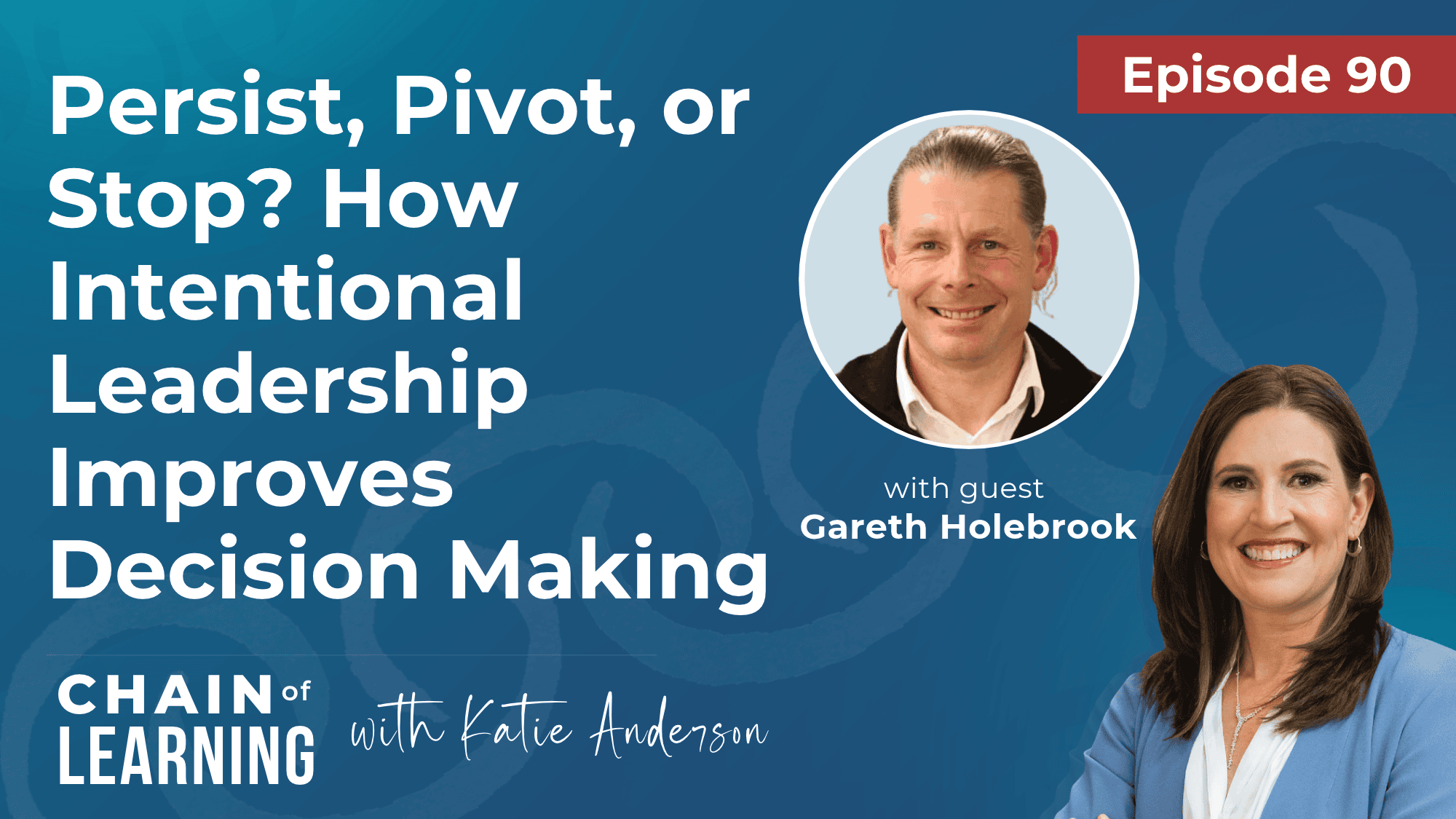





How do leaders know when to persist and when to stop?
Katie Anderson, transformational leadership consultant and author, talks with Gareth Holebrook, leadership coach and author of Ishi: The Discipline of Determined Intent. Gareth’s approach is to decide in advance, while calm, the conditions under which you will adjust, hold, or stop, rather than deciding in the moment under pressure.
 Book Giveaway – Ishi: The Discipline of Determined Intent

Gareth Holbrook has generously donated two paperback copies of his latest book, Ishi: The Discipline of Determined Intent, for two lucky listeners of the Chain of Learning® Podcast—open to listeners worldwide!
Discover how to turn intention into purposeful action, make better decisions, and recognize when to persist, adjust, or change course. Gareth shares practical approaches to help leaders stay committed to their goals while remaining open to reflection and learning.
Enter to win a copy! Register by December 4th at 11:45pm Pacific and be sure to share your lucky URL to increase your chances of winning.
When Persistence Gets in the Way of Better Decisions.
How do you know when to persist and when it’s time to step back?
If you’re a driven executive or change leader, you know how hard it can be to walk away from something you’ve already committed to.
Whether it’s a project, a strategy, or a business decision, the more you’ve invested, the harder it can feel to let go. And sometimes, that determination can get in the way of making better decisions.
In this episode, I explore the connection between persistence, intention, and leadership decision-making with Gareth Holebrook, leadership coach, Ironman athlete, and author of Ishi: The Discipline of Determined Intent, with a foreword by David Marquet.
Gareth shares what he learned from collapsing just miles from the finish line at the Ironman World Championship and from keeping a struggling business going for years.
Both experiences challenged his understanding of determination and shaped his four practices for intentional decision-making and continuous improvement: decide, forge, persist, and reflect.
We also explore how sunk cost bias and escalation of commitment can influence our decisions, and how intent-based leadership helps us move decision-making closer to the people doing the work.
Because as leaders, our responsibility isn’t to make every decision or have every answer.
It’s to be clear on our intent, remain open to having our thinking challenged, and create the conditions for our teams to think for themselves, take ownership of problem-solving, and feel safe to speak up.
In this episode, you’ll learn:
- Why the moment of highest pressure is the worst time to make a decision to adjust, hold, or abort
- How sunk cost and escalation of commitment keep you invested in the wrong decision
- How writing reflection questions in advance leads to more honest reflections and increases your learning
- How to create the psychological safety for your teams to speak up and challenge a decision
- How to use an Ishi card to set and govern your intention for a day, a week, or a year
Listen Now to Chain of Learning!
Tune in to discover how to recognize when your determination is helping you move forward and when it might be keeping you invested in the wrong decision.
Watch the conversation
Watch the full conversation between me and Gareth Holebrook on YouTube.
 About Gareth Holebrook

Gareth Holebrook is a leadership coach, consultant, and author of Ishi: The Discipline of Determined Intent, the first of five planned books on determined intent, with a foreword by L. David Marquet.
He trained as a weapons engineer in the Royal Navy, worked as an engineer and coach at companies including Sony, Navman, and Visa, and partners with Marquet, author of Turn the Ship Around!, to bring intent-based leadership to organizations in Australia, New Zealand, and Singapore.
Gareth has completed 32 ultra-distance races and lives on a farm in New Zealand.
Reflect and Take Action
How often do you set an intention without stopping to reflect on whether your actions are moving you toward it?
For me, Intention = Heart + Direction®. It’s about being clear on your purpose, the impact you want to have, and how you’re aligning your behaviors to achieve it.
As Gareth shares, determined intent isn’t just about committing to a goal. It’s also about knowing when to persist, adjust, or stop—and learning along the way.
One practice from our conversation that I especially appreciated is Gareth’s Ishi Card, which helps you put your intention into action through four steps.
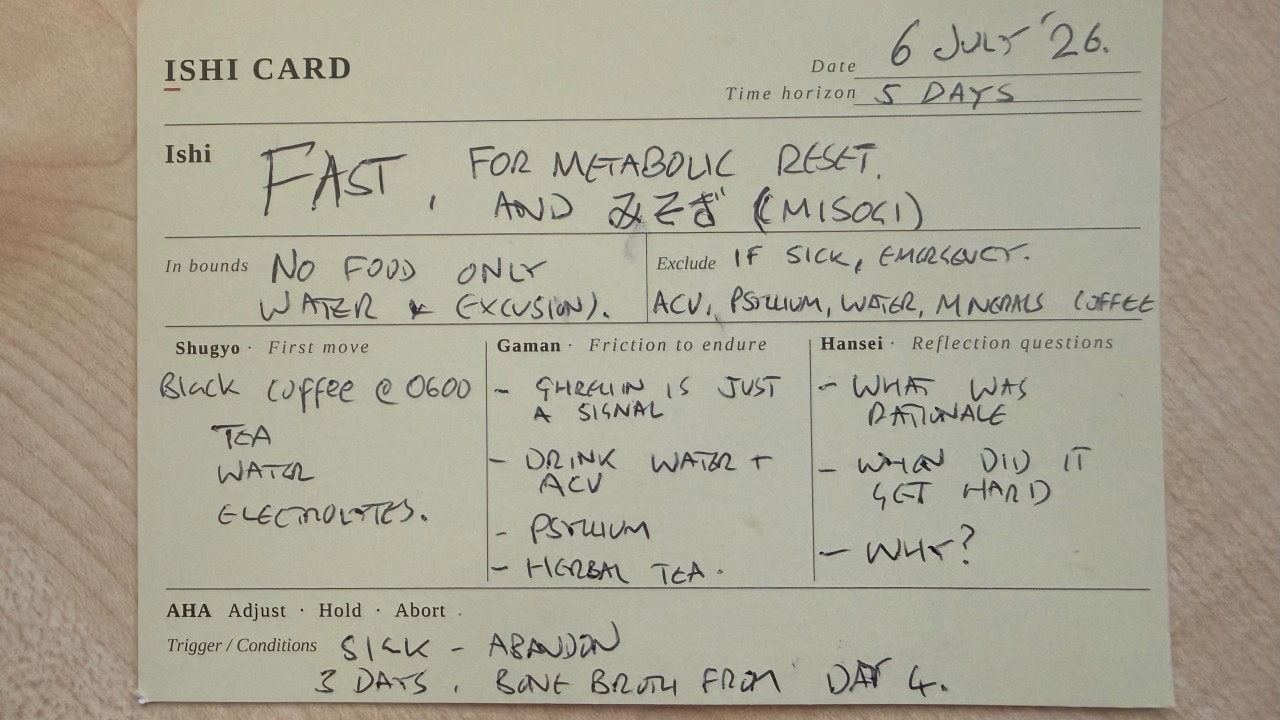
As you go through your week, think about something you’re working on right now. Then try these four practices:
- Decide: Write down your intent, whether it’s for a day, a week, or a year.
- Forge: Write down your first move. What’s the first step you’ll take toward your intent, and what will you practice?
- Persist: Write down what you expect might come up along the way. Decide in advance when you’ll adjust, hold, or abort.
- Reflect: Write down the questions you’ll ask yourself at the end to reflect on your assumptions, your thinking, and the outcomes.
This final step is the spirit of hansei — the deeper reflection that helps us learn from our thinking, our actions, and the outcomes we achieve.
As you look at the intentions you’ve set for yourself, where might your determination be helping you move forward and where might it be time to adjust?
Important Links:
- Download Gareth’s Ishi card
- Read Gareth’s book, Ishi: The Discipline of Determined Intent
- Early releases of Gareth’s upcoming books
- Read Gareth’s writing on Substack
- Connect with Gareth on LinkedIn
- Follow me on LinkedIn
- Subscribe to my newsletter
- Check out my website for resources and working together
- Episode 71 | Own the Thinking Process, Not the Thinking: How Leaders Build Problem-Solving Capability
- Episode 80 | Bad News First: How a Leader’s Response Builds a Culture of Learning with Isao Yoshino
- Episode 83 | Keep Ownership at the Right Level: How to Sustain Organizational Transformation with Anna Pessah
Subscribe to Chain of Learning
Be sure to subscribe to Chain of Learning on your favorite podcast player so you can build high-performing cultures of continuous learning. And share this podcast with your friends and colleagues so we can all strengthen our Chain of Learning® – together.
FAQs About Intentional Leadership
What does ishi mean in the discipline of determined intent?
Ishi is a Japanese word meaning “determined intent,” which Gareth Holbrook describes as the internal sound of your heart—what you truly want to achieve—and the actions you take to make it happen. In his book Ishi: The Discipline of Determined Intent, Gareth explains that it’s not just about setting an intention, but taking purposeful action and knowing when to persist, adjust, or stop along the way.
What is intent-based leadership and how does it work?
Intent-based leadership, developed by David Marquet, is an approach where leaders share their intent and the people closest to the work say what they intend to do. Gareth Holebrook, who works with Marquet, describes how his wife, an emergency physician, uses it to become the decision evaluator rather than the decision maker for every patient.
Timestamps:
03:12 – What determined intent means—and why action matters
07:25 – The four disciplines of the Ishi Spiral
10:05 – Why organizations struggle to make and sustain decisions
12:05 – Why good outcomes don’t always mean good decisions
13:15 – How to challenge your assumptions before making decisions
15:10 – The hidden danger of relentless determination
17:10 – What collapsing at the Ironman World Championship taught Gareth
19:05 – When persistence becomes a liability
22:55 – How determination kept a failing business going for five years
24:05 – Why knowing when to walk away matters
26:05 – The Ishi Card: Turning intention into action
27:05 – How to decide when to adjust, hold, or change course
28:10 – Why decision boundaries matter before pressure hits
30:35 – Learning from setbacks instead of just pushing harder
35:45 – How intent-based leadership changes decision-making
37:15 – Moving decisions closer to the people doing the work
39:45 – Why leaders become decision-making bottlenecks
41:10 – How to develop your team’s judgment without giving up accountability
43:05 – Why people need to feel safe challenging their leaders
43:45 – Who really owns accountability for problem-solving?
45:05 – How to practice intent-based leadership in every direction
49:15 – How Toyota uses hierarchy to develop ownership
51:35 – Bringing leaders and teams closer to better decisions
53:15 – Leading with intention: Gareth’s Ishi Card in practice
Full Episode Transcript
Gareth: [00:00:00] idea I’ve got is we ask ourselves the questions at the end of the cycle. I believe if we write the questions at the beginning of the cycle as a prospective hindsight and literally write them down, then we don’t become our own press office. So we don’t ask the favorable questions. We ask ourselves the hard questions at the point of the decision, and then we review those questions at the end.
Katie: Welcome to Chain of Learning, where the links of leadership and learning unite. This is your connection for actionable strategies and practices to empower you to build a people-centered learning culture, get results, and expand your impact so that you and your team can leave a lasting legacy. I’m your host and fellow learning enthusiast, Katie Anderson.
Have you ever kept going or working on something long after you knew it wasn’t working? A project, a strategy, maybe even a business. You’d already put so much in, stopping felt [00:01:00] like failing, so you push harder. For most executives, change leaders, and high performers, determination isn’t our problem. What’s harder is knowing when to step back and ask whether we should persist or make a choice to pivot or even fully stop.
So the real questions become: how do we know when to push on and when to stop? And how do we create the conditions with our teams so that they can think for themselves and make decisions, and to speak up and challenge us when they believe our decision isn’t the right one? To help explore these questions, I invited Gareth Holebrook to the show.
Gareth is a leadership coach and consultant, and the author of, “Ishi: The Discipline of Determined Intent,” with a forward by David Marquet. Gareth has spent 30 years in places where effort without judgment fails fast: as a weapons engineer in the Royal Navy, as an engineer and coach at companies including Sony and [00:02:00] Visa, and across 32 ultra-distance races, including the Ironman World Championship in Kona.
When I first met Gareth, I was instantly intrigued by the title of his book, Ishi, because it shares a character with a Japanese word that is core to my practice, shikō, intention. So we started our conversation there, asking Gareth what Ishi means to him and why he chose it. Let’s dive in.
Gareth: So the, the book called, “Ishi: The Discipline of Determined Intent,” I, I’ve been working on this book for 10 years.
And initially, the working title was, “Ishi: The Iron Mindset,” because I was thinking about Ironman and long-distance triathlon and how I think as an Ironman and how we can apply it at work. And then about a year ago, I was thinking, “Well, I don’t want to use mind- Iron Mindset because it’s, it’s a well-used phrase, so what can I use that’s unique?”
And within the book, there’s a lot of Japanese concepts, such as kaizen and ikigai, [00:03:00] and I went down a bit of a rabbit hole researching what would intent be for… uh, what would be Japanese be for intent? Um, because at the same time I’m working with David Marquet on intent-based leadership- And I didn’t wanna say intent-based, intent-based mindset or step on his toes.
Um, but I thought wouldn’t it be nice to think about the word in Japanese of intent? And there’s actually several different words, um, but the one I landed on was ishi, which means determined intent. Very precisely, it’s about the, the internal sound of the heart, what you really want to do, but then the action you take.
So there’s one thing being intentional, but we need to have an action with it as well. So yeah, ishi, determined intent.
Katie: And it’s so interesting. So the genesis in, uh, uh, if you’re watching this, you can see both Gareth and I have a triptych of Japanese words behind us. Actually, mine is all the same word, shiko, or intention.
And that was the [00:04:00] word when I w- moved to Japan in 2015, I asked for the word intention to be put on my business card. So it was an important word for me as well, and it’s that same thing. It’s the sound of the heart or the strength of your heart, which truly is heart, mind, and spirit into one. And then my- the second kanji in my, in intention is direction.
Are you orienting yourself in that direction? So there’s so much connected overlap. I love determined intent and intention. It’s so connected to that heart, and are we aligning ourselves really with, with what we’re wanting, the impact we’re wanting to have? So I, I love that connection between us.
Gareth: Yes. And I notice on the middle, uh, kanji, um, the top symbol, I can see the kokoro symbol, which is heart and mind.
Katie: Yes. So the kokorozashi, which is the same part, it’s the shi for ishi and shiko, is that samurai and heart, mind, and spirit, uh, symbol together. And then we just have a separate kanji that makes it, uh, ishi or shiko. So yeah, they’re, they’re ver- they’re very connected. So how did you… As you [00:05:00] were developing the, the ishi spiral, you have both English words in there, and then they’re connected to the Japanese words.
So maybe you could share briefly what the spiral means, and then we can explore how it came about and how you see it being helpful for people.
Gareth: Okay. So my, my background in engineering started in the UK, and when I left the Royal Navy, uh, as an engineer, I ended up working at Sony. Uh, and as part of my post-grad, I studied, uh, Japanese management theory.
So from the mid 1990s, uh, I was fascinated with the Toyota Production System, uh, with Theory Z, uh, and giving respect to people and distributing authority to people. So I was always fascinated with, um, Japanese culture, uh, and the way Toyota has, um, a- applied their principles in industry. Um, and when I came to New Zealand, I was fortunate to work at a small company who set up a Kanban line And, uh, so I was in manufacturing as an engineer, [00:06:00] and so I learned about Kanban.
And again, it was a, a Japanese boss I had. And so, um, during that time, I became more and more immersed in, um, karate. Uh, I practice Shotokan karate, so absolutely fascinated with Japanese culture. And then Ishii, uh, is… actually comes from, uh, the book comes from my journey as a triathlete. So for the past twenty-five years now, I’ve raced in short and middle distance triathlons, and then in two thousand and five I did my first Ironman triathlon, and that all ended in twenty twenty-two when I went to Kona in Hawaii and raced on the Big Island.
And throughout that time, I learned about grit and determination and of course ganbaru. So when I, when I started thinking about my life as an engineer, my life as a coach, and as a program manager, and also this second life as an athlete, I could see some crossover. So I was training all the time for Ironman, listening to books, listening to, [00:07:00] um, uh, Jeffrey Leiker and Mike Rother.
Uh, and I thought, “Yeah, what I’m trying to do as a triathlete,” things like continuous improvement and Kaizen, it applies to work in exactly the same way. So for the past ten years, I’ve been talking at conferences and meetups about being a triathlete and how it works at work, and that book is a culmination of that and the model I created with the flavor of Japan.
Katie: So what are the four key components of the Ishii Spiral, and how do they relate?
Gareth: So I, I looked back, I retrospected back on my life as an athlete, and there were four things that if I ever failed or I didn’t succeed, there were four things that I got wrong. Firstly, the quality of how I decided, and when I made a decision, was it clear to me saying yes to this, I have to say no to other things, or am I going to overload myself?
The next is to the deliberate practice. So you learn that in karate with kata. You [00:08:00] learn it in swim training. And I also learn it at work as well. So I use Toyota Kata. Um, I, I treat, um, the framework of Scrum as a form of kata to actuate a new thinking. So the second phase is about deliberate practice. The third, I was thinking about persistence.
And initially five years ago, I was thinking it’s all Angela Duckworth, it’s all grit. And grit is important, but as Angela says, Duckworth says in her new book, Situated, the situation is necessary. So while we want to be able to persist, we also need to govern ourselves not to persist too long. And then finally is reflect.
And of course, I use hansai for reflection, which I know you use a lot in, in your book, uh, um, Katie. Um, so the, the four phases are decide, forge, persist, and reflect. And the four, uh, words in, in Japanese are kettei for the decision, forge [00:09:00] is shugyo Persist is gaman, uh, not ganbaru. And then finally, Hansei. So I created this model.
I thought, “Well, these are the four failure modes I saw of myself as an athlete,” and I also see these failure modes for, um, people at work as well and how organizations manage decisions. But I don’t see it as a loop. I don’t just see it as a, a PDSA or PDCA, um, i- with Japanese theme, and it’s not an OODA loop.
I see it as a spiral, because as you make a decision, it influences your future, and you want to govern your future self. And as you reflect back, you’re likely to be in a different place. So a spiral, as it revolves around, you’re in a different place. No, no man stands in the same river twice.
Katie: I love that concept and, like, how these interrelate, and I wanna g- I wanna get into all of them.
I’m curious, what are some of the problems that you are seeing in the, your work, in the workspace with leaders that, that, that led to make those connections, too, [00:10:00] about decision-making and maybe how we’re, how we’re overloading ourselves with not saying no, or we’re persisting too long and not really… Well, and I see not reflecting.
But I’m curious how you see these play out in the workplace and who you really were writing this for.
Gareth: Yeah, so, uh, my, my, my thinking is, is leaders, um, people who create the, the strategy for an organization, it’s very easy to lock yourself in a room, spend three months on, on a strategy, and then project it out as a PowerPoint and expect everybody to understand what it means, and there’s that chasm between execution and strategy.
I think when we make decisions, the… it’s often very slow, and there is research to show that many projects fail because of decision latency. And I think one of the causes of decision latency is people know is once you’ve made the decision, it’s very hard to unmake the decision. So how do we govern that decision?
And, and I… And this is the w- my next book’s work is, is looking [00:11:00] into this, is once a decision is made, we need to treat it as a, an object that you decide, uh, and govern through a life cycle. And you apply attributes to it, an owner, uh, what are the abort criteria, when is it safe, and do you have permission to stop?
What are the boundaries? Um, how does it interrelate to other decisions? And I think larger companies struggle more than smaller companies in making the decision. But the problem, and I’ve, I’ve experienced this with some of the startups I’m at, the startups can make a decision on a dime, but the problem is, is another decision’s made the next day which counteracts that.
So they kind of flounder. Um, and so I’ve, I’ve worked at one company in particular in the UK where there was lots of distributed authority, and engineers had a lot of delegated authority and could make decisions. But the problem is, is two months later, another decision would come in, and it would take the whole project back to square one [00:12:00] So how, how do we manage decisions that not, not necessarily that it’s a good or bad decision, but when that decision’s made, that we can then look us at in the future?
And the flip side to that is how we, how we reflect back. The outcome may be good or bad, um, but what we want to look at is the quality of the decision irrespective of the outcome Because sometimes we make a poor decision and we’re lucky, and sometimes we make a good decision, uh, and, and we’re unlucky.
So how do we reflect back without a l- all of those biases?
Katie: Right. So it’s accelerating the rate of learning, right? So something I talk about often and obs- observed in my own experience working internally in organizations and in the organizations I support with, we, we end up f- not doing the deep reflection, and yay, if we achieve the goal, we just keep forging on.
But we don’t necessarily know, did we take the right process? Was that just sort of good luck? Or if we made… you know, didn’t get to the outcome, we’re just so, we’re scrambling and then just [00:13:00] keep repeating the same mistake over and over again. So both are needed. Reflection on why did we get to the outcome we expected, and what can we learn from that?
As well as, why is there a difference between what we thought was gonna happen and what actually happened?
Gareth: Yeah. And an i- idea I’ve got is we ask ourselves the questions at the end of the cycle. I believe if we write the questions at the beginning of the cycle as a prospective hindsight and literally write them down, then we don’t become our own press office, so we don’t ask the favorable questions.
We ask ourselves the hard questions at the point of the decision, and then we review those questions at the end. Um, and, and that overcomes the sunk cost and the escalation of commitment, uh, biases that we have.
Katie: You know, as you’re talking, it’s reminding me of a, of a process of reflection that I learned from my mentor, who learned from Toyota leaders, is that we, you know…
I- if we can have those questions in advance, then build into our, uh, our reflection [00:14:00] process, it helps us unreveal the assumptions in our decision-making process, right? So how do we get better about having these, having these questions? It’s not just a what went well and didn’t go well, but it’s uncovering the assumptions behind our thinking, and did we actually have the right inputs to make those decisions?
And sometimes the con- you know, the condition changes, but don’t just look back and like what worked and what didn’t, but how… what was our thinking process that led to the decision or the action that we took or didn’t take?
Gareth: And the way our brains are wired, we are all very dison- dishonest to ourselves internally, that we will create a narrative to support the outcome.
So that’s why we need to be explicit, to write down what the decision was and the assumptions and the questions, because then we can’t succumb to becoming our press office, that we say, “Why did this work?” Well, because it was a great decision, or maybe it wasn’t.
Katie: That’s a, it’s a really powerful practice for how we can truly embed deeper [00:15:00] learning and, uh, ke- sort of hold us honest, right, in, in that, in that true hansai of deep reflection.
We’ve talked a little bit about the work context, but I do want you to share your story and experience of, at the World Championships in Kona, because it was such a seminal part of how you wrote the book and what led to The Ishii Spiral. So, you know, your book opens on the floor at the Ironman World Championships, and what happened?
What did you learn?
Gareth: So I really wanted to race at the World Champs in Kona, in, in Hawaii. And from 2004, I kept trying to qualify, um, got really close in 2016, uh, but wasn’t there. Then in 2017, spent three months just doing nothing else but race, training for this one race. And then on race day, uh, it was really stormy.
I got seasick and had to pull out of the swim, and I, I think I’d overcooked myself. Physically, I was really strong, but mentally, probably I was a bit too drained. [00:16:00] And then I thought, I, “It’s, it’s never gonna happen. I’m never gonna get to the World Champs.” And somebody told me there’s a special wildcard entry that if you’ve done enough races, if you’ve done so many Ironman races and never actually qualified, there’s another pathway to go to the World Champs, and it’s called The Legacy Program.
So there I was, and I qualified in 2018 because I’d by that time done 12 Ironman races. So then they said, “Well, you can join, you can join us and come to the race in 2019.” Um, and I had a big job at the time at, uh, Visa, so I said, “Well, any chance can I defer it until 2020?” They said, “Yep, fine, 2020, you, you, you can race then.”
So I left Visa at the end of 2019 for the sole purpose of that year to do nothing else but train for that one race in October. That was gonna be the thing I wanted to do. Um, unfortunately, other things happened in 2020 and the race was canceled, and then it was canceled again in ’21. Um, finally in ’22, I got to that start line, so it was [00:17:00] 18 years to get to Kona, and I spent six weeks out in Hawaii, four weeks on the Big Island, uh, and I put…
I had no stone unturned. I absolutely checked everything. I trained perfectly and was going to have a perfect day. And I had a time in my mind of what I wanted to do to finish. Um, but as you say, Katie, 35 kilometers into the run, I was on the floor. I lost consciousness. I was out for 40 minutes And the heat got me.
And it doesn’t just get the age groupers and amateurs like me. Uh, last year the two lead females, they both collapsed, uh, with a few K to go because it j- it’s so hot. And the problem I had was a small detail was sodium. And while I was really meticulous with the water at Lucon and the carbs and everything about the gear, I hadn’t taken enough salt and started suffering from what’s known as hyponatremia, which is a lack of salt in your system, and it can [00:18:00] be really dangerous.
It has killed people, and it knocked me out. Uh, fortunately, s- while the doctors were tending to another athlete, a passerby gave me a bottle of salt water. And by the time the doc came back, uh, to sign me off, ’cause I’d already committed to finish, uh, to, to give up, and, uh, I was obviously quite upset. I said to the doc, “You know, I’m feeling a bit better now.
Maybe I can just walk it off and then wheel to the end. I, I’ll see how I go.” So I did finish. Uh, it was two hours slower than I wanted. Um, and it sounds like a really heroic story, that here’s this guy, he’s spent all his life trying to get to the world champs, collapsed at 35K with only seven to go. So that’s tw- it was actually the 22-mile marker for my American friends.
Katie: Oh, wow. You’re so close.
Gareth: Yeah, it’s not far. And then, uh, but Taylor Knibb, she was at the, uh, 24-mile marker, and then she just, she did the same thing last year. You can see videos of her, like, skewing around on the road and then just sitting down and watching the second [00:19:00] place getter go into first. So it happens.
Um, but I finished, and I was really proud, so I got called an Ironman. I finished the World Champs. But really it was unsafe. So I crossed the finish line, but I also crossed the line of safety that day. And so while four years ago I was seeing this as a real heroic story, and I thought it’d be the first chapter of my book, um, in the last year, I thought, actually, no, there’s something else that was going on here, and I was so persistent and so doggedly determined to get to the finish line that I put my own health and safety at risk.
So I didn’t govern myself. My persistence was ungoverned. And in the last year, I… finishing off the book, I reflect back, and there’s been many times when I’ve overreached. So that did not finish in 2017 is because I was just training too hard, too fixated. And a few years before that, I got shingles ’cause I was just racing.
Almost every weekend, I seemed [00:20:00] to have a big race. I did five Ironman races in that year.
Katie: That’s crazy.
Gareth: Yeah. And it was just too much. I’m not a pro, and I was trying to live the life of a pro, and, um, and my body gave me the signal to stop, basically. And, and so that, that’s the essence of my story. It’s not just about blind grit.
We find with a lot of triathletes, y- the, the challenge isn’t motivation, and especially the triathletes I’ve coached, is not motivating the triathlete to get off the couch. It’s to coach the triathlete to spend some time on the couch to recover. And, and o- o- often driven people fail to do that.
Katie: What a powerful reflection that it- there’s more to learn than the r- the end result, right?
So it’s looking at the process to get there and maybe what were the things you did well, and then what were the things where, you know, you’ve had some powerful realizations that, that, you know, just focusing on the outcome and being [00:21:00] persistent to the outcome was actually not a good thing. I’m, I’m curious, too, you also have said in, you know, in other places that that same pattern had already cost you a business as you look back on…
If you, when you look back on your, you know, your professional history, too. So I’m curious about how you see that connection with dogged persistence and how that, that connected w- to yourself as a leader in the business environment.
Gareth: Yeah. Back in 2004, I was a program manager at Navman, a, a GPS company working on GPS car navigators, and I was getting itchy feet.
I wanted my own tech startup, and I was already doing shorter distance triathlons, and an opportunity arose. I did a half Ironman in Auckland, and the naming sponsor was an altitude training company. So using high-tech equipment, you’d breathe high altitude air And it’s great for mountain climbers, people going to Nepal.
But also mostly it was cyclists and triathletes. Uh, um, the, one [00:22:00] of the big sponsored triathletes on the product was, uh, Cameron Brown, who’d won IRONMAN New Zealand five times at that point. So I was intrigued about this, this idea of altitude training, and, and I thought, well, I also want to get into wearable tech, and I’ve been working with Timex on a GPS watch, and I thought, wouldn’t it be great to have a, a service where I’m working with the triathlon community?
And then in, in the back I’ve got a few software engineers and we’re developing some technologies. So, um, off I went. I franchised the product, set it up in Christchurch in New Zealand, sold my house in the UK, and threw everything into it. And I thought I’d, I’d developed the identity as a, a, an, a tech entrepreneur And I’d read so many things about Richard Branson and, and other, uh, startup founders where you’re always on the cusp of bankruptcy until the day you’re not.
It either fails or it flies. And I really struggled. But the [00:23:00] signal was, even though altitude training works perfectly, and I still use it to this day, it really helps, as a business model, it just didn’t work. And I carried on for five years. I was technically insolvent after about nine months. So I sold all of my assets.
I sold shares, got investors in, borrowed money, beg, borrowed, and, um, and got friends and family to support me. Uh, I stayed at a friend’s house which was under construction, no power or water, and I just carried on and on for five years. And at one point, my accountant said, “You’re working so hard on this.
You’re so passionate. Um, but in the meantime, the rest of us are actually earning money.” At the time, and I was saying to that friend of mine, an ex-Navy friend, uh, “One day I’ll write a book about this and, and you’ll be in the book.” And he is. It is, is mentioned in my book. Now, admittedly, I thought the book would be something like the second billion is easier than the third or something like that.
Um, it was a failure, but [00:24:00] I, I learned so much about myself. Uh, and I don’t regret making the decision. Um, but I do know, know that what I ought to have done is had an escape route after six months. And by the time I was locked in, the only way out would’ve been bankruptcy. So what I did do was an elegant wind down of the company and went back into work in 2009.
Um, so I did close the company down, um, formally, I think in 2012. Um, but it was a, it was a tough time for me. It wasn’t easy, um, but it was self-imposed. But there I wasn’t performing Hansei, and I was attaching my identity as an entrepreneur to the suffering. So I saw the suffering as virtuous. And so this was probably using Gaman in the unhealthy way, which I know is a, is sometimes seen as a challenge in Japan as well
Katie: It’s like that, that going for it, doing it, doing your best, and keep persisting.
I, I’ve seen that play out in my own life. [00:25:00] I’ve seen that play out in others. It’s almost like, you know, you just keep doubling down because you, you know, you’ve already made the investment. And the concept of learning from failure is so powerful. I mean, I… that’s one of the things that people comment on my book, “Learning to Lead, Leading to Learn,” how Mr.
Yoshino was also really reflects on learning through the mistakes and major business failures, too. I mean, he had a business idea, too, that cost Toyota $13 million. So that was, that was pretty hard. I, I appreciated some of the concepts in your book about, in the same way that you’re s- you’re offering the idea to put our Hansei questions, our reflection questions in advance, almost like a hypothesis so we can check, how can we better bring forward those decision points before the pressure hits or before we have, you know, that, that crisis moment?
So maybe we’re more clear-headed in asking ourselves almost those questions. And, and how, how does that fit into that counterbalance of, of the persistence perhaps?
Gareth: Yeah. So [00:26:00] this is… I think that, I think I lead this in the preface as the minimum viable issue, and I believe this is the one thing that we can all do, and it’s a pattern that I have done for at least five years, and that is to write it down, to have an intent, to deliberately write it down on an index card, and it…
and you d- define the time horizon. So you could write down today what my intent is for today, and there is a such a thing as an intention card, or you could write it down for this month or this week or this year. Um, but just writing down the intent is insufficient. It’s good enough to know what your clear conscious goal is, and I’m, I’m coaching a few, uh, leaders at the moment, and one of the things that we agree to do is that every morning m- my client will write down what their intent is for the day, and my weekly coaching session with them is, at the end of that coaching session, we write down what the objective for the week is.
So you write down the intent, [00:27:00] then you write down the first move. What is a first step towards that intent? Because that creates the activation energy, and that’s the Shugyo. Then you talk about what are you going to practice and learn, what’s he trying to explore. But this is the key, is to govern the persistence, is a model which I call AHA, adjust, abort, and hold.
Adjust, hold, and abort. So the f- you temporarily, you can pull the Andon Cord, you can take a pause and ask yourself, “Is this still working or should I adjust the method?” The second question is, is this uncomfortable or distracting, and do I just need to press on? Did I expect this, and can I just persist? So that gives us the persistence.
Or the third one, we give ourselves permission that to abort, to say we’ve now triggered the abort, so I’m now going to stop. And we set that beforehand. And imagine [00:28:00] in Hawaii, if I’d have set myself the abort criteria, if I collapse and lose consciousness, I’m out and there’s no coming back, that would’ve been the safest thing to do.
So what we do is we make that decision, the abort criteria, when we’re calm, when we’re making the decision Not in the moment, ’cause in the moment you will be biased. So when I had that startup, I was, I was persisting. I had sunk cost, escalation of commitments, and I was not going to give up. What I should have done is given myself tr- financial trigger points, at which point I say, “That’s enough.
I call it.” And then finally you pre-write the hansai questions. So it’s called an ishi card, and what you do is you write down your intents. You write down the time horizon. So is this for a day, for a week, or a year? And then you write down your first move, the practice you’re going to perform, what you’re going to expect during persistence, and how you’re going to overcome it.
Are you going to adjust, hold, or abort? And then some of [00:29:00] the questions you’re going to ask at the end of the decision, the practice, and the persistence.
Katie: What a powerful, simple structure, but it’s, it’s really providing that, that anticipation. Oh, you have the ishi card.
Gareth: Yeah, so I template them out.
Katie: Fantastic.
And we’ll put it, we’ll put an example of that on the website, too.
Gareth: W- so when I go to conferences, I hand the ishi card out and, and challenge people to write an ishi, um, ei- either for the week or for the year. Um, so I’ve been… I’m at a keynote in Melbourne in a few weeks, and I’m the closing keynote, so I’ll say, “You’ve learned all of these things today, but that means nothing if you don’t actually do it.
So w- I’m challenging you now. Write down one thing that you can do tomorrow, and write down the intent, the first move, when you’re going to continue or give up, and what question are you gonna ask when you’ve tried it?”
Katie: I love that. So at the, at end of my keynotes or workshops or any kind of presentation, I always share a daruma doll and the, you know, fall down seven times, get up eight, the, you know, the motto there.
And I ask people to set their intention, [00:30:00] so very similar, like, what’s the one thing they’re gonna practice with intention? I, I like then the follow-up questions that you have, too, about, okay, what do you, you know, expect to happen? What are the, what’s the next step you’re gonna take towards that? And breaking it down even further.
So I see this connection between shiko and ishi, the intention and the deliberate intent as well. So that’s, that’s real- I love that.
Gareth: Yeah. And, and that reminded me. So I, I listened to your book again last weekend, Casey, before this pod- podcast, and, um, I remember you, you mentioned for- fall down seven times, get up eight quite a few times.
Katie: Yes.
Gareth: It’s an epigraph to my chapter on persistence. So on the one hand, we need to govern the persistence, but we also need to know how to fall down and then get up again. And almost every Ironman I’ve ever done, and I’ve done 32 ultra-distance races now, each one I failed, e- e- except for one. Each one I failed because I’ve- I was not as fast as I expected.
Something went wrong. But you always recover. You always say, [00:31:00] “Okay, I’ve learned from that. How can I be better next time?”
Katie: Yeah. Well, that’s a, that’s a mindset of failure, right? You failed to achieve your high goal, but you succeeded in many other ways. You know, Gareth, I’ve shared with you that I, you know, I lived in Australia for four years in 2002 and 2006, and I got into triathlon as well, but not the same…
You know, I did a h- I did the half Ironman for my 30th birthday, and that gave me a glimpse into the amount of training and challenge that doing a full Ironman would have. So I am in great awe of the, you know, the commitment and the training and, and just, uh, the persistence it takes, and also the healthy persistence maybe when to step back on what that is.
Gareth: Thank you. Yeah. And, and I’d like to say o- of triathlon, it, it… Some people may perceive it as beyond reach, and I, I believe it’s something that we can all do. I’m no superhuman. I’m, I’m not naturally talented, especially at swimming. I’m actually not a strong swimmer. And I, and I might be slim and, and a, [00:32:00] a, you know, done running all my life- But actually, Ironman is something that we can all do, and I’ve seen all sorts of people from oxygenarians to people with Down syndrome.
When I did the, the world champs, uh, there’s a guy called Nick there, and he was wearing 1% on his shirt, and he was the first person with Down syndrome to finish an Ironman. And there’s all sorts of people finish it, and it gives you a great sense of pride and achievement, and that’s why I do it. I don’t do it because I’m fast.
I do it because I like to set myself the challenge.
Katie: Yes. And I, I love that too. It’s not about winning, it’s about winning for yourself, which could be whatever goal you have. And another sort of little-known fact about me that I always share in my two truths and a lie on my Japan leadership experience is that I am Australia’s most average swimmer, uh, because of a, a…
Yes, well, not, not all of Australia’s, but back in the early 2000s, I actually came into triathlon as a, as a swimmer. I now am a big cyclist, but I [00:33:00] compete, I… Well, I wouldn’t say I competed. They were more, you know, go out and give it a go and do the 2K or 3K swim. But in the Bondi Coal Classic back in the early 2000s, I won the award for being the most average of all the swimmers for the females, and I won a trip to Vanuatu, so that was great.
But I, I loved, I loved that the race, uh, organizers not only awarded the top finisher, but they awarded someone the average award too for this, and they got the same thing because it’s about giving it a go, right? And, and making the challenge for yourself. So it may not be to win the race, but it’s to enter the race and participate in the race, so.
I don’t usually like to consider myself average, but I was very proud of my average swimmer award and have a T-shirt of me, uh, or a picture of me in a T-shirt saying average female on the back.
Gareth: You know, the, the, the person who finishes in 16 hours and 59 minutes, um, because the race closes, the race finish closes at 17 hours, that last person across the line usually gets the biggest cheer of [00:34:00] the day And often I’ve seen the winner of the race go back to the finish line at midnight to give, present the medal to the last person finishing.
And I’ve sometimes, ’cause I- usually my races are around about 11, 12 hours, and so I’m in the massage tent having a massage, and I’m listening to other people finishing, and I’m thinking, “Wow, there’s still people out there.” And so the, the people who do 17 hours have a, a different kind of endurance, uh, just to finish, uh, which is a huge achievement.
Katie: Right. It’s about competing against yourself, right? And your, your own goals. And, and I think that’s something that’s really powerful is like, how do we get each a little bit better every go, every try? Um, and it’s not about what other people are doing, but it’s about how are we showing up or achieving the things that we want in our lives, but also how are we sh- showing up as human beings with that learning mindset and with the persistence and the commitment and the, the ganbatte, the ganbaru spirit of give it your best, but also know when to stop, right?
And so those are the counterbalances of [00:35:00] those two, those two spirits. I wanna bring it back to the, to the workplace, too. You know, you mentioned that you work with, um, David Marquet, and you are an agile coach as well. And so much of this is helping leaders learn a different way of thinking and a different way of showing up to create the conditions for other people to understand that they too have the opportunity and the responsibility to contribute their ideas.
I’d love to hear your thoughts, too, on how you’re working with organizations to, you know, not only set your intent for your leader, but make it safe for your team to challenge it or to bring forward their own ideas and how these concepts play out in the work that you’re doing.
Gareth: Yeah. David Marquet, so I, I first met him in 2015 in Sydney.
So I went to an agile conference there, and he was a keynote speaker, and I did a one-day workshop with him. And I read his book, Turn the Ship Around. I’d, I’d read it. Uh, Simon Sinek wrote about David in his book, Leaders Eat Last. And so then I read David’s book, and then saw he [00:36:00] was in Sydney. And in 2020, his next book, “Leadership is Language,” was published.
And I think,” Leadership is Language,” is more profound. And then I, I contributed and helped him, um, a little bit on his next book called Distancing, which he wrote with Mike Gillespie, which was published last year on psychological distancing. And all three of his books have found their way in reference into my book, and, and I was very fortunate that David wrote the forward to my book, and he said the issue is intent-based leadership turned on the self.
So you’re applying intent-based leadership to yourself. So what is intent-based leadership? Well, David’s story was he was a submarine commander, and he was a top of his class, really high-performing naval officer in the US Navy. And he spent a year learning the USS Olympia to become its captain, but at the last moment was asked to instead command the USS Santa Fe, which was the worst performing ship of the fleet in the Pacific.
And so he, [00:37:00] he went to join the ship, and the problem he had was he was trained for a completely different submarine with different systems, different propulsion, different sonars. And all of a sudden, he wasn’t the smartest guy in the room on all of the equipment, so he had to depend on his crew to show their intent And so he was given a l- a, a level of latitude by, um, the US Navy to try something new, which was he gave intent to, of the mission to his crew, and then asked for the crew to give their intent of how they’re going to execute on it.
Um, Dr. Stephen Covey joined him, uh, while he was writing The Eighth Habit. He’d already written The Seven Habits of Highly Effective People. And between them, they co-created a model called The Ladder of Leadership, where as a leader, you state the intent, the outcome you’re looking for, and then you sequence a number of questions and ask for your subordinate, for y- the person who reports to you, what, what do they see?
What do they [00:38:00] think? What would they like to do? And ultimately, what do they intend to do? Now, you can go beyond that saying, “This is what I’ve done or what I have been doing.” But the sweet spot is to say, “This is what I think. These are my options, and this is what I intend to do.” And as a leader, you still retain that power of veto.
You can either provide more information or clarity or notice that your subordinate is not competent, so you need to help them understand what the context is. Um, but ultimately, the person doing the work decides on the work, so we’re pushing the authority and decision-making to where the work is. Uh, so pushing it to the Gemba, literally.
And so, um, so and I really enjoyed his, his next book, which was Leadership is Language, um, the, the questions we can ask and how we talk to our teams, how we can narrow that power gradient. So in 2020, during the COVID lockdowns, I reached out to David and said, “Would love to [00:39:00] bring intent-based leadership to New Zealand.
What can we do?” And I’ve been working with him ever since. Uh, and we work it with clients. He, he, he covers North America and Europe. I generally have had Australia, New Zealand, and some Singapore clients.
Katie: What a great opportunity to collaborate, and you come… You have experience in the Navy as well, so you have some shared language and context, uh, from that as well.
Gareth: Yes, it’s, it’s, uh, certainly reading Turn the Ship Around, which was about his time on the submarine, resonated with me. I spent five years in the, in the British Navy, in the Royal Navy. So it did resonate with me, but intent-based leadership is not just for the military. Uh, so here in New Zealand, I’ve worked with the fire service, with some airlines, and, and some with, uh, some technology startups, where what we want is the CTO, especially if the CTO is a founder- Not to be the decision bottleneck and just enable the team to pick up the decision-making.
And there’s some tricks in language that you can use as a senior leader to [00:40:00] enable your team to think for themselves, and ultimately that’s what we want to try and do.
Katie: I, I hear so often from my clients and people reaching out to, to work with me about they want that. They want empowered decision-making, empowered problem-solving at all levels, and they’re wondering, “Why aren’t people taking responsibility for thinking and solving problems?”
And often, you know, there are system issues, but I, I go back to saying it’s how we might be showing up as leaders, how you might be showing up, and are you a- you know, asking the right things or I’ve been talking about leaders stepping into what I call The Doer Trap. You’re doing it or telling people what to do and not actually honoring their, uh, their ownership of their thinking, and then, you know, you do h- I like that there is that check, but hear their thinking first and give them that opportunity rather than just assuming that you need to do it.
And then you get in this vis- vicious cycle. Not a good ishi- ishi spiral, but the vicious cycle of I just have to keep doing it. Yeah, so that’s what I think all leaders want in their [00:41:00] organization, right? But it’s like how do we do it?
Gareth: Yeah. So one, one thing my, my wife is an emergency attending physician, so she sometimes runs the Auckland Hospital emergency department.
And so sh- and she works with me on intent-based leadership as well, and she … The, the challenge she’s faced with is there could be 100 patients at any one time, and she’s ultimately accountable for the clinical outcome of every patient. And the nurses and junior doctors could go to her and say, “Doc, what do you want me to do with this patient?”
And she can’t be bedside with all of them. She can’t be the decision bottleneck. That is really serious. So she uses that ladder of leadership to say to the junior doctors, “Well, tell me what you see. What, what do you think? Where have you seen this pattern before? What are your options? What do you intend to do?”
And it’s not that she’s delegating the decision-making, but she’s not abdicating responsibility. She’s becoming the, the decision evaluator, not just the decision-maker. But what we need to do [00:42:00] as leaders is create the environment where people feel safe to speak up, to dissent, to have an outlier opinion, and feel safe to say, “I see this.
I think this is happening.” Amy Edmondson in a, in a book, Fierce Organizations, talks about nurses who could spot there’s a problem, but because of the power gradient with the surgeon, they didn’t feel safe to speak up. So we want to create the environment where people are safe to speak up.
Katie: Yes, I came from healthcare, and that was a huge thing for us to talk about, is like how do we create the culture of safety where people can raise issues and especially around safety and other, other things that not just because of a sense of authority are being shut down.
It is essential to be able to truly have a culture of safety or empow- any kind of empowerment, to be able to speak up, but in a respectful way, but not be, be shut down just because you may not have the right title.
Gareth: Yeah. Um, there, there’s a, a story in David’s first book. [00:43:00] I think they were offloading some seals, um, near a beach, and he was in a, in a different room.
He came back into the control room, and he heard the navigator say, “Ahead,” or a stern, and immediately said, “Stop. No, it’s the other way around. We’re gonna ground.” And luckily, the most junior person in the control room says, “No, Captain, you’re wrong.” And he looks again at the charts and saw that the submarine was pointing in the opposite direction.
Now, if they were in the environment where it wasn’t safe to speak up against the captain, maybe they would’ve issued that command and, and grounded the sub. So we want to be in an environment where you can speak up respectfully, um, if you see something that your, your senior misses.
Katie: It’s really interesting.
I’ve, I’ve just spent the last week with a client that’s trying to create a more empowered problem-solving and decision-making culture, and it was interesting. They were using the words, “We just need more accountability. We need more, you know, we need more ownership and accountability for problem-solving.”
And [00:44:00] I was helping them see that actually the accountability resided with them as the leaders. The responsibility for the thinking is what resides with the other people, but they need to be the ones that are, you know, setting the clarity of where we’re going, creating the conditions or the environment, as you said, where people can, you know, are they– They can speak up, they can share their minds, they can, like, the safety to fail in the right environment, not in a catastrophic way.
But the accountability resides with the leaders to own the process of the thinking or the process of the intent-based leadership. Yeah, so I thought it was interesting that the, the, these words were used interchangeably, but they actually mean something very different.
Gareth: Yeah. And, and you’ve, you’ve picked up on something that I’ve noticed a lot as well.
Uh, when I go to clients and talk about intent-based leadership, wherever I am in the organization, people go, “Yeah, love this. This makes perfect sense. If only they could do it,” or, you know, “Them upstairs,” or, “If only they could pick up the decisions.” And from that, I, I’m really inspired, Casey. This is when I first found out about your work, is that video you did on Kaizen.[00:45:00]
And the idea of Kaizen is it’s a discipline on the self. It’s almost a sacrifice to the whip on the self. And so my challenge to anybody is you can imple- implement intent-based leadership with your boss. So one of David’s chiefs, Andy, who’s– we still work with, he went on to another submarine, and he used intent-based leadership as a chief to his captain.
So it’s not just about the leaders changing the behavior of the leadership to the people that we’ll lead to, um, but every leader has a boss. Even the CEO has a board to report to. And how we implement intent-based leadership is to our peers, to our subordinates, but also the people we report up to.
Katie: I always say you too are a business condition that requires improvement.
It’s not just all the other people. How you are showing up is creating the dynamic within your team, within your, uh, you know, subordinate relationship, within your, your one-up [00:46:00] as well. And so how you’re showing up is impacting that, too.
Gareth: And, and I, I really like in your book, by the way, you, you mentioned it a few times about the use of the word subordinates.
And, and I, I don’t have a problem with this because I, I understand that we have an org structure. We’re not a true– There’s never such thing as a true flat structure, and we need to be explicit that there is a higher and lower order on that structure. And it’s, it’s up to us to l- level the, the power gradient, but there is that structure there.
And the reason I say it is I was co-presenting with David once a few years ago, and a question came up. So he said something like, “How would you ask your subordinate to answer that?” And somebody in the room from the agile coaching industry stood up and said, “I’m a CEO of a consultancy, and we have no subordinates in my business.
It’s a really bad word.” And it, it created a visceral reaction by the use of the word subordinate. Um, so I’m really glad in, in your book that you specifically say it’s a mechanical description of an [00:47:00] actual structure, but that doesn’t mean if you’ve got a subordinate that you’re a better, smarter, or more powerful person, and we need to adopt our behavior.
But the word subordinate itself is not a toxic word.
Katie: I know, and I had to call that out and say specifically I use the word subordinate because Isao Yoshino, the 40-year Toyota leader that I was writing about, that’s the word he uses. And so I wanted to honor and be respectful to the term he used, and he…
They don’t– At Toyota, they don’t see subordinate as being someone who is, you know, subjected, you know, a subject. A subordinate is truly just the org, org structure. And the beauty of what Toyota’s done is that they really inverted that, that the– it’s not just the s- the leader’s there to help provide the support.
It’s not just to tell you what to do. And so I think sometimes we put our own constructs on, on words. But I did have to call that out because I had, I too had many people having a similar visceral negative reaction to that. But again, it’s what the meaning is in the [00:48:00] context within any environment. And that speaks to why also we have to adjust language, we have to adjust words.
We have to, you know, be cognizant of what’s going to resonate the most in any culture, whether it be an organizational culture or, you know, country culture. All these principles and the practices are the things that can really hold true.
Gareth: Yeah. But it’s in, in defense of that visceral reaction, it used to be a real big thing.
And so, and this is one of the first things I studied when I first left the Navy, is that, um, especially in the UK, I don’t know so much in the US, but in the ’50s after, after the Second World War when we demobbed, all of the officers and senior ranks in the military became senior business leaders, and all the juniors became junior business leaders.
So that hierarchy still existed. And in fact, when I was leaving the Navy, I was interviewed for a defense contractor, and they said, “Well, you’ve got the smarts, you’ve got the experience, but the problem is you, you’re leaving the Navy as a, a leading hand, nearly petty officer, and you’ll [00:49:00] be working alongside and maybe even senior to former chiefs.
Um, how’s that gonna play out?” And one thing I like about New Zealand is it tends to be more egalitarian than the UK, but there’s still that former military hierarchy. And I know Japan still has some level of hierarchy. I know Swede- one thing I like about Sweden is it’s a very flat culture, and, and w- you need to be, uh, sensitive to which culture you’re working in.
But when we say sh- hierarchy, that hierarchy exists, it’s just how we behave within that hierarchy.
Katie: Spot on, and that’s what I talk to people about. Like, Toyota actually leveraged the hierarchy that in many other Japanese companies turned into this true kind of command and control, wait for the leader to tell you the answer.
Toyota leveraged the hierarchy to create a really powerful Hoshin Kanri or strategy deployment process, the way that the catch ball or the conversations that happen between different levels, the communication, and that leader’s role is set the direction or [00:50:00] provide the challenge, and then provide the support.
And that, I mean, that’s is a different role than just top down. It’s top down, bottom up, and the communication within that.
Gareth: Yeah, and, and my experience at Sony was it was very hierarchical.
Katie: No. A lot of people, like when I first moved to Japan, I lived there for nearly two years in 2015 and ’16, like, are surprised that not all of Japan is like Toyota.
You know, those of us who come from a, a background in Lean or the Toyota Production System or Agile, Toyota and some other companies like it have done some very special things, and that leveraged the hierarchy that was part of the culture, but in a very different way. It truly has more of that intent-based type of style of leadership.
Gareth, we could go on and on. Uh, you know, I know you’re working on another book, uh, uh, bringing in the concept of the Ishii Spiral to more organizations. Maybe you could say one thing that you’re working on with that, and then we can, we can wrap up this conversation for now.
Gareth: Yeah. At the moment, with the Kette book, which I’m hoping to be on LeanPub this month, I am really close to it.
Uh, but what I am [00:51:00] doing is I’ve got a Substack page, uh, called Kette, K-E-T-T-E-I Uh, which is The Decision. And my central argument is we in organizations need to get better at governing our decisions, and I’m working on that. I’m using case studies from around the world.
Katie: Well, my closing question will be, how can leaders then…
I, I was gonna ask a different question, but I think it’s both, like, you, uh, you’ve really already answered and gave a great idea of how anyone listening wants to get started with one thing this week. You had a great example with the Ishii card. What’s one thing that listeners can do to start getting better at the decisions?
Gareth: Yeah. So, um, I’m, I’m thinking, um, the Gemba. So it’s really important that leaders go to see the work, go see for yourself, go to the real work, the real place. Uh, and I… Something I’ve encouraged and coached and practiced myself as a senior leader in, in tech companies. One thing I’ve done with a department that I led the team, and I was a director in, in [00:52:00] the, in the, in the executive suites.
I challenged the team to go and come to me, come to the decision points, and I’ve coined the phrase the inverse Gemba. It’s not true inverse Gemba, because you, you’re not going to the work, you’re going to the decision. One thing we can all do is try and understand what the purpose and strategy is of our organization, and try and understand what’s on the mind of our leaders.
Because we’re all human beings, and we’re all in an environment of com- complexity, and we’re all trying to do our best. And if we can understand what the leaders are trying to achieve, it can connect us both together, and we can both benefit.
Katie: Again, have to have that level of trust and be invited in. But the more we can break down silos, break down assumptions about what other people are doing, the more we really understand the work and make better decisions together.
So that’s powerful. I look forward to your next book, and really encourage people to check out, uh, “The Ishii Spiral,” and continue to connect with Gareth. I’ll be putting [00:53:00] all the links in the show notes below. So thank you, Gareth, for being part of my Chain of Learning and coming on the podcast to share your insights from triathlon and leadership and so much more.
Gareth: Thank you, Casey. It’s been a pleasure.
Katie: In his forward to Gareth’s book, David Marquet describes Ishi as intent-based leadership turned on the self, applying the same discipline we ask of our leaders inward to ourselves, setting a clear intent and then governing it, deciding in advance when we’ll adjust, hold, or stop.
And this connection between intent and intention, shiko, is why Ishi resonated with me so much. Ishi and shiko share the same character, the shi in each word. On its own, that syllable shi means the word kokorozashi, a blend of two symbols, samurai and heart, or rather heart, mind, and spirit integrated into one.
Kokorozashi is what Gareth calls the sound of [00:54:00] the heart, and I refer to as the strength of your own heart. For me, Intention = Heart + Direction. What’s our purpose? What impact do we want to have? And are we aligning our behaviors towards it? And that’s what we need for ourselves and what we want for our teams.
When leaders are clear on their intent and open to having it challenged, they create the conditions for the people around them to think for themselves and speak up. This is leading with intention. One practice from our conversation that I really appreciated was Gareth’s walkthrough of his Ishi card, how to be more intentional about setting our intent and then going through the whole cycle of learning.
As you go through your week, think about something that you’re working on right now, and then try the practices that Gareth outlines on the Ishi card. First, decide. Write down your intent, whether it’s for a day, a week, or a year. Second, forge. Write down your first move, the first [00:55:00] step towards that intent and what you’ll practice.
Third, persist. Write down what you expect to come up along the way, and when that does, whether you’ll adjust, hold, or abort. And fourth, reflect. Write down the questions you’ll ask yourself at the end. This is the true spirit of hansai, the deeper reflection in how we truly accelerate learning. If you can learn from your assumptions and the thinking that led to the outcomes you expected, you’re going to learn your way forward that much faster.
I’ll put the image of Gareth’s Ishi card on the podcast website, which is also linked to in the show notes. If you enjoyed this episode, please share it with a friend or colleague. And thank you to everyone who’s left a rating or review on Chain of Learning on Apple, Spotify, or YouTube, or wherever you listen.
Your comments mean a lot, and they also help others discover the show and grow our Chain of Learning. Thank you for being a link in my Chain of Learning today. I’ll see you next time. Have a great day.
Subscribe to Chain of Learning
Be sure to subscribe or follow Chain of Learning on your favorite podcast player so you don’t miss an episode. And share this podcast with your friends and colleagues so we can all strengthen our Chain of Learning® – together.