




What really makes Toyota’s Production System resilient?
Toyota’s Production System stands as a testament to the power of innovation, efficiency, and continuous improvement in manufacturing. By embracing the principles of Just-In-Time production, Jidoka, and Kaizen, Toyota has created a resilient and adaptable production system that has set the standard for not just the automotive industry but in leadership and management. The company’s commitment to employee involvement and empowerment, technological innovation, and sustainability further strengthens its position as a global leader in manufacturing.
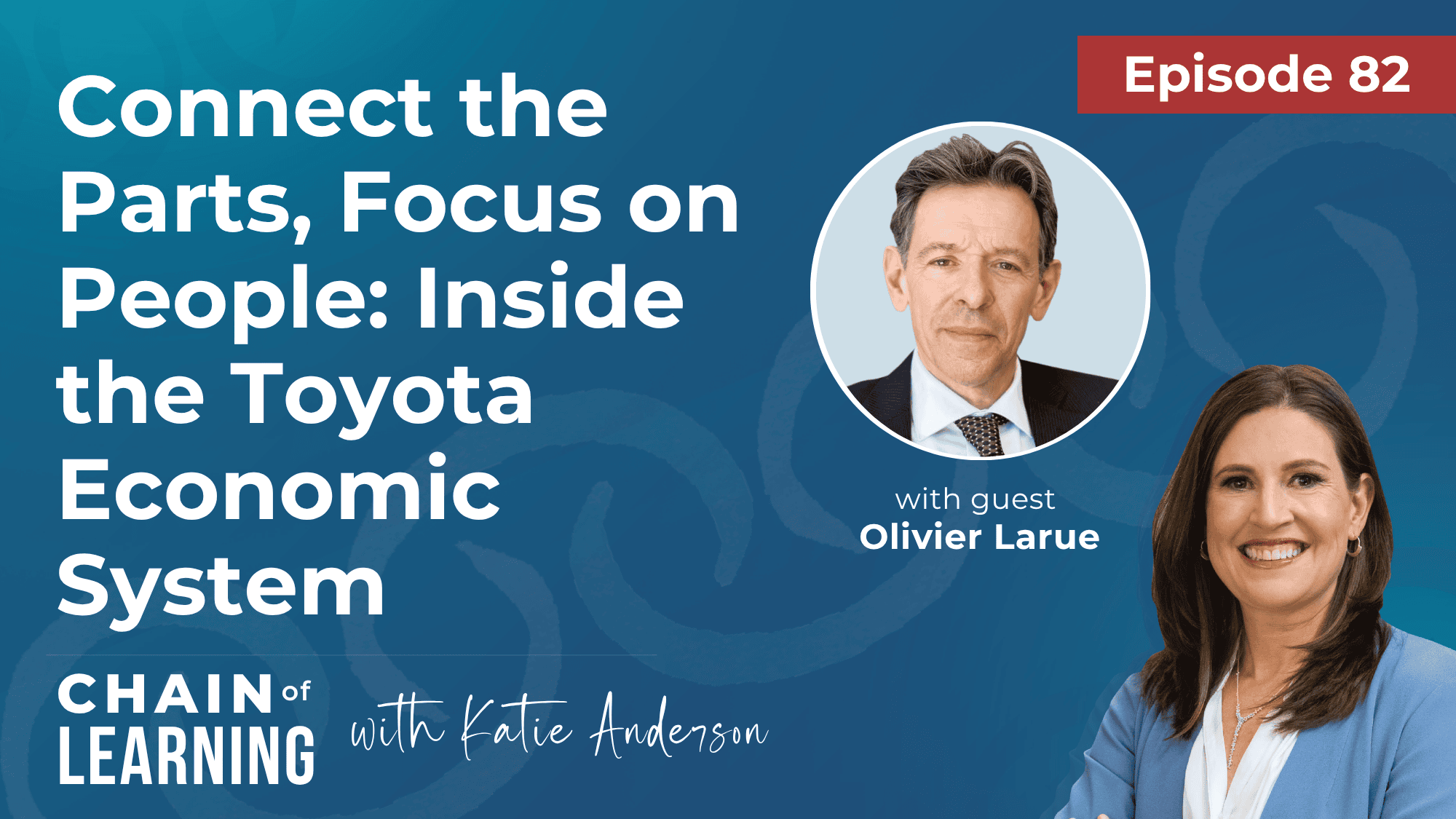
Leadership consultant Katie Anderson and her guest Olivier Larue, author of The Toyota Economic System, explore how using elements from the Toyota Production system help leaders with problem solving and maintaining a people first culture.
Katie Anderson is an internationally recognized keynote speaker, Shingo Award-winning author, transformational leadership consultant, and passionate learning enthusiast dedicated to helping leaders create people-centered learning cultures and high-performance organizations.
The Toyota Production System Connects People, Problem Solving, and Results
Profit or cash. Efficiency or flexibility. Speed, or doing it right.
Change leaders feel like they have to make trade-offs like these all the time. But the choice often isn’t real.
Some contradictions are unavoidable. Others only look that way until you understand the real problem. The most effective organizations realize they don’t have to pick a side if they can resolve the underlying tension.
Olivier Larue has spent three decades helping companies do this, including more than a decade with the Toyota Production System Support Center (TSSC), which he’s documented in his three-book series The Toyota Economic System: a philosophy about people and society, the technical design that turns it into results, and the management practices that keep it alive through continuous learning.
The real breakthrough in the Toyota Production System and lean isn’t the tools, optimizing one part of the system, or making unnecessary trade-offs. It’s how every part connects, and understanding the real problem to solve, so people remain the focus and results last.
In this episode, you’ll learn:
✅ How to tell a contradiction that’s real from one that only looks real, so you stop choosing between things you can’t afford to lose
✅ Why an economic lens, not just an operational one, changes where you look for the answer
✅ Why the number and order of Toyota’s seven wastes aren’t arbitrary, and why overproduction, the first waste, drives how you understand the rest
✅ Why declaring people “empowered” means nothing without the leadership response and conditions that let them act on it
✅ How respect for people and continuous improvement extend to avoiding layoffs even in downturns, and why that matters in a world of AI and supply chain disruptions
Listen Now to Chain of Learning!
Tune in to learn how seeing the whole system can help you challenge false trade-offs, solve the right problems, and create the conditions for people and results to thrive.
Watch the conversation
Watch the full conversation between Katie Anderson and Olivier Larue on YouTube.

About Olivier Larue
Olivier Larue was trained by Toyota Motor Corporation and has spent thirty years helping Fortune 500 companies design and implement industrial manufacturing solutions, including more than a decade as a consultant with TSSC, the Toyota Production System Support Center, and hands-on work in the biopharmaceutical industry. He is the founder and president of Ydatum, and the author of the three-book series The Toyota Economic System.
Reflect and Take Action
Is the trade-off you’re facing actually real?
As Olivier and I explored, some contradictions are real. Others only look that way because we don’t yet understand the system, the problem we need to solve, or how we’re showing up as leaders and change practitioners.
And there’s a contradiction here for us, too: we can’t control our way forward to an empowered, people-centered learning culture.
As you reflect on how you’re leading change:
- Examine the trade-off. Where are you treating something as an either/or choice? Is the contradiction real, or might there be a problem you haven’t clearly defined yet?
- Clarify the problem. Before deciding that you have to choose between two competing outcomes, make sure you understand the problem you’re actually trying to solve.
- Notice the pull to push or control. Are you pushing for buy-in or taking ownership of the thinking because you want the change to happen?
- Create the conditions for empowerment. Consider what would enable others to see the possibility, choose the change for themselves, and retain ownership of the thinking.
Our job isn’t to force a choice between contradictions or own the thinking for others. It’s to create the conditions where people can choose, think, and own the solution themselves.
Where are you treating something as a trade-off when it might be a problem you haven’t clearly defined yet? And what would it look like to create the conditions for others to choose, think, and own the solution instead?
Important Links:
- Full episode show notes
- Connect with Olivier Larue
- Purchase a copy of The Toyota Economic System (three-book series)
- Learn more about Ydatum
- Follow me on LinkedIn
- Subscribe to my newsletter
- Check out my website for resources and working together
- Join us on the Japan Leadership Experience
- Episode 35 | Stuck in the Middle? How Embracing Both-And Thinking Drives Results with Wendy Smith
- Episode 79 | Build Powerful People: Why Transformation Starts with Your Own with Gary Peterson
Subscribe to Chain of Learning
Be sure to subscribe to Chain of Learning on your favorite podcast player so you can build high-performing cultures of continuous learning. And share this podcast with your friends and colleagues so we can all strengthen our Chain of Learning® – together.
Frequently Asked Questions
What are the core principles of the Toyota production system?
At its heart, TPS rests on two pillars: continuous improvement and respect for people. The technical foundations — just-in-time and jidoka, or built-in quality — matter, but what really makes the system work is developing every person into a capable problem solver. Leadership consultant Katie Anderson offers this advice: don’t get caught up in the tools; TPS is really a leadership approach for building an organization full of thinkers.
What are the seven wastes in lean manufacturing?
The seven wastes are transportation, inventory, motion, waiting, overproduction, overprocessing, and defects. Toyota created this list not as something to memorize, but to help people see their work differently and notice where problems and opportunities live. Katie Anderson encourages leaders to keep it simple and stay focused on the intention: developing people to see waste so they can improve the work themselves.
What are the main differences between traditional manufacturing and the Toyota production system?
Most traditional approaches put results first, process second, and people last — and treat lean as a toolkit to bolt on. Toyota flips that order: people first, then process, then results, because good products come from good thinking. The real difference isn’t the tools; it’s whether you see improvement as something you install, or as a way of developing people and leading with respect.
What are the fundamental principles of lean manufacturing?
Lean comes down to two things: relentless continuous improvement, or kaizen, and genuine respect for people. In practice that means creating value for the customer, going to the gemba to both see the work and show you care, reflecting honestly, and developing people’s capability to solve problems. Everything else — the tools, the acronyms — is in service of that, because when you put people and learning first, the results follow.
Timestamps:
02:43 – How a NUMMI experience shaped Olivier years later
05:14 – Why call it the Toyota Economic System?
09:42 – Profit vs. cash: the trade-off companies get wrong
12:32 – Why Just-in-Time doesn’t mean zero inventory
16:30 – What happens when company values and work conflict
20:20 – Why leaders have to “earn” how they manage
21:42 – Why Toyota’s seven wastes are in a specific order
23:38 – The hidden cost of human waiting
27:20 – Why leadership skills alone aren’t enough
30:05 – Why organizations keep repeating the same problems
31:26 – What Andon actually means for empowerment
35:17 – The leadership response that makes problems safe to surface
39:16 – Why Toyota can avoid layoffs during downturns
44:30 – The unanswered question about AI and economic growth
48:30 – How enthusiasm turns pull into push
50:44 – Why isolated improvements don’t transform systems
54:35 – Refusing the either/or trade-off
Full Episode Transcript
Olivier: [00:00:00] So this is what appears to be at the surface a contradiction because people say, “Well, you know, in Lean, there is no layoff,” but you’re gonna lay off. Well, yes, because the reality is that if you’re not efficient, I have no choice but to lay off. Another word what I’m trying to say is that at Toyota, there is no layoff because they’re extremely efficient.
They can afford it. It’s not because they feel like not having layoffs.
Katie: Welcome to Chain of Learning, where the links of leadership and learning unite. This is your connection for actionable strategies and practices to empower you to build a people-centered learning culture, get results, and expand your impact so that you and your team can leave a lasting legacy.
I’m your host and fellow learning enthusiast, Katie Anderson. How often do you feel like you have to make a choice between seeming contradictions, profit or cash, efficiency or flexibility, speed or doing it right? What if most of these trade-offs aren’t real? If you’re leading change, you feel this constantly.
You want [00:01:00] results, and you want to develop people. You want to move fast, and you want it to last. And when that tension gets uncomfortable, the instinct is to push, to control. But in reality, that doesn’t often result in either of the outcomes you want. My guest today has spent his whole career inside of a system built to refuse that choice, that trade-off, not by compromising, but by solving the problems underneath it, and he draws a distinction that’s important for all of us to reflect on.
Some contradictions are real, and some only look that way because we don’t yet understand the system or the real problem we need to solve. Olivier LeRoux was trained by Toyota Motor Corporation and has spent thirty years helping Fortune 500 companies design and build manufacturing systems, including more than a decade as a consultant with TSSC, the Toyota Production System Support Center, and hands-on work in the biopharmaceutical industry.
He’s the founder and president of WhyDatam and the author of a recently released three-book series, [00:02:00] The Toyota Economic System. Olivier and I discovered last year that we both live in the San Francisco Bay Area, and since then, we’ve met up a few times in person for great conversation and insights. While he’s originally from France, Olivier’s leadership journey really starts here, where we both live, in the Bay Area, with an incredible opportunity, a four-month internship during his master’s program, working on the front line at NUMMI, the joint venture between Toyota and General Motors, one that you’ve heard me talk a lot about in past podcast episodes because of the connection of Isao Yoshino, the subject of my book Learning to Lead, Leading to Learn, and recent podcast guest John Shook.
So that’s where we started, with a question about how did that experience at NUMMI shape Olivier as a leader and as a human being. Let’s dive in
Olivier: Well, so I think that when I was working at NUMMI, it didn’t shape me at all other than I didn’t want to be there because, um, I was doing a master’s degree, [00:03:00] and I didn’t want to be an hourly on a shop floor.
Okay? I, I had… You know, I, I wanted to do something else. I wanted to be, uh, maybe more of a consulting area. So, uh, but what h- what’s important is that sometime you live something at the moment, and you don’t realize it’s actually gonna shape you later. Because when, uh, I became a consultant, and when I went to TSSC after being a consultant, and I began to work on the shop floor with operators, I could relate to them.
I had a much greater, uh, possibility of understanding where they were c- where they were coming from. And so, so I think that really helps me develop a different sets of maybe traditional skills, and, uh, that’s one thing. And then the second thing is that I don’t know that I appreciated was b- what was being taught to me at the moment when I was on the shop floor.
And, um, so when I was later trying to apply what’s being taught to me, I also understood how difficult it was for the people on the shop floor to [00:04:00] understand it when it’s not well explained or when we don’t have the patience. So I think it, it shaped me later on with a level of patience Uh, and a, a level of being able to relate to the operators on a shop floor.
Katie: Yeah. Sometimes those, those lessons aren’t necessarily learned in the moment, right? Or, you know, now you’re the teacher, it’s like, oh, I, you know, I remember what it was like to be the student.
Olivier: And then also when I, when I left NUMMI and I had a full-time job, I was trying to apply some of the things that I had seen, but it was very difficult.
I just, I just couldn’t do it. I just couldn’t replicate what I had seen. And so it give me a level of humility about what I thought was actually not a big deal. Because when you are first introduced to the system, it’s kind of looking at a car or looking at anything that you haven’t made yourself. It doesn’t look that complicated because you look at it very superficially.
But when you’re actually trying to do it, uh, it’s a different story. So I think it, it, it, it also brought a level of humility about, um, how hard sometime it can be to actually [00:05:00] implement it.
Katie: So many great experiences from your, your many years of not only working then at TSSC and other consulting engagements around the world.
Also from your trio of books called The Toyota Economic System, and these are so fantastic. I, I highly recommend them for anyone who is trying to do this work. You call it The Toyota Economic System, and most people are familiar with the Toyota production system. How did you come to this, this as the label, The Toyota Economic System, and what led you to then write these books?
Olivier: It is no question that it’s the Toyota production system, but I do think that the impact of the production system that Toyota created is much greater than just the benefits of applying it on a shop floor. When you work for Toyota for a long time, and you begin to understand the Toyota philosophy, you, you begin to realize that- They are aiming for something much greater than just being [00:06:00] efficient on a shop floor.
There is a, a level of, uh, stewardship that comes with the work that they are doing that is pretty impressive. And then the reality also is that the Toyota economic system or the Toyota production system was recognized worldwide around 1973, ’78 on the first and second oil crisis. Where many company during that economic crisis were struggling, Toyota continued to do well, continued to be able to improve profit while in economic slowdown.
At the end of the day, it’s the economic impact that it had on its revenue and its profitability that, that, that made the system famous. So it’s a little bit in relationship to that as well. That’s why I called it the Toyota economic system.
Katie: Yeah, it’s, and it’s a broader system. Y- you have this perspective, and as do I, we’ve had some shared conversations around this, that often people focus on the concept of efficiency or a small segment of it, but it’s really so much more.[00:07:00]
And I’ve talked about this on the podcast too, about in, like Japanese business is built on this concept of sanpō yoshi, goodness for the customer, goodness for the company and the people, and goodness for the community. And I, when I’m, when I was looking at the, the different books that you’ve structured, it almost seems like they, they align with those ideas as well.
How did you think about the structure of the three books and why you did them in the sequence that you did?
Olivier: Well, you know, I had a long time to think about them because I s- I, I, I spent many years at Toyota, and then, uh, it was many years in the making. What was most significant to me when I looked at the production system and I began to understand it a bit more deeply, not that I understand it completely, but, but when I understood it more deeply, I began to, to realize that it was reconciling contradictions that could not be reconciled outside of this production system.
There are three books, and there is a, um, an environmental, uh, reconciliation that happened with economic growth. [00:08:00] Toyota is trying to minimize its footprint as far as the environment, and we see it everywhere, where, I mean, it’s published all the time. We also, um, see that there is always a contradiction between what we call profit and cash flow when you’re in a company.
Many companies seek to make a profit, but they end up short on cash flow, and they have to incur debt. And many, many startups, even in, in, in the world, you know, end up not making it because eventually they run out of money, and the bank don’t, won’t give them more money, and they, they run out of it. I, I begin to see those contradiction.
And then the last one that basically covers the managerial aspect of it is a contradiction between the nature of people, which is very creative- Uh, very innovative, also the very mundane and, um, boring side of manufacturing. So how you recon- reconcile the, the, the two, right? And, and the more time I spent with the Toyota Production System, the more I saw and felt that when Toyota was trying to solve a problem, they were not just trying to solve a problem in isolation.
They were not trying to [00:09:00] solve just one problem at the expense of another. They were really trying to avoid the trade-offs and the contradiction that came with sometime a, a, a solution. And so living with Toyota, it’s, it’s, it’s, it’s very often, uh, feeling a sense of dissatisfaction constantly because problems are hard, hard to solve.
But, uh, that’s because they’re trying to solve hard problems, not just a problem right now for the quarter and then we’re gonna deal with it later, maybe when it’s a new manager that comes on board. So there’s a big difference there. It, it’s the idea really to avoid the trade-off and reconcile the, the, the factors that are in contradiction.
Katie: The one of the ahas that I had, which I ha- I hadn’t quite, uh, I guess reconciled or thought about myself, was that, was that seeming contradiction between, you know, the balance sheet and cash flow. And I, I think this is y- gets at the crux of a lot of challenges that current companies are facing with trying to apply what we might call lean or the Toyota Production System in, in their companies.
Can you speak in sort of, I guess, terms that beli- that [00:10:00] listeners can understand, and I, you know, there’s so much detail in your book, but why this is such a challenge, and what’s the sort of the reframe that we need to have around this?
Olivier: There’s no question that when we do something Um, economy of scale i- is a big factor in being able to be more efficient.
Uh, when we talk about… What I mean by economy of scale i- is being able to almost the expression like kill two birds with one stone, right? Right. Uh, the more your asset is working, the better, the more money you’re making. And, and the problem with this is that as the world becomes more and more diversified in its product base, because people want cars and all kinds of goods in different colors and shape.
So now what we have is an operation that is forced to make different kinds of products in different colors, shapes, features, and all that. The problem is that when we are trying to make different kinds of product in different kinds of shapes, colors, and features, um, the tool that we have or the machines that we have are not very flexible.
They, they, they require very [00:11:00] often what we call a changeover, right? They got to be retooled. Uh, we got to stop, and then when we stop, we are losing time, and the asset is not making money. It’s basically not efficient. So what we try to do then is do it as the least often possible, right? So we end up running big, large batches of a product.
The problem with learning– with, with running a big batch of a product is that it increases the lead time of delivery, the production lead time, essentially. And, and, uh, to support that production lead time, we have to have inventory, and inventory costs money, ties up your cash, and that’s the relationship there between profit and cash flow.
What we’ve, uh, what we’ve seen is that in the mass production system, traditionally When you wanna make a profit, you have to compromise the cash flow. And when you are favoring cash flow, then you end up compromising the profit. And we see it very f- very, very often when companies try to actually start lean.
Um, you know, somebody comes in as a brand new manager and say, “Oh, we have too much inventory.” And well, they start cutting the inventory, and [00:12:00] every- all of a sudden they can’t ship. They don’t have enough product to ship to the customer, so they end up missing revenue. But without revenue, you can’t make a profit, you can’t absorb your cost.
So yes, now they have less inventory because they have less things, but they can’t ship. And then because they can’t ship, they can’t have revenue. And because they can’t have revenue, they can’t have profit. So we see this constant tug of war, and the only solution to be able to reconcile the two, one of them, is to eliminate the changeovers, and that’s one of the big technical breakthrough that Toyota came up with.
Too long of an explanation, maybe I’m-
Katie: No, no. I mean, I think, uh, the, all these different, different seeming trade-offs, right? And so it’s like you have to be able to reconcile them at the same time, and, and Toyota’s really done that at the same time. I- we hear so much that, like, just-in-time doesn’t work because actually it’s…
Just-in-time doesn’t mean that you have zero inventory. I mean, maybe that’s the extreme ideal condition, but it, it’s, it’s stretching us to think about how can we improve that. All the companies I go to in Japan, including Toyota [00:13:00] suppliers, they have inventory. They just have strongly calculated what the right amount of inventory is so that they can do the things.
And so it’s about how are we thinking better about how we’re doing the work, not just blindly putting in place everything ha- like zero inventory is the answer. No, that’s the, the aspiration, right? And you articulate this really well in the book too. There’s Toyota, and this is my experience too in talking with Mr.
Yoshino as well as other Toyota leaders and c- other companies in Japan, is that they have, they’re very clear on the ideal condition. Their ideal condition for the business, for the process, and for management and management’s behavior And then it’s wor- working towards that ideal condition and, and deeply understanding what the current condition and then closing that gap.
And so, like, that’s that problem-solving mindset. Like, you have to know where you’re going for and then deeply understand where you are. In the book, you talk about, like, these ideal conditions for both the business and ideal conditions for, [00:14:00] like, the human side in the organization. Uh, what are… Let’s, you know, you talked about for the, the technical, it’s zero defects, which we just, you know, 100% value added one by one, on demand, in sequence.
So we can, we could go deep on those, but I really wanna go deep on the ideal condition as it relates to humans. Physical safety, mental safety, human development, and, and how you’ve come to really see those play out in the or- in, in how you’re helping other organizations get towards that ideal condition.
Olivier: Yeah. Actually, when I went to Toyota, it’s the first time that I was introduced to that notion of, uh, uh, ideal condition for the worker. Ideal condition for, essentially for the worker, for the employee, right? And so physical safety is pretty easy to understand. I mean, it’s obvious. Today we know in, in the 21st century, I mean, we still have companies that violate that, you know.
I mean- But not without pretty large consequences, uh, you know. Um, but the idea of mental safety is, is not very well understood, [00:15:00] and the idea of mental safety is really being able to do something with the assurance that what you’ve just done is good. It’s not only good for the customer, but it’s good for everything.
There is no compromise because, um, when it’s not good for everything, then, um, you carry the burden. Uh, maybe you carry the burden of wondering whether you made a defect and potentially harmed the customer, or maybe you are doing something, making a product that’s not very good for the environment, um, so on and so forth.
So that creates, for the lack of better word, a statics, you know, or, or a s- a level of resentment in the person, and that needs to be addressed because what we want to be able to do is tap into the genius of people. The genius of people is not always available if, if there is a contradiction in, in tapping into that genius.
In other word, do people really want to do things that are not really good? I, I, you know, some people might have to [00:16:00] do it because there is a need for doing it, but at the end of the day, it’s less than ideal. So when we work for Toyota, they do a lot of work, and they’ve strong attention that whatever the employer is being asked to do is morally and ethically very correct.
And, and to be honest with you, we, we see a lot of contradiction in many companies. Sometime we see companies have a very cont- big contradiction between what people are asked to do and what the communication is in the company. And when there is a disconnect between what people are asked to do and, um, what the communication is Then, then we end up with resentment, and we end up with people that don’t give their best.
Katie: Can you give me example of, like, how you’ve seen that? You don’t have to name a company, but, like, a- and how you, how you helped the leaders see that there was this disconnect and the impact [00:17:00] it was having.
Olivier: Well, I don’t wanna give a lot of examples because, but, because I’m, I don’t think that one company is worse than any other.
But, I mean, okay, so maybe you work for Facebook, and you know what? They, they’ve, they’ve never worked… I’ve never worked with them, so maybe I can say that because it’s kind of a general topic right now, right? You know, there’s a lot of controversy. Is it good for kids? I do think that employees that work for companies that are, uh, putting products out where there is maybe a suspicion about whether the product, what they are doing is, is, is really good for society, it’s, it’s not a good thing.
A, a company like Toyota, for instance, would welcome the regulation because they don’t want a cr- they, they don’t want a contradiction between what the employee is asked to do, and when a, when an employee is asked to do something, they’re asked to do their best. You know, but if you don’t fundamentally think that what you’re doing is best for society, will you actually do your best?
I, I know that then when I was working for Toyota, uh, and I was being asked to do [00:18:00] my best, I did not have a second thought as whether what I was doing was legit or not.
Katie: Yes, and we have to reconcile or not, but that’s, it’s harder, it’s harder to show up that way, and that’s where the, the doing the right thing or doing good for society, you have to have alignment to really be able to show up with your full authentic self, alignment with, with the organization.
And that understanding how the connection between the work you do serves that greater purpose. I mean, I remember going to Autoliv, uh, airbag supplier of Toyota i- in the United States, and how, I think they’ve, I, I’m sure they worked with TSSC, and how, like, even the, the janitors at the floor would say, “I help save lives.”
And, like, so this connection to purpose, so I’m not just doing a menial task, I’m doing something that’s important, and it gets out of this clock in, clock out, uh, mentality as well. But they, they were able to align on what the, the good for society is on that, not just we’re making a profit, but we’re, we’re doing something in service of, of a great
Olivier: Yes, and you know, [00:19:00] they don’t, they, they don’t necessarily require that everybody makes the connection.
Um, but what they require, I think, after working with them for a long time, is that the contradiction is not there. It’s up to you to make the connection. The reason for which you come to work, you know, it’s the reason for which you come to work. I mean, we can’t make people who don’t wanna do problem-solving or people who don’t wanna have a greater sense of purpose have a sense of purpose.
Maybe they have a sense of purpose somewhere else. Some people go to work just to make money, and then their sense of purpose is outside of work, in the community by doing volun- by volunteering or something else. The thing they are more worried about the contradiction Because people see contradiction.
When you tell people, “Do this because it’s good,” but you can see that it’s not because there is facts about that it’s not, then, then, then it create disenchantment and, and they’re avoiding that.
Katie: I, I… You know, it gets back to a phrase I, I say often is like, leaders’ responsibility is creating the conditions.
So you’re not commanding that someone identifies their purpose with the, that of [00:20:00] the organization, but you’re creating the conditions so that they can see it or that they can choose the reasons that they’re showing up.
Olivier: You’re touching on something very important, and it’s actually what, that’s the reason I w- I wrote the three books in that sequence.
I… And I realize, you know, now that the three books are out, the managerial book, the last one, the third one, is selling much better than the others ’cause everybody’s jumping on the, on the third book. But I wanted to write first the, the principle and the philosophies followed by the technique because at the end of the day, you know, we have to earn how we manage.
In other word, you know, we can’t just say, “Okay, I’m gonna do lean, and I’m gonna, I’m gonna be a great leader i, in this environment,” and ask people to go find a defect in the pile of inventory. Well, finding a defect in the pile of inventory is not easy Finding a defect when there is two parts, yeah, that’s easy, ’cause you can just pick the one that is no good.
But when there is 10,000 parts, you have to, you know, or, or, or some other examples, right? Many people who are very intelligent, very highly educated, in many industries have to solve a problem that happened three or four [00:21:00] month ago, and they’re in a conference room trying to collect data that is obsolete.
And, um, they’re struggling to solve that problem. They are scientific. They are applying the scientific method, but because the problem happened four and five months ago and nobody was there to see it, it’s very hard to solve. Any, any company needs good leaders. It doesn’t matter if it’s Toyota, lean, not lean, it doesn’t matter, okay?
And, uh, and science is science, okay? Uh, what we have to appreciate about Toyota is that when people are asked to be leaders and when people are asked to solve problem, Toyota has created the condition to make that possible.
Katie: You know, I, Olivier, as I’m thinking back and, and I’ve, I saw this today in book three as I was going back through it again.
The last time we got together in person, I had just returned from Japan in November and had made a post from this very same Toyota supplier where the chairman had gone through the seven wastes from Toyota. And I think this might be one of my most top controversial [00:22:00] LinkedIn posts ever because, you know, he said there are seven wastes, and they come in a certain order.
Oh, my gosh, there was so many pr- opinions. And in your book, uh, and in our, in our conversation, you said, yes, there is purpose and intention around why Ohno created the wastes, the seven wastes in this sequence. Doesn’t mean there aren’t other wastes to observe. Tell us, like, what, what’s the importance of the order of the seven wastes as they originally were intended, and how that helps you in organizations?
Olivier: Well, I mean, the first one is overproduction. And, you know, the worst overpro- overproduction, you know, goes back to book number one and, uh, frankly, also book number three. Because when you’re making something that is not needed, obviously, then you’ve got this contradiction, right, uh, in the communication and the intent, right?
Where we’re told to do but, you know, it’s not needed. Uh, so on the human side, it creates a contradiction. But, uh, um, practically speaking, on the business side, it’s also a huge contradiction. Many companies end up making products [00:23:00] that nobody is gonna want, um, but they’re making it to be able to absorb their cost.
Again, it’s the idea of economy of scale, right? And so this overproduction is the worst waste because it encompassates all of the other waste. Not only you made too much of what you don’t need, but it has all the other waste in it because you went through making it, correct? Um, so that’s the first one to eliminate, and that’s the idea of producing according to customer demand and not just relying ec- on economy of scale.
Now, economy of scale is good if you can achieve economy of scale while servicing the customer. But making more than what the customer want, it’s not gonna sell Uh, and so the second waste is, is waiting. The, the reason the second waste is waiting is because when something is waiting, there is no value being created.
And, and, and what Toyota really thinks about here is really the waiting of, of humans, okay? Uh, human waiting, right? The, the, uh, the greatest cost in making a product is, is human labor. [00:24:00] Now, if you look very narrowly about the boundaries of one company, the percentage of labor versus material may be, you know, different depending on the company.
But the reality when you look at the supply chain, the only thing that gets paid throughout the entire supply chain is people. People get paid for their work, they get paid for owning intellectual properties, for… I mean, you only pay people. You know, machines don’t get paid unless somebody actually gets paid because they made the machine.
It’s the people who extract the dirt from the earth to make the metal that get paid. So all the way through the supply chain, the cost is really people, so we got to minimize that cost. That’s why number two is, is waiting, and especially when it comes to human wai-waiting. Okay. Uh, the third one is the conveyance.
Because when we convey, then there is no transformation of the product. And not only that, but when we convey, there is expenditure of, of energy and time, which is costly. Okay? So after that is surpro- uh, it’s, it’s called kind of, [00:25:00] um, overprocessing, maybe doing too much of something in making the product. So drilling a hole too, too, too deep, applying too much paint or something like this.
Now, the reason all those first four wastes come before inventory is because if you really think about it, right, um, overproduction is a form of inventory. So how can you remove inventory without removing overproduction? When you have waiting, conveyance, and overprocessing, you’ve got lead time. And the purpose of inventory is to support the lead time.
So trying to reduce the inventory before you actually reduce the lead time is absurd. You just can’t do this. It’s absurd. And that’s why many companies who go after the inventory, reducing it without actually looking at the reason for which the inventory exists, end up being in trouble by not shipping.
So they’re trying to focus on their cash flow. We could have less working capital. Let’s go out. You know, this year is the year of reducing inventory, and they start doing it, but they change nothing structurally, structurally. So they end up with misshipping and then poor revenue, [00:26:00] and now cash flow and revenue or profit has conflicted.
So now we have inventory, right? So we can’t reduce inventory before we address, address the lead time and overproduction, followed by essentially motion. Because motion now, when we get down to the motion aspect of it, we’re talking about small increments of time. Now we’re talking about seconds, a fraction of seconds, right?
How you organize the work. And then the last one is defects because if you do the least amount of the preceding one, in other words, defects happen when you touch the product. The more the product waits, the more it gets conveyed, the more it gets overprocessed, the more you make a product that you don’t need, okay, the more defect you’re gonna have.
The more motion you put into your work, the more likely you have to have defects. So defect is the last one because if you minimize all the preceding waste, then it’s gonna be a lot easier to make no defects or less of them. Do I make sense?
Katie: Yeah, no, I, I think it’s really interesting because more on the technical side, but it actually relates to the human dimension, too, and so many people learn different acronyms like TIM WOOD or whatever [00:27:00] to remember the waste.
Wa- wastes are often the entry point for a lot of people in lean, in Kaizen, in continuous improvement because there’s, you know, they’re tangible and you’re able to see. And having that nuance of the sequence actually makes a lot of sense, uh, in where you need to get started. I
Olivier: don’t want to interrupt you, but let’s go back now.
Let’s make the connection that you wanted to make earlier, that we made earlier about the managerial aspect of it, right? So again, you can have a great leager- leader on the shop floor, right? Leadership is required no matter whether you’re Toyota or somewhere else, right? What is the leader actually doing?
He can be a great leader, but the decision that the leader is making and the question the leader is asking and the request that the leader has of the employees is equally as important as his leadership skills. In other word, asking somebody again to find defects in a pile of inventory, y- you may do it very nicely with all the leadership skill that you may have, but the reality is that the condition is not there for the person to [00:28:00] be successful.
Katie: Right. So let’s look at what– for overproducing first. Let’s, like, look in sequence about how this is going, and then that will help us… If we work on these other things, it’ll help us see the defects down the line. We can get more refined on that. So start with the bigger, the bigger challenge and then, and then work your way through that as you’re getting more clear on the problem-solving.
Maybe where you’re starting, like, wow, our ideal condition is zero defects, and we have a lot of defects, and so how do we reduce that? But then let’s go in and use our, our, our mindset around how are we seeing waste. So let’s start with are we overproducing? Are we hiding and m- disguising things? So how do we make the vi- invisible visible through that and, and working through that way?
Olivier: Another example would be this. Like for instance, we very often, all the time- See companies that have a manufacturing line, let’s say there is 10 people in the line, and they have to make a shipment, you know, by, by 6:00 PM, whatever it is, and they miss the shipment or the line is not performing very well.
So what’s the traditional countermeasures to actually meet [00:29:00] making the shipment? Is to put more labor, more resources, more people, more workers in the line to make up for the lack of stability, to make up for the losses we have. So now you’ve got more people in the line, right? So the cost actually is going up, but you’re making a shipment, right?
So the interesting thing here is that people know that instead of solving the problem that we have, we’re just working harder to mask it. Now, I’m not, I’m not saying we can’t… we shouldn’t be making shipment. That’s not the issue. The issue is that the solution does not stop as simply putting more people in the line to make shipment.
There must be a second step from the leader that says, “Okay, well, we had to work harder and make more people in the line, have more people in the line to make the shipment, but now let’s go back and reflect what were the problem? What did we do wrong?” And when that does not happen, then we see that there is a communication discord, a contradiction between what the company is really trying to do and, and what the, what the company does.
Katie: That resonates so much with my experience too, is that of course, [00:30:00] in the moment, you have to respond to the, the emergency or the issue, like the deadline, the timeline, if there’s truly an emergency. But what a lot of organizations don’t have is the muscle strength to go back and say, “Okay, so now how do we look at that so that we are understanding what was the root cause that really got us to that point, and then how do we work on preventing that in the future?”
And so like we just are so forward, we just gotta keep going that the going back to do the problem-solving doesn’t feel, um, productive, and then we keep repeating the same thing. Or I came from healthcare, we literally were putting band-aid solutions on top of band-aid solutions, leading to complexity and great inefficiencies in the, in the system, and heroics.
Olivier: And so much so that Toyota even doesn’t trust itself, you could say. That’s why they put mechanism in place that, you know, when you work on the assembly line, for instance, if a problem happens, there are structure in place so that the team leader can come quickly and work with the operator to solve it.
But if the problem is not solved by the time the car finishes, uh, its [00:31:00] work cycle, the worker on the car finishes the work cycle, the line stops. It’s actually, you just can’t just keep the line moving with the defects because… So there are infrastructures in place Where, um, the system itself is going beyond sometimes the will of the people that would be instinctively, “Okay, just keep going.
You know, we got to make shipment,” right? No, the system itself is stopping. Uh, like for instance at Toyota, if we have to take a car off the line to fix it because it’s a big problem, because we cannot fix it on the line without incurring unreasonable amount of downtime, then there is only a certain amount of cars that you can take off the line before actually the s- line completely stops, and we fix it and for good.
Katie: So some listeners might be familiar with this, called Andon. Andon being a Japanese word that means signal. And I actually d- when in Japan, I, uh, was speaking for a large, um, asset management company for all of their senior executives in Asia Pacific, and they were really curious around this concept of how do you create [00:32:00] the conditions within an organization that empower people to speak up when there’s a problem, and this concept of Andon.
And, and Mr. Yoshino and I were both there, and he talked about NUMMI. That was the transformation point for the leaders who had come from GM, where speaking up to say there’s a defect or a problem was you’re gonna get fired. Versus at Toyota, they actually, they want you to do that, and not only that, it’s not like, “Oh, I just empower you to speak up.”
The team leader comes over to help, and if they’re not able to c- solve and help the, you know, the problem at this, that point, as you said, then m- there’s, there’s more swarming.
Olivier: That’s right.
Katie: And in, in your book you talk about, like, this concept of empowerment and, like, how we, we’ve kind of used this word like we’re empowering the people.
But, like, without the leadership response, like-
Olivier: Without the framework, the technique. Wait. You know, empowering people is not, not that people are children, but to make an analogy, right? It’s like going to your children and say, “What do you want to eat tonight?” And they will tell you, “Well, I’d like a lollipop.”
And you say, “No.” Well, then why did you ask them [00:33:00] what they wanted? What you should have done is give them a choice. So what Toyota is very good at doing is not just empowering for the sake of empowering, but they empower within a framework of thinking that is very precise, okay? Uh, let’s go back to the Andon issue, right?
So o- obviously not stopping the line is a problem when there is a problem because maybe we’ll pass a defect, okay? Right? In other words, if you have a problem on the assembly line and you see it, and you don’t stop the line to fix it or fix it on the line, then, um, the defects can go on and you make a defect for the customer and it’s a big problem.
At the same time, stopping the line is very costly. I mean, if you think about it, every time the line… I mean, at Toyota, for instance, right? Takt time is roughly between fifteen seconds and maybe a minute and some seconds, right? Whatever. Let’s take a minute for sake of argument, right? So it means that every one minute a car comes out of the assembly line.
And a car, you know, to build a car on average is probably twenty thousand dollars, right? So I mean, every minute the line stops, you lose a car. It’s [00:34:00] twenty thousand dollars a minute, right? So we have to also understand that stopping the line is very costly. So if solving the defect is not an option, but if stopping the line is also very costly, what’s the only solution?
It’s to solve it while the line is working, right? I mean, do, do, do you see the c- do we get caught into this, “Okay, I know I can’t stop the line, but there is a cost to it, so I’m gonna put the infrastructure on the shop floor so that the problem can be solved before the line stops.” And the vast majority of problem that happen on a shop floor are solved before the line stop, before the line stop because of the infru- infrastructure that’s, that’s put in place.
Katie: I think that’s a really important point to clarify because I hear people often say it’s stop, like, Andon is stop the line. Actually, it’s a signal to then they need help before you have to stop the line. So-
Olivier: That’s right. That’s right …
Katie: the, the, the empowerment is to say there’s a, like, it’s not to not pass on the defect, right?
So I need help, we’re not gonna be able to do this, then there’s quick response by the team lead to come and help, [00:35:00] and then it’s only then if they’re not able to resolve it that, that, that the, if during the one minute that the car is coming down the line, that they actually stop the line. And so I th- I think that’s a really important point there, but it’s saying that this is the expectation and there’s gonna be help.
And as a organization, it’s important for us to solve this problem very quickly, and let’s ke- let’s not have lost revenue through having to truly stop the line. But we will because we also don’t wanna pass the defect down, and then at the end have all this rework and maybe 100 cars have to have had the same defect.
So anyway, it’s, it’s a just a shift in mindset and also a shift in leadership behavior of welcoming those problems. You know, bad news first, tell us about the, the defect, and I’m here to help, not here to punish.
Olivier: And that could appear being a paradox, right? But it’s not. Actually, it’s not. It’s not. Because it’s not a contradiction.
The only solution to actually getting out of this conundrum is to fix the problem now, right? And so the resources are in place to do this. [00:36:00] When you implement Lean, and you look at the managerial aspect of it, and you’ve read a bunch of books about management, and you say, “Okay, we will do this. We will now implement Andon, and every problem that shows up, we’re gonna address it real time, hopefully before we stop the line.”
But the reality is that if you have a completely poorly designed product, no standardized work or, uh, haphazard work, then you have so many problems that it’s not gonna be working. It’s, it’s impossible. In other word, again, you have to earn this slowly. So, so, so the leader in a Lean environment has to understand very deeply what we just talked about, but also very deeply that to get there, you have to have a product that’s manufacturable, and you have to have work that’s been greatly studied and defined so that it’s somewhat stable.
Before you actually go there. Do I make sense?
Katie: Totally. That’s something that, you know, I, I got to really understand more deeply in the time that I lived in Japan, and realizing how much their, you know, the product development side of Toyota [00:37:00] was essential for the production system to then be effective, and they…
How intricately those are connected, the development of the product. Uh, Olivier, I’m really… This word of con- you know, contradictions is one that has come, uh, up for me, especially when I l- I’ll always talk about con- the contrasts and contradictions living in Japan and also through Toyota and, and you’ve highlighted some here and, and in your books too, you know, efficiency versus humanity, profit versus dignity, growth versus sustainability, efficiency versus flexibility.
How do you think about some of these seemingly contradictions and, and what is your advice for, like, us as listeners who are trying to create, or the listeners here who are trying to, trying to build this in their organizations? How do you, how to, how to manage these seeming contradictions?
Olivier: Okay, that’s interesting what you’re saying, because some contradiction appears to be contradiction when they’re not, and it’s the lack of understanding of the system that makes them appear, uh, as being contradictory.
For instance, the idea that, you know, you [00:38:00] want me to stop the line, but at the same time, if I stop the line, it’s gonna cost a lot of money. This is a system design that appears to be contradictory because we don’t understand it when it’s not Now, there are, however, contradictions that are real in many aspect of our lives, uh, that have to be solved.
And problem-solving or progress in society is all about solving those contradiction. It’s all about innovating toward solving those contradiction. I mean, medicine is all about that, right? Trying to find a drug with the least amount of side effects, right? For instance, right? We have to distinguish between what is a true contradiction and what is not.
Sometime we don’t do a very good job at that. Sometime it appears that the Toyota Production System is contradictory in, in nature because we’re asking people to do things that seem to be contradictory, uh, but it’s not. And sometime, uh, we have a true contradiction because we haven’t solved the problem yet.
Katie: Hmm. Or identifying what the real problem is that we need to solve. We’re, like, staying at that [00:39:00] symptom level. What’s an example of one of those that you see coming up in your, your work with clients that is a seeming contradiction but isn’t one, but isn’t necessarily obvious to them about what, what they’re really trying to solve?
Olivier: I think that one of the, one of the biggest contradiction that seems to be, and it’s difficult to address it, is the issue of labor. Let, let me start by saying that, you know, y- it’s well known that Toyota has not laid off people for a long time. It’s not a policy. I mean, well, at least when I was at Toyota, they kept telling me, “It’s not a policy, it’s a, it’s a practice.
It’s a practice that we can afford.” What happened is that because the labor efficiency is very high, they can afford to withstand periods of slow growth without having layoff. And so this needs to be earned. In other word, when you have a company that is very wasteful, that has excess labor, then they start a lean program, and poof, pretty much right away or very shortly after because they’ve done the math, they find out that they have [00:40:00] excess labor.
And poof, now there is a layoff Okay, so poof, now you find a big contradiction between, okay, well, I thought lean was about respect for people and no layoff, and I just went through a layoff, okay? We have to be very careful about those approaches. We have to go slow about making sure that we slowly, maybe through attrition, uh, through natural attrition, right?
Because people retire. We are able to size the workforce according to the need of the work, and also maybe because in other areas we’re reducing waste, and we’re able to improve the profit, you know, reduce cost, and maybe absorb some of excess labor in a short term. So this is what appears to be at the surface a contradiction because people say, “Well, you know, in lean there is no layoff.”
Well, but you’re gonna lay off. Well, yes, because the reality is that if you’re not efficient, I have no choice but to lay off. Another word what I’m trying to say is that at Toyota, there is no layoff because they’re extremely [00:41:00] efficient. They can afford it. It’s not because they feel like not having layoffs.
It’s not because it’s a human respect thing necessarily. Well, it is, but it’s earned. It’s because the labor efficiency at Toyota is the absolute highest of any industry that I’ve ever visited or company that I’ve ever been in, okay? It’s, it’s about 78% labor efficiency, and the average labor efficiency of the US is probably no better than 40, and in many industries it’s probably 10%.
So they can afford it, but getting there means developing people, creating a framework, working with them, being patient.
Katie: It’s so important, too, that if people think that the result of their innovative ideas is going to result in their layoff, they are probably not going to truly br- you know, do their, do their best work.
And I’ve been thinking about this a lot lately, and so Gary Peterson of O.C. Tanner just came on the podcast and talked about that was such a critical part of their lean [00:42:00] transformation, too, and they had attrition over years and actually really reduced their workforce at the same time they were making improvements.
Toyota does that, other companies in Japan, too, and I think this really creates the engine of improvement. And you know, Olivia, you and I are based in the Bay Area, San Francisco Bay Area, heart of Silicon Valley, and there is so much news right now of, like, thousands of people getting laid off from companies, um, cutting them and then pointing towards AI.
And I, and I’ve been talking to friends who work in these companies. They say, like, the culture has really shifted. It used to be this innovation and problem-solving and people first, and I think when people feel the risk of their jobs in a very real way, they aren’t showing up Truly to their fullest self.
I don’t know, what are your thoughts on that as it relates to this world of AI and so many layoffs in the culture that’s getting developed in companies around us?
Olivier: Well, I mean, I have two thoughts that comes to mind. One of them is the… Because I do live, I have lived a long time in, in this [00:43:00] area, and I know the Silicon Valley very well.
Actually, before I even went to Toyota, I was working in Silicon Valley. And the Silicon Valley is great, but they’re so product driven. The Silicon Valley is a product driven environment, and they– It’s not they don’t care, it’s not that they don’t care about the method by which they actually, uh, create the product or manufacture the product, but they are caught in this cycle of, “If I don’t create a new product, then I’m not gonna be able to survive.”
There is truth to that, um, that’s also because they are caught into that cycle. In other word, they are in some way so inefficient on the organization of work that they are relying entirely on the product innovation. And so what I’m saying here is that this focus on product innovation is shifting a- them away from the work organization, and people is all about the work organization.
I mean, at the end of the day, when you organize work, unless you have only machines, it’s about people. How you organize work, the method of production you’re using very [00:44:00] much touches people. And so the Silicon Valley, even though they are saying things about people and, you know, people driven or whatever it is, they are so product driven, there is no space, no time.
They never get there. It’s like, uh, somebody drowning into this product innovation and no– never being able to actually address. So it’s always a reactive thing. It’s always reacting, reacting to the fact that, okay, well, now we have, uh, we have excess labor. Uh, I, I don’t know if I make sense or not, but, uh, that, that’s, that’s my, my thought.
Um, now on AI It is a complicated question because everybody, I mean, everybody’s thinking about this. You know, the, the speed at which the transformation is gonna come is so fast. When the Industrial Revolution came about, we had about 150 years, you know, to be able to transfer from an agrarian society to an industrial society, and it happened slowly.
This transformation obviously is gonna happen fast, and whether it’s gonna happen faster than the [00:45:00] benefits from growth. I guess the big question for AI, will it increase the GDP? If AI increases GDP, gross national product, cr- you know, if it creates economic growth in the society, then we will be okay. But if it doesn’t, then it’s gonna be a big problem.
So, and I don’t know that anybody knows the answer to that yet. Right now, there is a level of growth, GDP, that’s being, uh, registered mostly because of expenditure on energy and infrastructure, right? And a little bit of savings on efficiency. But if it doesn’t sustain over the long term, then it’s gonna be a problem, and I do not have an answer.
I just don’t know. All, all I know f- I… my conviction is that if AI does not sustain GDP growth, we have a problem.
Katie: Thank, thank you. And I mean, none of us have the answer. We’re living, we’re living, like, through this accelerated time. You said something that really resonates with me, too, and like, there’s still people in our organizations, and [00:46:00] fundamentally, how do we create then the conditions for them to use their best thinking to contribute?
How do we leverage the machines to help us, as we always have? Uh, but if we have humans, we still need to be there showing up in a way that captures the most from… not from an extractive way, but in a way that, like, brings forth all their creativity and their, and their involvement. And coming back to, you know, always, I always wanna ask leaders about their own personal transformation, and one moment or a, a reflection where you realized that maybe how you were showing up as a, as a as a human or as a leader wasn’t as effective as you had really wanted to be.
What was that moment, and, and what did you learn from it? What did you need to shift?
Olivier: Uh, being on the shop floor has helped me understand how to behave a little bit better. It’s very easy, um, for somebody who, who has a, um, bit of a passion or a conviction to roll over people, [00:47:00] uh, especially those that don’t have the same conviction.
So you have to be careful and patient about, you know, making sure that the people that you are addressing in the environment that you’re trying to change don’t necessarily share the same perspective, and they may not be interested in sharing the same perspective. So it’s not about rolling over them.
And so in some cases, you know, you’ve got so much conviction about what needs to happen, you can go a bit fast, a bit too fast, and, and, uh, and I’ve lived that at Toyota. You know, some of my leaders, some of my mentors and teachers, um, they have so much conviction that, um, they were tough sometime. They, they did not slow down, and it was hard for me to keep up.
And there’s two schools at Toyota really, I think. There is the hard school, uh, kind of the ma-marine camp school Where there is a harsh leader, and some of my, some of my, uh, leaders at Toyota, my teacher senseis were very harsh, and I learned greatly from them. Um, and some other senseis were not so harsh, and I also [00:48:00] learned greatly from them.
So there is a time for, for everything. So but m- m- my answer to you is really, you know, you’ve got to be careful of who your audience is and not burn them out. Uh, you got, you got to step back and say, “Okay, you know, you’ve got your own conviction, that’s fine, and maybe they’re legit,” and I think they’re legit.
I think the production system that we’re trying to deploy is very legit, very legitimate, and I think it needs to happen, and I think it will happen because if it doesn’t, we’re in trouble. Environmentally, we’re in trouble. In many aspect of, of our society, we’re in trouble if it doesn’t happen. So I think it will, and I have conviction that it will.
But how you go about it, sometime you have to be a bit patient, you know?
Katie: Yes, be patient and not let your own enthusiasm or desire for the outcome outweigh bringing people along on the journey. And I, I see that… I mean, I was such an enthusiastic, passionate change leader, and just sometimes my enthusiasm would overstep and I’d say, like, we end up taking on the ownership or we’re moving from trying to create pull to pushing because we’re so [00:49:00] passionate about the vision we see, but it can get…
it can, like, actually have the opposite impact that we want.
Olivier: That’s right. And you know, some s- I remember having a lot of friends who I worked with long time ago who did not follow the same path, um, going to Toyota, and then say, “Well, we know when, when you have a hammer, you see the problem. Every, every problem is a nail,” or something like that, right?
Yes. But, but I don’t think it’s the case for the Toyota Production System. I think that’s why, that’s why I wrote the books the way I wrote them because I think I want to expand the benefits of this production system. I, I see a natural evolution in how people are creating a better production system, uh, overall.
The Toyota Production System, we need to realize, solves many problems if we implement it. Now, it’s not easy to implement, but it does solve many problem, and it’s… for that, it’s very legitimate. Very legit. I call it legit.
Katie: So last question for you. So many listeners are passionate about creating these types of cultures, [00:50:00] applying the tools on the technical side, and believe in doing the right thing, and, you know, we often want to start with the people and the culture, or we’re just starting with the technical and the, the, the problem solving and jumping into there.
For anyone who is listening, you know, I know every organization has its own problems to solve, but what’s the best first step towards better that, that listeners can take in really trying to bring all the insights from, you know, that you have documented so clearly in your books to forward in their organizations?
Olivier: I’m not sure. I don’t think that there is a one single… I, I… When I wrote the book, I wrote the, the book to present the framework, so it’s linear, and if you follow that path, you end up maybe you have a better understanding of the Toyota Production System. But as far as implementing it, it really depends on, on the organization.
One thing that I think is very important, and we probably don’t do enough, [00:51:00] is that we tend to go into a company or companies tend to start a project, and there is this school of thought about either you have a pilot project, right? The problem with that in the US, my experience has been that we’re not very good at pilot.
People don’t like to learn from others very much. They like to be innovative, innovative by themselves. So you make a great condition somewhere, but nobody looks at it, uh, not very much So I, I think that, uh, the better approach is to start somewhere, wherever the problem is, okay? Like, depending on the company.
But as you start somewhere where the problem is, don’t just involve the function or department that is directly related to that problem. Also involve other functions and department that are not directly, but indirectly related. Because what happen is that companies are systems, and all the pieces of that system are so interdependent that you solve a problem in isolation, then you cannot go [00:52:00] much further than just the problem you just solved, and oftentimes not long-lasting, because other problem that you haven’t solved will stop or erode the progress you’ve made here.
So specifically, for instance, uh, solving a, um, a defect issue on the shop floor and work with manufacturing, make sure you also involve… So now, okay, you’ve solved a defect. We made less of a defect in manufacturing. So ideally, if we make less defect, the line works more efficiently. But the problem is that you may have a machine here that stops all the time.
It’s not making a defect, but it keeps on stopping. So although you are making less defects, you have a small improvement, but you still have this problem now of that machine not working. So what I’m saying here is that when you look at a manufacturing system, a production line in manufacturing, which is what I do really, okay?
Then you make sure that you involve all the parties, engineering, maintenance, purchasing, all of the aspect of making this [00:53:00] product, because if you just do one activity in isolation, uh, and you’re making one improvement, you may find out that there are other problems that are now gonna cover the benefits of what you just did, and you don’t get the result, and then leaders get frustrated, and so on, and then we get into that loop of, “Well, what have you done?”
You know.
Katie: Right. So we have, like, you optimize for the point improvement, but you’re actually de-optimizing for the, the system transformation. We need to look broader, and what I hear in that, too, is that you’re bringing people along. You’re make, you’re making sure you have the right inputs to understanding that problem, but also helping them see.
You’re, like, tilling the soil for broader transformation, not just that, that one part. So, so many great insights, uh, Olivier. I’ve, I’ve really valued getting to know you. Uh, for listeners here, like Olivier’s trio of books really go deep, both on the technical, the social, the philosophical side. It’s gonna answer so many questions for you.
Uh, thank you for writing these books. I have [00:54:00] really deeply learned from them and have learned from you, uh, and enjoy the conversation. So thank you so much.
Olivier: Thank you. I love your book as well. It’s right here, right here on my shelf, and I refer to it often.
Katie: Oh, well, thank you. We’re all together. And you know, I think it’s great that you started your journey off at NUMMI, which Mr.
Yoshino came, inspire- like he and John Shook worked together to help train people at NUMMI, so you were a result of the cultural transformation that he helped build. And so that’s really part our chain of learning, and we’re continuing to impact so many more people.
Olivier: My pleasure
Katie: The key concept that runs through this whole conversation for me is contradiction, or rather seeming contradiction.
As Olivier emphasizes, the reframe for all of us is refusing the trade-off between what seems to be polarities, either/or choices, profit or cash, efficiency or flexibility, the creative human or the mundane job. As we explore, some contradictions are real, and we have to figure out how to make a [00:55:00] decision on the trade-off in the moment, in the long term, and some only look like contradictions because we don’t yet understand the system or the problem to solve, or even because how each of us are showing up as a leader or change practitioner.
As I’ve been talking about a lot recently and exploring in my new book that I’m currently working on, it’s a contradiction to try and control our way forward to an empowered people-centered learning culture. Our job isn’t to force a choice between contradictions or push for buy-in or own the thinking.
It’s to create the conditions where people don’t have to choose between doing the work and doing it right, where people see the possibility and choose the change for themselves and retain ownership of the thinking, and this is what real empowerment looks like. If you’re a change leader or practitioner wanting to more deeply understand the philosophy, the technical aspects, or the management practices that have made Toyota so [00:56:00] successful, be sure to check out Olivier’s book series, The Toyota Economic System, and connect with Olivier on LinkedIn.
I’ll put the links for these in the show notes. As you reflect on this episode, think about how you’re leading change in your organization or your life. Where are you treating something as a trade-off when it might be a problem you haven’t clearly defined yet? And when you feel that pull to push or to control, what would it look like to create the conditions for others to be empowered to choose, think, or own the solution instead?
If the idea of refusing the either/or paradox has landed for you, go back to episode 35 with Wendy Smith, where we explore this concept of both/and thinking and the power of paradox much more deeply. And for ideas on how to build a culture of growth that has gained efficiencies without layoffs, go listen to my recent conversation with Gary Peterson in episode 79.
If you enjoyed [00:57:00] this episode of Chain of Learning, be sure to follow the show so you never miss an episode, and I’d value you leaving a rating or review of the podcast on your favorite player, Apple, Spotify, YouTube, as it really helps expand our chain of learning and connect these insights with other leaders who can benefit from them.
Thanks for being a link in my chain of learning today. I’ll see you next time. Have a great day.
Subscribe to Chain of Learning
Be sure to subscribe or follow Chain of Learning on your favorite podcast player so you don’t miss an episode. And share this podcast with your friends and colleagues so we can all strengthen our Chain of Learning® – together.